
From a 6-Inch Baseline to a Full Early-Entry Range
Our baseline remains the high-volume 6-inch triangular-interface program, but the audited construction-tool catalogues support a wider OEM envelope from Ø150 to Ø350 mm. The same range overlaps current Husqvarna Ultra Early Entry blade families, which publish 150–343 mm and 8/9 mm segment options.
For the cutting physics, use our guide to up-cut rotation, skid-plate support and spall control.
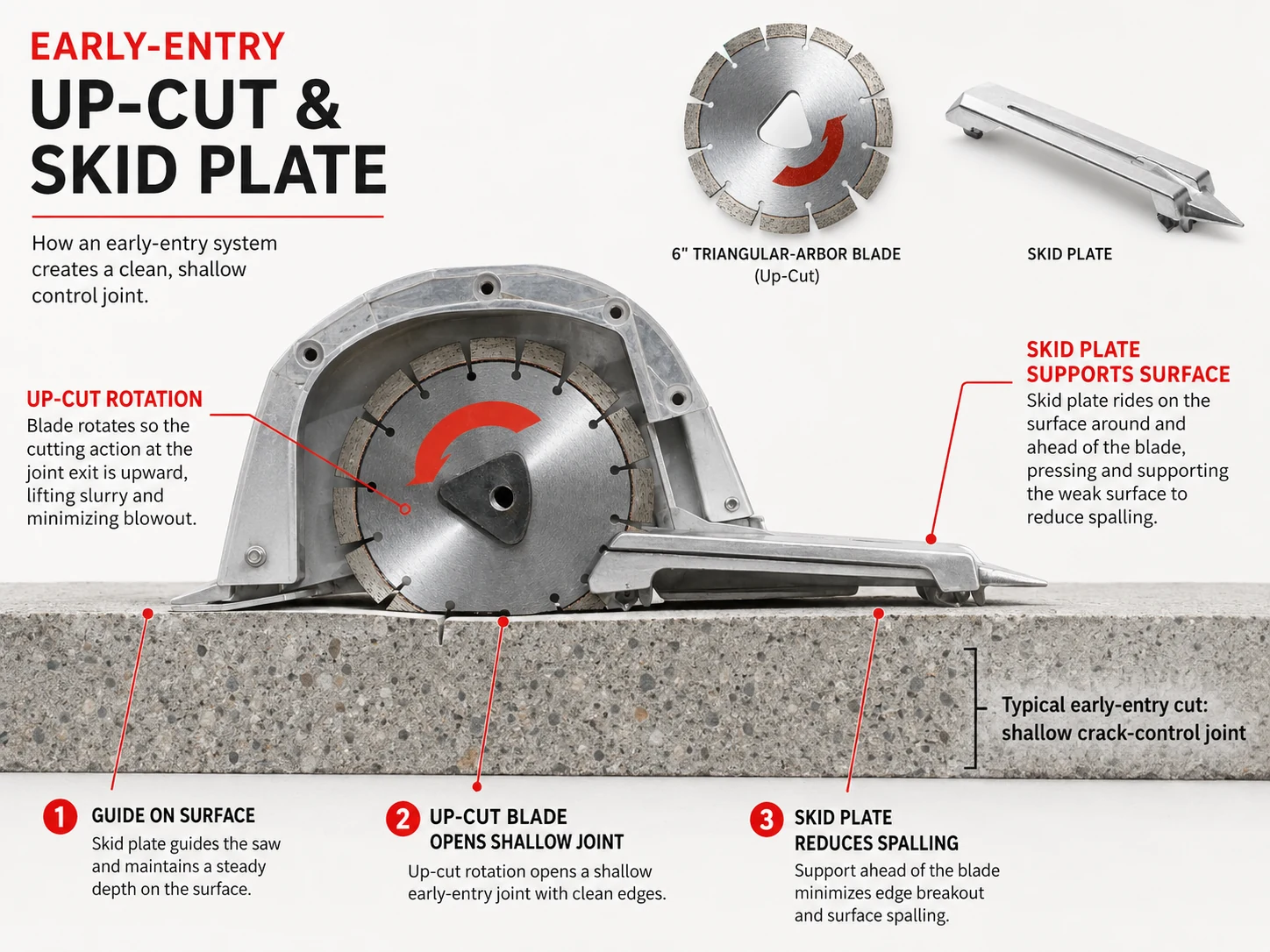
Catalogue-Backed Configuration Envelope
| Diameter | Typical segment direction | System approval |
|---|---|---|
| Ø150 mm / 6 in | 8–10 mm height · about 2.4 mm width | Saw pilot, triangle, drive and plate |
| Ø200 mm / 8 in | 8–10 mm · about 2.6–2.8 mm | Depth, kerf, RPM and plate slot |
| Ø250 mm / 10 in | 8–10 mm · about 2.6–3.0 mm | Machine and aggregate class |
| Ø300 mm / 12 in | 8–10 mm · about 3.0 mm | Power, depth and approved RPM |
| Ø343/350 mm / 13.5–14 in | 8–10 mm · about 3.0–3.2 mm | High-production saw and plate drawing |
Two Commercial Configurations
- Option A · Blade program: machine-matched blade, marking and private-label packaging.
- Option B · System program: blade + approved skid plate + fitment record + bundled packaging.
What We Do Not Turn into a Public Claim
The catalogues support the size, segment and triangular-interface envelope. They do not prove a universal 0.1 mm plate tolerance, one replacement interval or automatic blind-test equivalence. Those fields remain on the signed drawing and sample acceptance record.
Low-Friction RFQ
Send the saw model or old-blade/flange photo, diameter, kerf if known, cutting window, aggregate or job location, annual quantity and blade-only versus system scope. We return the proposed SKU matrix and sample plan.