
3-Plate / 6-Edge SDS-Max Drill Bits — the Round-Hole Architecture, Factory-Direct
Program Overview
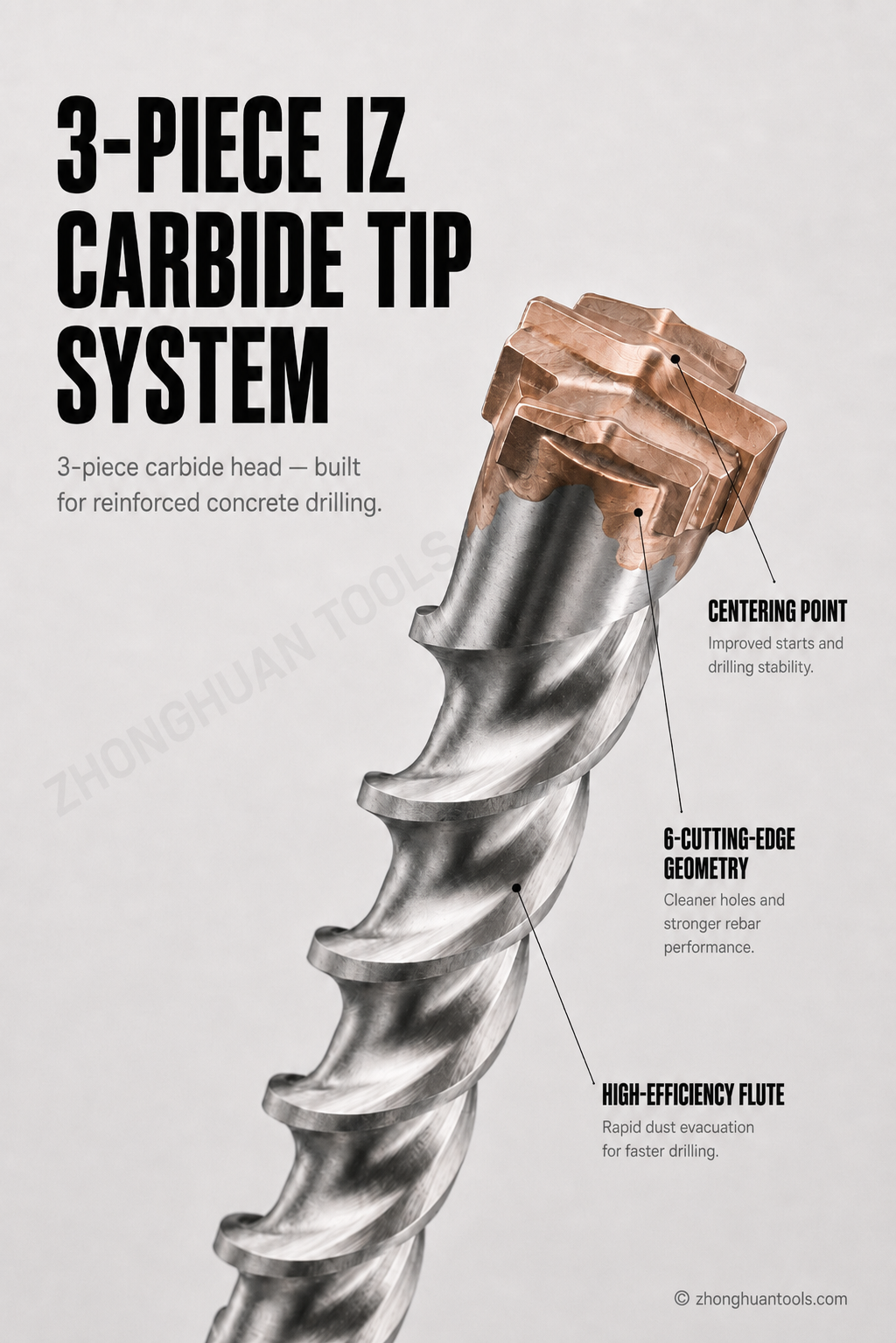
The 3-plate / 6-cutting-edge SDS-Max head — the architecture behind the Diager Ultimax 168 and the DeWalt mining bits Latin America calls broca francesa — drills round, diameter-calibrated, straight deep holes that flat-tipped bits cannot match on rock. Zhonghuan manufactures this head type in-house: three controlled-atmosphere brazed virgin carbide plates around a self-centering point, on a progressive 42CrMo body, in mining lengths to 920 mm — supplied factory-direct as an OEM / private label program for mining and fastening distributors.
What the Geometry Buys You
| Design element | Function |
|---|---|
| 3 carbide plates / 6 cutting edges | Each blow is shared across six contact lines — no single edge takes the full hit on uneven rock; the bore stays concentric and holds nominal gauge |
| Self-centering point | Engages first and anchors the bit — no walking on sloped or fractured collars, clean spot drilling at 15° into a face |
| Progressive core | Body diameter steps up along the flute — bending resistance for 920 mm bits driven off-axis by hand |
| Wide-spiral deep-hole flutes | Clears coarse rock cuttings in deep dry holes — the main defence against packed-dust overheating |
How this family compares against full carbide head construction — and how to word an RFQ so 6-cutter / 3-plate / full-head never get confused — is covered in our 3-plate / 6-edge vs full carbide head guide. The brand-level story of the benchmark line is in the Diager Ultimax 168 analysis.
Size Program
| Spec | Range | Notes |
|---|---|---|
| Diameter | Ø22–45 mm (Ø32 is the mining volume size) | 32 mm hole fits ø25 mm (1") cartridges with working clearance |
| Total length | 450 / 570 / 620 / 920 mm | Covers the Diager and DeWalt mining length systems; specify working length when hole depth is the requirement |
| Shank | SDS-Max | Fits all SDS-Max rotary hammers; SDS-Plus per project |
| Carbide | Controlled-atmosphere brazed virgin carbide, YG11C class | Approved YG11C-class carbide with lot material certificate |
| Body | 42CrMo, progressive core, heat treated | Multi-stage: normalizing, quenching, annealing, stress relieving |
Application Scenarios
1. Mining Blast-Hole Drilling
Material: Medium-hardness or mixed rock at the working face; for hard, abrasive rock compare the ZHMAX-7
Recommended: Ø32 × 620 / 920 mm
Notes: The volume application. Round, full-gauge, straight holes let ø25 mm cartridges seat fully in 450–800 mm holes; retire bits on gauge wear. Field engineering in the blast-hole drilling guide; the wider program on the SDS-Max mining drill bits page.
2. Deep Anchor and Dowel Holes
Material: Concrete, stone, hard masonry
Recommended: Ø28–32 mm, length per embedment + 50 mm
Notes: Diameter-calibrated holes drive anchor pull-out values — the same property the head was designed for. Six edges also tolerate incidental rebar contact better than a flat two-edge tip.
3. Service Penetrations in Masonry and Stone
Material: Brick, block, rubble masonry, natural stone walls
Recommended: Ø28–38 mm, lengths to 920 mm
Notes: Pipe and cable through-holes in old, inconsistent walls reward the self-centering point and distributed impact — mixed material is where flat tips chip.
Mining drill bit packing: photos from our factory
Our long SDS-Max mining drill bits in individual protective tubes inside a carton, followed by strapped cartons on a wooden pallet. Tell us your sizes, quantities and packaging requirements for an OEM quotation.


OEM & First-Order Terms
- MOQ: 200 pcs per size
- Samples: Paid samples; sample and shipping cost carried by the buyer; ~30 days sample lead after confirmation
- Production timing: Confirmed after specification and capacity review at order placement
- Branding: Laser-etched logo + custom packaging (bulk / blister / branded box)
- Quality: ISO 9001; material certificates with every shipment; material certificates tied to the approved carbide grade and shipment
Benchmarking Against the Ultimax 168 Class?
Send us your sizes, rock conditions and target volumes. We reply within 24 hours with specifications and a sampling plan.
Get a Quote