
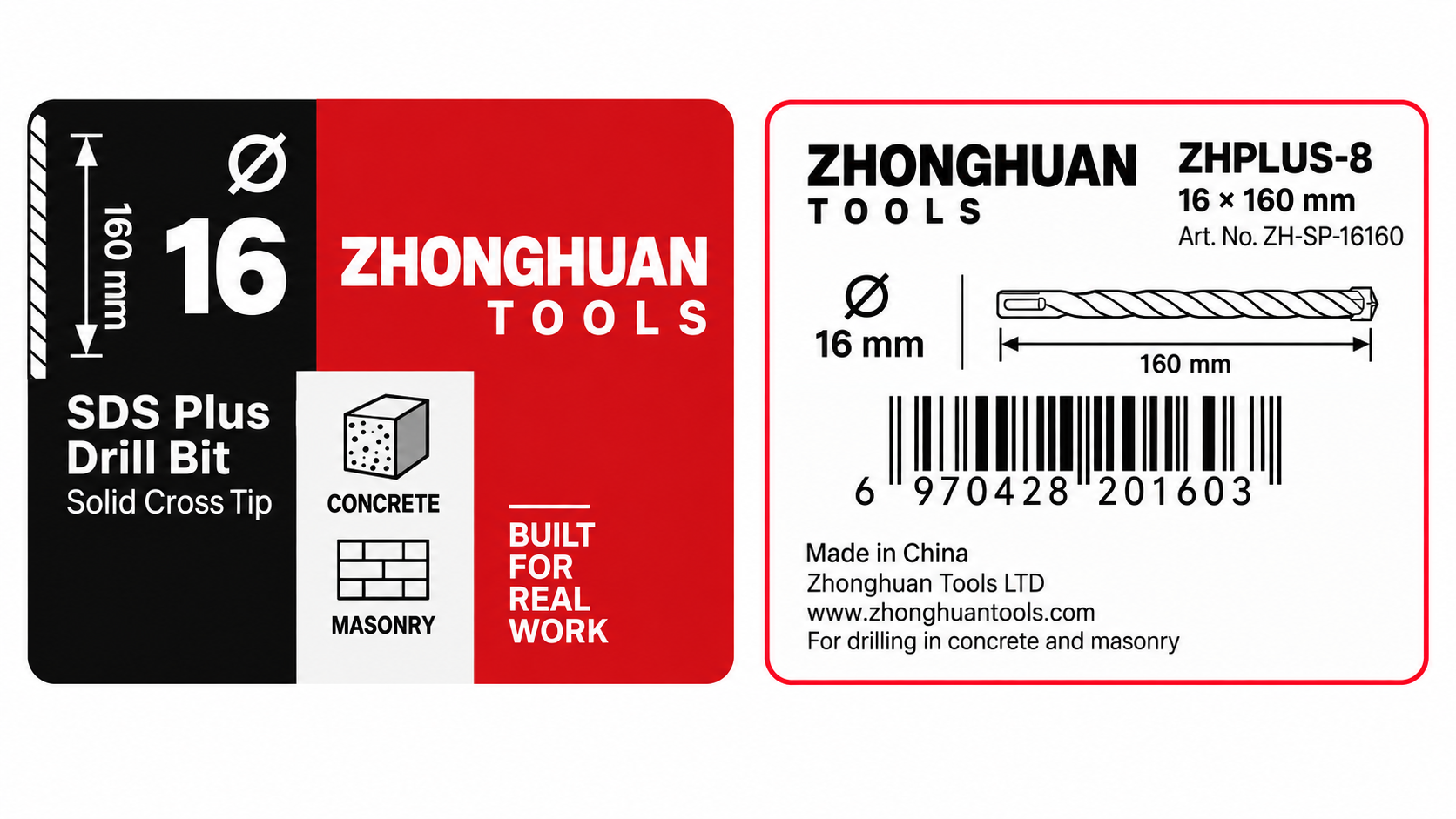
Label artwork example
Front-and-back brand label
ZHPLUS-8 artwork example bringing together your brand, size, item identification and barcode area.
View full imageProfessional 2-cutter, 4-cutter cross and full-carbide-head rotary hammer bits for concrete, reinforced concrete and anchor holes. Complete range Ø4–25 mm.
Three head constructions for plain concrete, reinforced concrete and demanding anchor work

A continuous controlled-atmosphere mesh-belt brazed 2-cutter head built around a self-centering carbide tip: it bites instantly on smooth concrete without walking, drills a clean round hole, and runs with low vibration. YG8C carbide on a tapered 40Cr core that resists flute breaks on deep holes — a precise, fast hole-starting bit for concrete, brick and masonry.


A continuous controlled-atmosphere mesh-belt brazed 4-cutter SDS-Plus drill bit for reinforced concrete, hard concrete and masonry. Its rebar-resistant carbide cross geometry is designed to reduce snagging during incidental reinforcement contact; the four-flute spiral supports fast concrete dust evacuation, stable hole tracking and precise anchor-hole geometry.

The Rebar Killer architecture uses a one-piece 4-cutter carbide head joined to the steel body without separate brazed cutting inserts. It keeps working through reinforcement encounters and removes the insert joint that can release or chip under repeated rebar impact. This is the higher-duty Ø4-25mm option for rebar-heavy concrete; structural reinforcement still requires drawing review and project approval.
Precision manufactured to international standards
Compare head construction and application before selecting sizes. The diameter and overall-length ranges below describe each program. We confirm the available diameter × working length × overall length combinations on the drawing and quotation for each SKU.
| Program | Head construction | Application fit | Diameter | Overall length | Working length |
|---|---|---|---|---|---|
| 2-Cutter IZ SDS-Plus Drill Bit | Brazed self-centering 2-cutter | Plain concrete, brick and masonry | Ø5-16mmØ3/16" - Ø5/8" | 110-400mm4-5/16" - 15-3/4" | Per approved SKU drawing |
| 4-Cutter 5X SDS-Plus Drill Bit | Brazed 4-cutter cross | Reinforced concrete and anchor holes | Ø5-25mmØ3/16" - Ø1" | 110-600mm4-5/16" - 23-5/8" | Per approved SKU drawing |
| Full-Head Carbide SDS-Plus Drill Bit | One-piece 4-cutter carbide head; RFW joint | Rebar-heavy concrete and demanding anchor work | Ø4-25mmØ3/16" - Ø1" | 160-600mm6-5/16" - 23-5/8" | Per approved SKU drawing |
OEM / Private label
We prepare SDS-Plus labels around your brand and sales channel. Explore our front-and-back brand-label artwork examples.
Label artwork example
ZHPLUS-8 artwork example bringing together your brand, size, item identification and barcode area.
View full image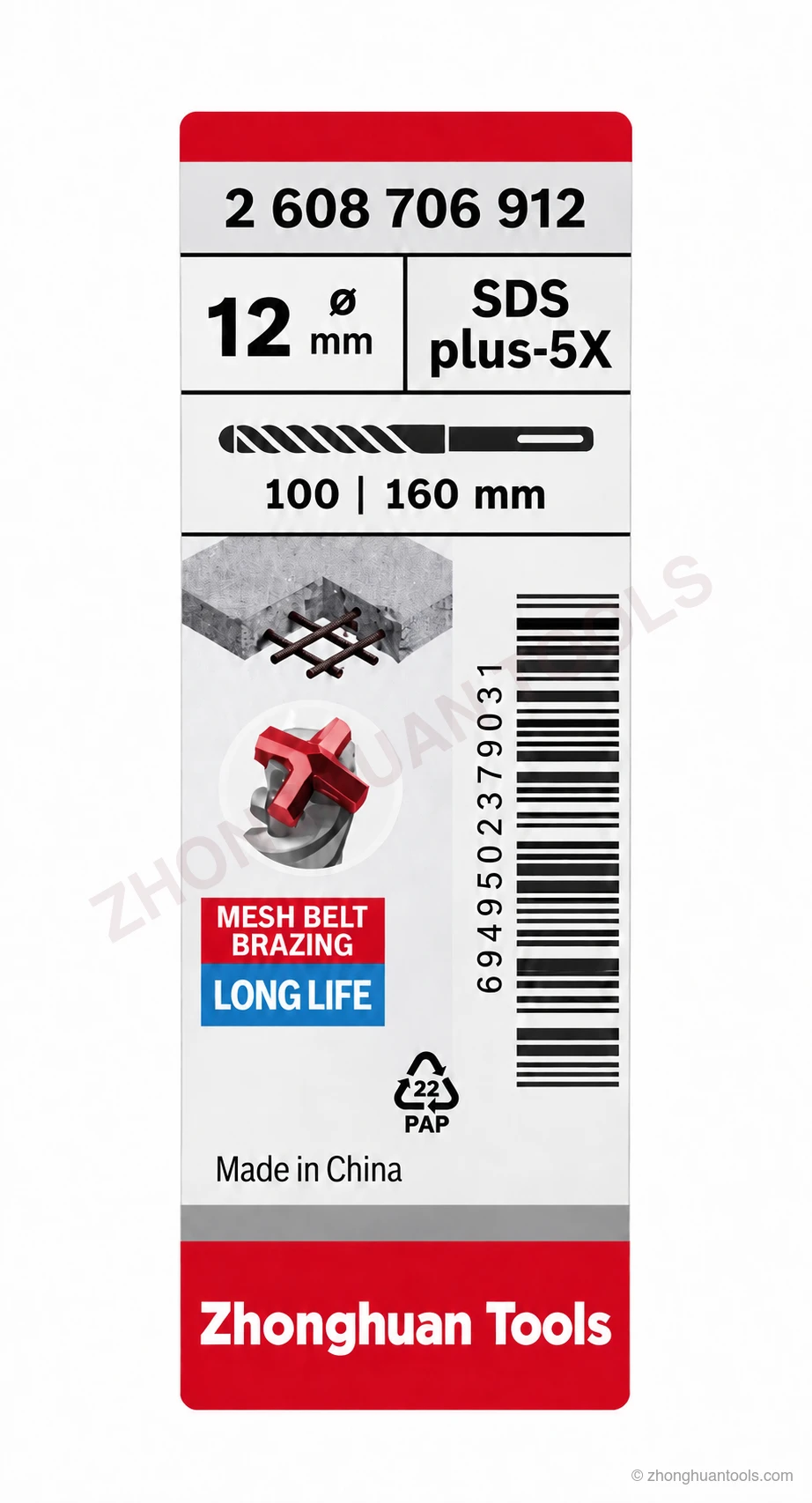
Label artwork example
SDS-Plus 5X artwork example with dimensions, construction and application information.
View full imageWe adapt your artwork and label language, then confirm the item ID, size and buyer-provided barcode for each SKU. The approved product and packaging sample become the reference for production and repeat supply.
Professional manufacturing services for global partners
Our SDS-Plus range covers Ø4–25 mm in three constructions: a Standard 2-cutter line (Ø5–16 mm) for plain concrete, brick and masonry; the continuous controlled-atmosphere mesh-belt brazed ZHPLUS-5X 4-cutter cross line (Ø5–25 mm) for reinforced concrete, hard concrete and precise anchor holes; and a Full Carbide Head line (Ø4–25 mm) for the most demanding reinforced-concrete and high-volume anchoring programs. Standard lengths run from 110 mm to 600 mm; longer lengths are quoted on request.
Yes, we provide full OEM/ODM services including custom sizes, private label branding, and customized packaging. Minimum order quantities apply based on specifications.
The Standard 2-cutter and ZHPLUS-5X 4-cutter cross lines use impact-tough YG8C tungsten carbide with continuous controlled-atmosphere mesh-belt brazing. The Full Carbide Head line uses a one-piece YG8C head. Carbide grade is only one part of performance: head symmetry, joint preparation, brazing control, body straightness and measured circular run-out determine whether the finished bit drills consistently.
Our SDS-Plus drill bits are produced under an ISO 9001 quality system, CE marked for applicable markets, and checked for SDS-Plus shank fit with go/no-go gauges. SDS shank fit is controlled with the applicable SDS interface and go/no-go gauges; DIN 8039 / ISO 5468 remain the reference for straight-shank masonry drill bits.
Yes, our SDS-Plus drill bits are fully compatible with all major rotary hammer brands including Bosch, Makita, DeWalt, Hilti, and Milwaukee.
SDS-Plus is the 10 mm grooved shank system for rotary hammers, developed from the SDS system Bosch introduced in 1975. The grooves lock the bit in the chuck while letting it slide back and forth, so the hammer’s blows reach the carbide head directly.
Key differences from regular drill bits:
• Hammer action: SDS-Plus bits are driven by rotary hammers that combine rotation with a pneumatic hammer mechanism, delivering up to about 4,000–5,000 blows per minute, which makes them typically 3–5× faster in concrete than regular bits.
• Quick change: no chuck key; the bit is pushed in and locks automatically.
• Shank design: a 10 mm grooved shank instead of a smooth cylindrical shank.
• Energy transfer: the grooves carry both torque and impact energy to the head.
Regular twist drills cut by rotation only and are not built for impact, so they are not suited to concrete or masonry.
These are different shank systems for different power classes. SDS-Plus uses a 10mm shank for compact rotary hammers; SDS-Max uses an 18mm shank for heavier drilling and demolition, and the two are not interchangeable. Zhonghuan's SDS-Plus range covers Ø4-25mm in three constructions: Standard 2-cutter, ZHPLUS-5X continuous controlled-atmosphere mesh-belt brazed 4-cutter cross, and Full Carbide Head.
Technically possible with an adapter, but not recommended.
Safety:
• A standard drill has no hammer mechanism for the SDS-Plus bit to work with
• The bit can slip or release under load
• An adapter adds play and vibration at the chuck
Performance:
• Rotation-only drilling in concrete typically takes 5–10× longer
• The carbide head overheats and wears prematurely
• Holes wander and lose roundness
Tool selection:
• Concrete and masonry: a rotary hammer with an SDS-Plus chuck
• Wood and metal: twist drills in a standard chuck
• Occasional masonry with a hammer drill: cylindrical- or hex-shank masonry bits made for hammer-drill mode
We offer OEM/ODM services for custom sizes, branding, and packaging.

Learn how multi-material drill bits work, which materials they drill, 1/4" hex vs straight shanks, operating modes and OEM manufacturing with Zhonghuan Tools.

A practical SDS drill bit guide for contractors, distributors, and OEM buyers. Understand SDS-Plus vs SDS-Max, 2-cutter vs 4-cutter, rebar work, and the RFQ details that actually matter.

Manufacturer-side guide to 40Cr vs 42CrMo / 42CrMo4 for SDS drill bits, SDS-Max bodies, drill rods, and chisels. Compare steel spec, cost logic, carbide geometry, and when each material makes sense.

The complete guide to SDS Plus drill bit lengths. Understand the difference between overall length and working length, how to match length to anchor embedment depth, and what to stock for different construction applications.