

Cutter Count and Head Construction Are Different Specifications
A 6-cutter label counts active cutting edges. A full carbide head label describes a one-piece carbide head. These describe different design dimensions. Here we compare the three-block / six-edge construction used by our ZHMAX-168 with a one-piece full-carbide-head SDS-Max design. For six-cutter applications, sizes and brand examples, start with our dedicated six-cutter guide.
Both Routes Serve Concrete and Reinforced Concrete
Six-cutter SDS-Max is used for concrete and reinforced-concrete drilling, including anchor holes; hard stone and deep drilling are additional applications. Makita’s B-61379 documentation explicitly places it in concrete and reinforced-concrete work. A full-head product can address the same jobs. Neither construction creates a universal performance ranking, and neither should be assigned a stocking role solely from its name.
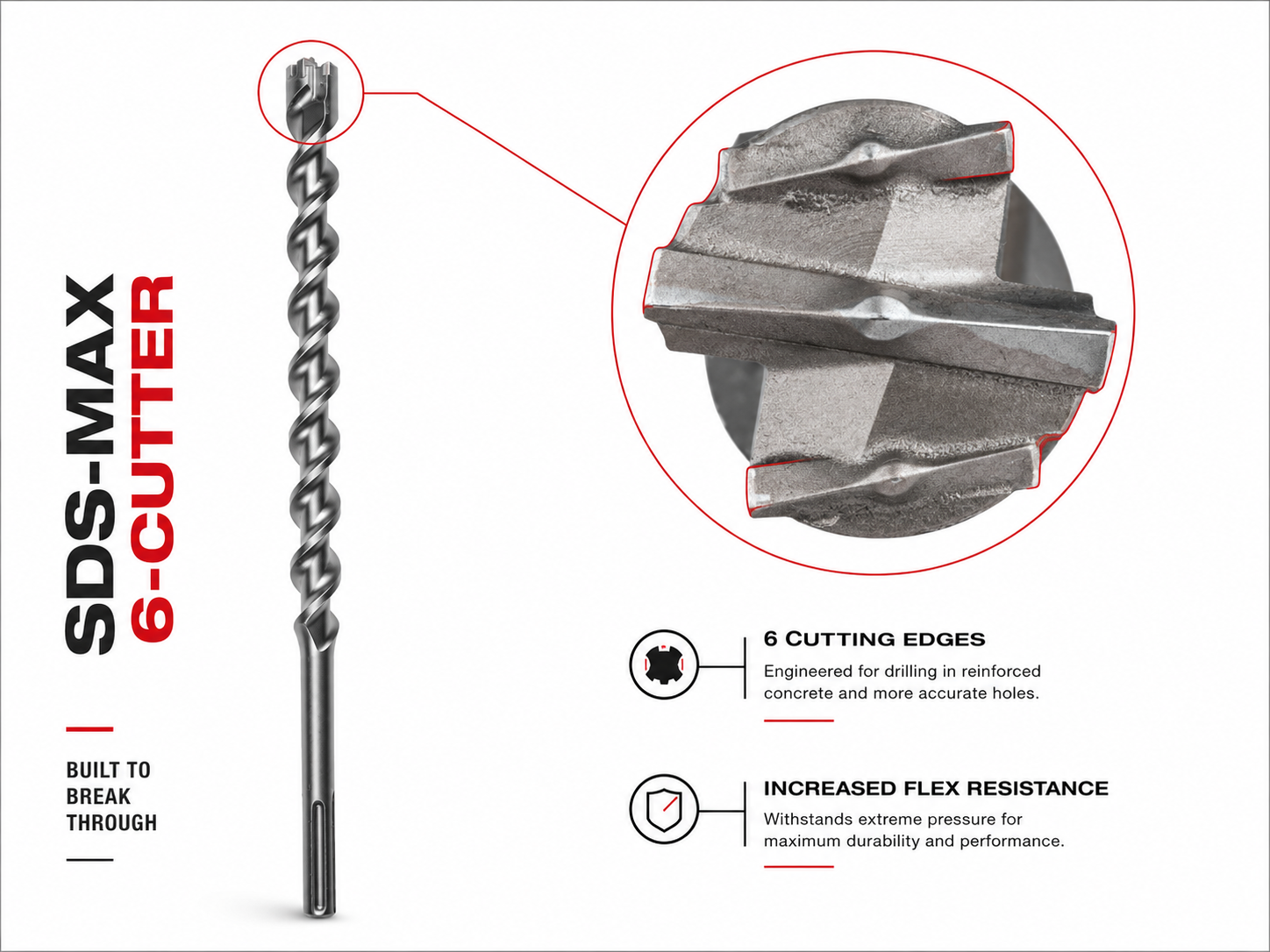
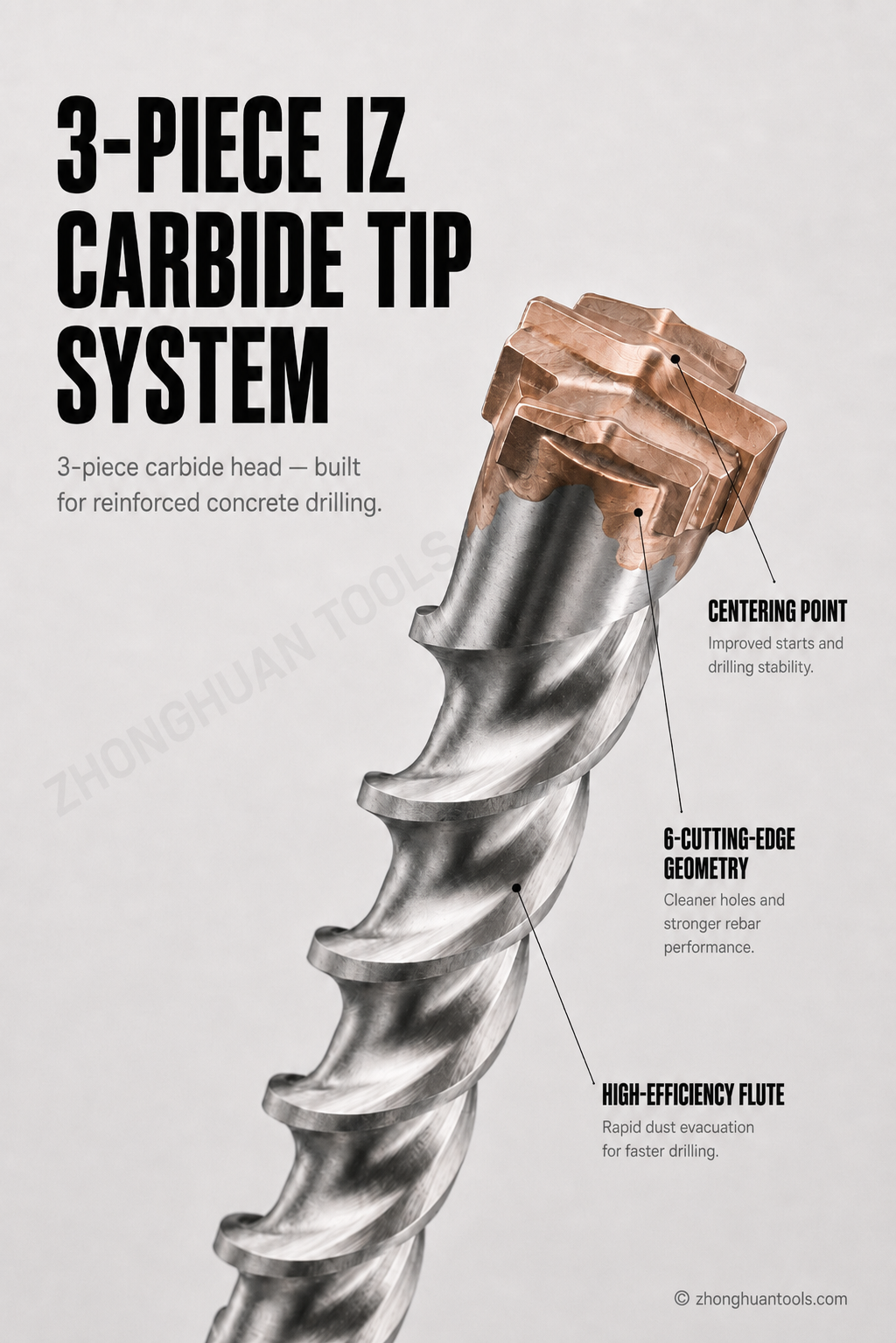
Compare Complete Drilling Systems
| Factor | Three-block / six-edge head | One-piece full-carbide head |
|---|---|---|
| What the description establishes | Three carbide blocks form six working edges in the specified layout | A single sintered carbide head; edge count is stated separately |
| Connection to the body | Our ZHMAX-168 uses controlled-atmosphere belt-furnace brazing | The complete head is joined to the body by the model’s specified process |
| Design review | Block support, joint quality, centering geometry and edge alignment | Head geometry, carbide condition and the head-to-body joint |
| Concrete and rebar | Assess binding, edge damage and useful drilling rate on the target job | Assess the same outcomes under the same conditions |
| Deep-hole behavior | Flutes, core section, runout and heat treatment matter alongside the head | The same body and dust-removal factors remain important |
| Procurement decision | Choose the matched model and verified size program | Choose the matched model and verified size program |
Select by Application and Failure Mode
Start with substrate, aggregate and reinforcement, then the hammer and its impact class, followed by the actual failure mode. If the problem is wandering at the start, review the centering geometry. If it is binding or carbide damage, review edge support, reinforcement contact and the joint. If long holes slow down or drift, review dust clearance, core stiffness and runout. This sequence gives the head architecture a specific job to solve.
A one-piece head removes the joints between separate carbide pieces, but it still has a connection to the steel body. Three carbide blocks introduce their own support and joining requirements, but their presence does not prove inferior rebar performance. Likewise, more edges do not guarantee faster drilling. Dimensions, material, joining quality and operating conditions must be compared together.
One Sample Test for Both Routes
Compare matched diameter and working depth using the same hammer and representative material. Record time per accepted hole, diameter and roundness, binding, wear, carbide damage and body condition. Define permitted rebar exposure with the jobsite team. Confirm anchor-hole tolerances and cleaning against the anchor instructions. Compare the cost per accepted hole after these requirements are met; a catalogue claim does not replace that result.
Our ZHMAX-168 and Full-Head Programs
We have introduced ZH168, catalogued as ZHMAX-168, as our factory-direct alternative for buyers benchmarking the Diager Ultimax 168 six-cutter architecture. We manufacture this model and are seeing strong demand for it among our South American customers. We match the program to concrete, reinforcement, hard aggregate, required hole depth and the buyer’s SDS-Max hammer.
We supply ZHMAX-168 as a six-edge SDS-Max program for concrete, reinforced concrete, masonry, hard stone and deep-hole requirements. Our published program specifies a three-block head, YG11C-class carbide, 42CrMo body, Ø22–45 mm and 450 / 570 / 620 / 920 mm total-length options. We confirm the working length and available diameter-length combinations for each order.
Our full-carbide-head SDS-Max line offers a different head construction for an application-matched quotation. Send the material and expected rebar, hammer model, diameter, useful depth, quantity and optional benchmark. We recommend the relevant model and sample plan without imposing a standard / premium / specialty hierarchy on cutter count.


