

A 3-Cutter Full Carbide Head SDS-Plus, in One Sentence
Three tungsten-carbide cutting edges set at 120° around a self-centering point, ground into one solid sintered carbide head that is welded — not brazed — to a spiral SDS-Plus body, in Ø3–20 mm. The payoff is a bit that centers itself, drills a clean round hole for anchors, tolerates rebar contact, and punches straight through a steel deck plate into the concrete behind it without a tool change.
Why Three Cutters at 120°
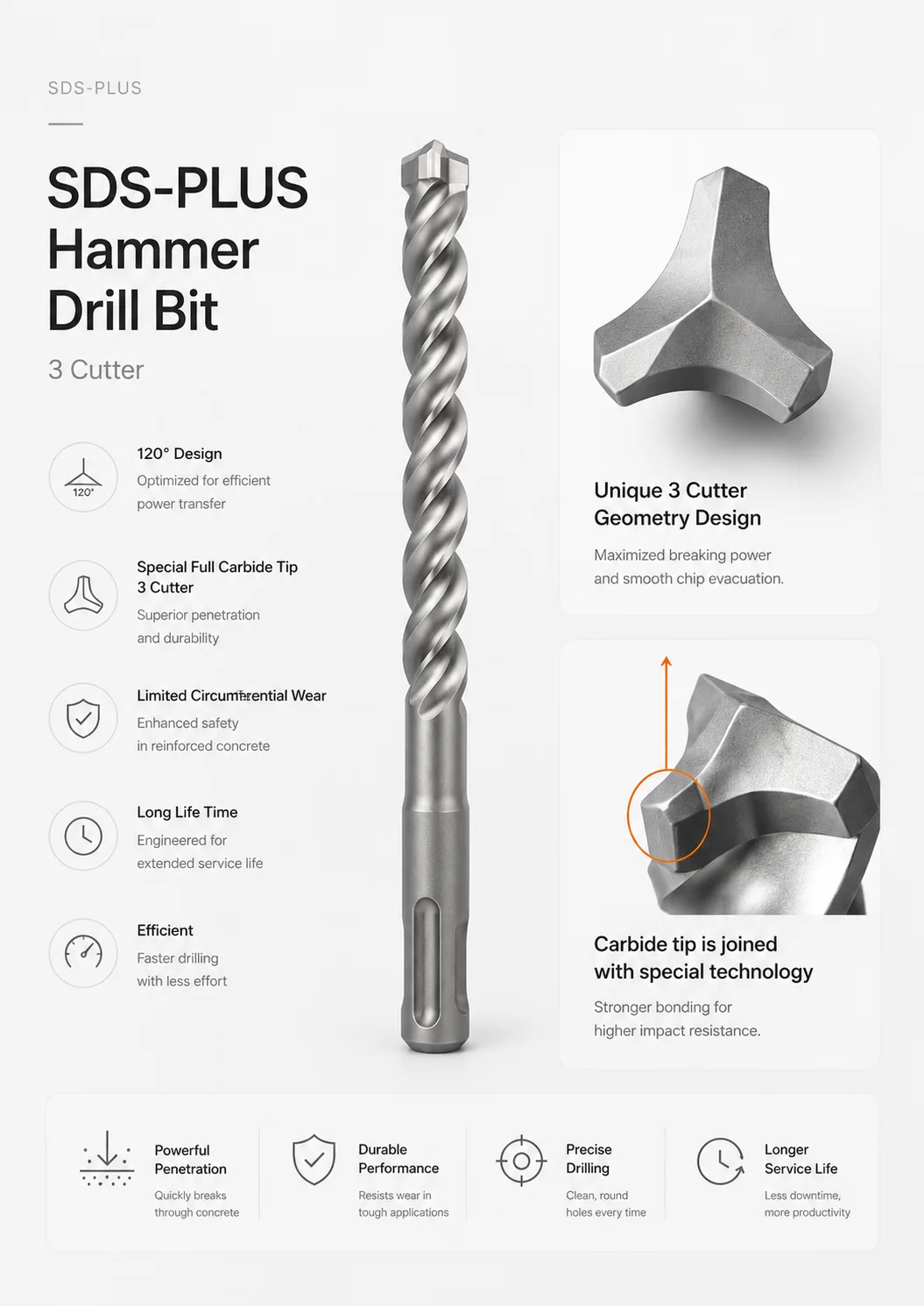
A triangle is the minimum stable contact set. A 2-cutter chisel rocks between its two diametric edges the moment one edge meets harder aggregate or rebar; a 4-cutter cross-head can over-constrain on uneven contact and skate off line. Three carbide edges at 120° keep at least two engaged at all times, so the head stays centered, spreads impact across more edge length, and shears through reinforcement instead of deflecting off it.
Two field consequences matter to a specifier. First, the geometry drills a near-perfectly round, calibrated hole — which is what lets a mechanical or chemical anchor seat to its rated pull-out value. Second, because the one-piece carbide head holds its gauge (outer diameter) as it wears, the bit stays calibrated and is less likely to bind or grab when it grazes a bar — limited circumferential wear means steadier, safer drilling in reinforced concrete, with less kickback transmitted to the operator.
Honest pedigree: the 120° three-cutter form is the geometry Heller markets as its patented Trijet tip. Zhonghuan does not use the Heller brand or claim its PGM certification — we manufacture the single-piece full-carbide version of this geometry at SDS-Plus diameters, at OEM economics.

One-Piece Carbide Head, Seam-Free Weld
The label that matters is full carbide head, not carbide-tipped. A conventional masonry bit brazes small carbide plates into a slotted steel head with a silver-copper filler. Under repeated hammer impact — and especially on rebar contact — that braze layer is the fatigue path: the carbide chips, fractures, or detaches, the bit walks, and the hole goes oversize. A full carbide head removes that failure mode by making the entire cutting head one sintered piece of tungsten carbide.
That one-piece head is joined to the steel body by resistance friction welding — a filler-free, solid-state weld with no silver-braze seam to fatigue. It is the same joining family Zhonghuan uses on its full-head ZHMAX line, reaching the seam-free, rebar-tough result the European brands get from friction or diffusion bonding. The full-carbide-head grade is our higher-cobalt YG11C, which trades a little hardness for the binder volume that absorbs the heaviest impact without edge spalling. Body steel is 40Cr as standard, with a 42CrMo option for the harshest duty.
Flutes, Listel and a Chamfered Edge
The head only performs if the body clears its dust. The spiral flute carries swarf out of the hole; the listel (the raised land between flutes) rides the wall and holds the hole round. A generous flute volume keeps the cuttings moving so the carbide stays in contact with fresh material rather than re-grinding dust — which is where the real-world speed comes from. The cutting edges are chamfered, which reduces snagging and the impact shock fed back through the tool: less jamming, less vibration, a more controllable bit for the operator.
The Deck-Plate Job: Concrete and Steel in One Pass
The signature application is composite steel decking. When you fix into a concrete slab poured on profiled steel deck, a carbide-tipped masonry bit stalls or deflects at the steel; a full carbide head drills the concrete and punches through the light-gauge steel deck in the same pass, with no swap to a metal bit. On elevated slabs and deck-fixing runs that bit-change is the slow step, so eliminating it is the productivity story behind this geometry. To be clear about limits: this is light-gauge decking, not a tool for cutting structural rebar — for intentional heavy-rebar interception, see our full-carbide-head rebar program.
Where It Fits Beside 2-Cutter, 4-Cutter and Full-Head
The 3-cutter full carbide head is one option in the SDS-Plus head family, not a replacement for all of it:
| Head | Construction | Pick it when |
|---|---|---|
| 2-cutter | Brazed, single carbide insert, self-centering tip | Budget volume SKU; clean concrete and brick; small diameters |
| 4-cutter cross | Brazed, two perpendicular inserts | Fastest in clean concrete; rounder holes than 2-cutter at standard cost |
| 3-cutter full carbide | One-piece sintered head, resistance-friction-welded | Round holes for anchors + rebar contact + seam-free durability; deck-plate pass-through |
| Full-head (ZHMAX-8 class) | Monolithic carbide head | Maximum life and impact resistance, heaviest rebar; higher cost |
Cutter count and flute count are separate decisions — see SDS-Plus 4-cutter head types.
Specifications
| Shank | SDS-Plus |
| Diameter | Ø3–20 mm |
| Head | 3-cutter, 120°, one-piece sintered full carbide head |
| Carbide grade | YG11C full-carbide-head grade (higher-cobalt, for heavy impact) |
| Head-to-body joint | Resistance friction weld (filler-free, no braze seam) |
| Body steel | 40Cr standard; 42CrMo option |
| Flute | High-volume spiral; sand-blasted finish |
| Applications | Reinforced concrete, anchor holes, composite steel deck pass-through, natural stone |
Lengths to customer spec; other diameters and packaging available on request. We do not publish FOB pricing — contact us for a quotation.
OEM & Private-Label
Zhonghuan manufactures the 3-cutter full carbide head SDS-Plus under OEM and private-label programs — your brand, your packaging, with documented carbide grade, weld method, and runout inspection. Send your diameter range, target application (anchor work, deck fixing, rebar exposure), and packaging brief and we will reply with a sample plan, an inspection record set, and a quotation path. Contact Zhonghuan Tools.
Related Procurement Programs
If you are sourcing this geometry for a distributor, importer, or private-label channel, these OEM programs cover the questions buyers ask next.
- Full Carbide Head SDS-Plus Drill Bits Manufacturer — the OEM-tier full-carbide-head SDS-Plus program this 3-cutter sits inside.
- SDS-Plus Drill Bits for Anchor Bolt Installation — round, calibrated holes for mechanical and chemical anchors.
- SDS Drill Bits Manufacturer & Wholesale Supply — full SDS-Plus / SDS-Max OEM and wholesale program.


