

What Y-Cutter Actually Is, in Geometry
A Y-Cutter (also catalogued as 3-cutter, Trijet, or tri-blade) is a hammer-drill bit head with three carbide cutting edges arranged at 120° around a central self-centering tip, forming a 'Y' footprint when viewed end-on. The geometry sits between the older 2-cutter chisel head (one straight carbide insert across a diameter) and the 4-cutter cross-head (two perpendicular inserts forming a plus sign).
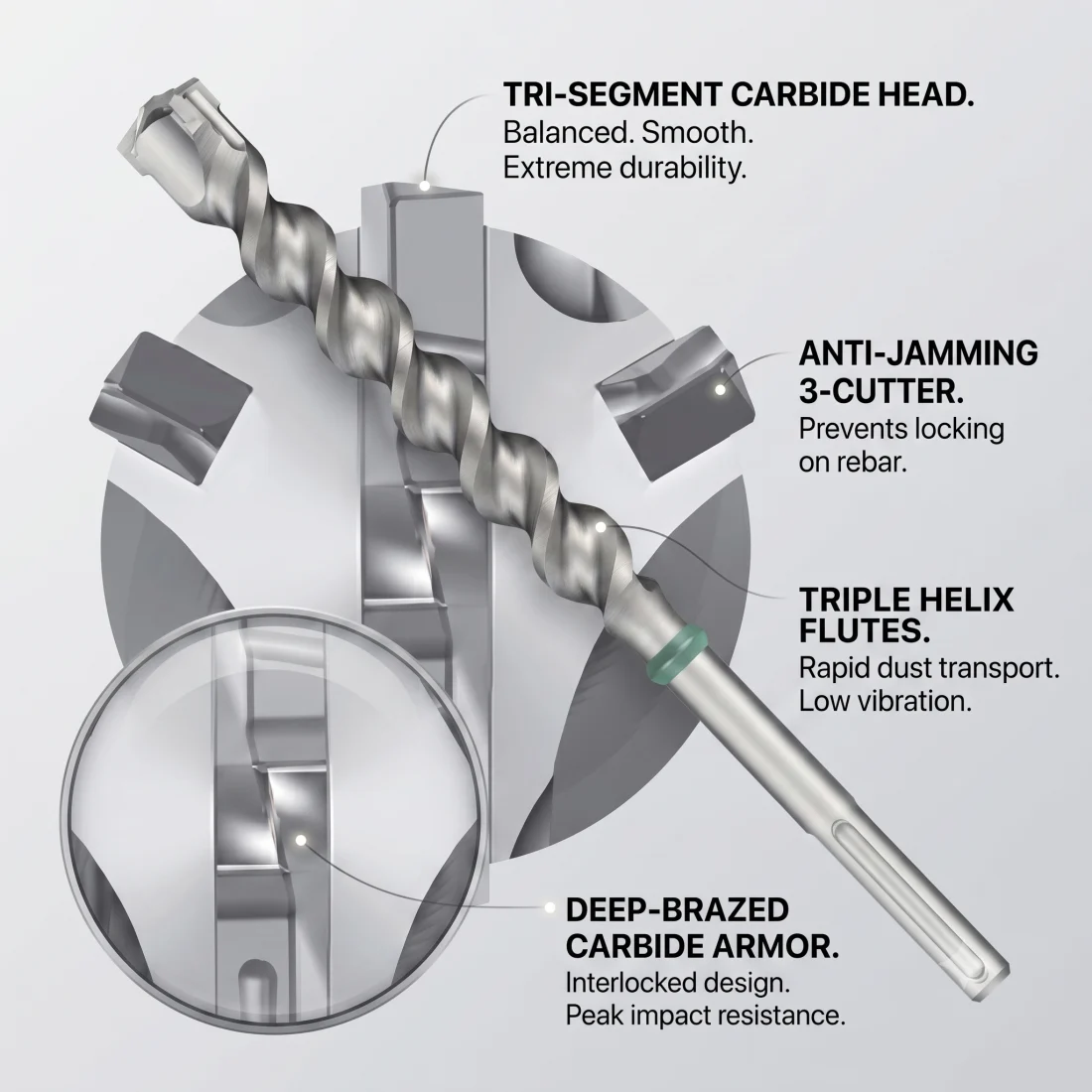
The carbide can be either one solid piece pressed/sintered to the Y form and then ground (used at smaller SDS-Plus diameters where there isn't room for three discrete brazed inserts) or three discrete carbide segments brazed individually at 120° into a steel body (used at larger SDS-Max diameters where the cross-section accommodates thicker individual pieces). Both constructions produce the same geometric footprint but require very different manufacturing capabilities — a distinction that drives the entire OEM landscape we'll cover below.
The structural logic of three blades at 120° is straightforward: a triangle is the minimum-stable contact set. A 2-cutter rocks between its two diametric edges when one edge encounters harder aggregate or rebar. A 4-cutter can over-constrain on uneven contact and skate. Three blades at 120° always have at least two edges loaded simultaneously, distributing impact force and keeping the bit centered during rebar contact.
Heller's Trijet Ultimate: Where the Standard Came From
The Y-Cutter geometry originates with Heller Tools GmbH (Dinkelsbühl, Germany), which has refined the 120° three-cutter concept for over a decade. In Heller's current catalogue it is one product line — Trijet Ultimate — built around the patented "Trijet" tip and sold in both shank types:
- Trijet Ultimate SDS-Plus — Ø5–30 mm.
- Trijet Ultimate SDS-Max — Ø12–50 mm.
It is one line, not two products. (Heller previously broke the larger SDS-Max sizes out under the name Enduro Y-Cutter, and some resellers still use it; the current catalogue folds them into Trijet Ultimate and now reserves "Enduro" for its chisel range. When you see "Enduro Y-Cutter SDS-Max," read it as the SDS-Max Trijet Ultimate.)
The problem the design solves is rebar engagement: when a 2-cutter bit hits rebar at an angle, the leading edge can deflect and walk the hole, or the single chisel edge stalls and shears carbide. The Trijet tip puts more edges in contact, lowering per-edge stress under rebar contact, plus a double centre-tip that improves initial bite on smooth concrete. Heller's catalogue states the line delivers the longest service life in concrete and reinforcement; older Heller material cited figures up to ~9× the rebar life of a conventional 2-cutter — a marketing number whose absolute value is debatable but whose direction is consistent with the physics: more edges engaged means lower per-edge stress under rebar contact, which means more cycles before edge spalling.
The European versions also carry PGM certification (Prüfgemeinschaft Mauerbohrer — the German masonry-drill testing body), an independent reference point that manufacturers in several countries, China included, have also met. Heller's distribution footprint is dense — direct plus regional specialists like DFS Fixings (UK), drills-oren.com (DE), Reichelt (DE), KC Tool (US importer) and Multifix (ZA) — which is why a search for "Y-Cutter SDS-Max" returns Heller imagery from a dozen reseller domains. The brand looks ubiquitous because Heller distributes widely, not because it is the only player.
Two Carbide Constructions, One Geometry: Single-Piece vs Multi-Piece by Diameter
The most-overlooked technical fact about the Trijet Ultimate family is that the same 120° three-cutter footprint is built in two different carbide constructions — and the split is by diameter, not by shank type. Heller flags the larger sizes in its catalogue with an asterisk: "designed with multiple-piece carbide."
| Property | Single-Piece Carbide (smaller Ø) | Multi-Piece Brazed Carbide (larger Ø, Heller's *) |
|---|---|---|
| Where it appears | Below ~Ø20 mm — most SDS-Plus sizes and the smaller SDS-Max | ~Ø22 mm and up — in both SDS-Plus (22–30 mm) and SDS-Max |
| Carbide head construction | Single solid carbide piece, pressed/sintered to near-net Y form, then CNC-ground to final geometry | Discrete carbide segments, each individually brazed at 120° into a steel body |
| Visual identification on a sample | Smooth, unified carbide head — no braze seams visible | Carbide segments visibly separated by copper-coloured braze fillets at 120° |
| Capital equipment gate | 4-axis CNC carbide grinding + a powder-metallurgy supplier that can press the Y-shaped near-net blank | Multi-position brazing fixture with tip-coplanarity control + CNC tip grinding for runout TIR |
| Why it must be this way | At small diameter there's no cross-section for discrete pieces of useful thickness — the only path is grinding the geometry from a single solid block | At larger diameter there's room for thicker independent segments, and discrete segments absorb impact energy per piece better than a unified block under heavy impact loads |
This split has direct OEM consequences. A factory with 4-axis CNC carbide grinding and a competent carbide foundry can produce the single-piece (smaller-diameter) heads — but without a multi-position brazing fixture and tip-coplanarity grinding it cannot produce the multi-piece (larger-diameter) heads at acceptable quality, and the reverse holds too. A "Y-Cutter capability" claim needs to be qualified by which construction the supplier actually has in-house — and verified by sample inspection.
The visual procurement consequence: a larger-diameter head should clearly show discrete carbide segments separated by copper-coloured braze fillets at 120°; a smaller-diameter head should look like a single homogeneous carbide form with no seams. If a large-diameter sample looks unified, either it is a different geometry or someone is selling something other than what they claimed.
Heller Y-Cutter vs the Multi-Segment Head: Two Ways to Beat Rebar
The Y-Cutter is not the only premium answer to reinforcement — the other is the multi-segment head (our ZHMAX-7 is one). Both are brazed multi-cutter heads, both exist to stop a 2-cutter from snagging and snapping on rebar, but they reach that goal with different geometry — and the difference decides which one a buyer should specify.
The Y-Cutter places three carbide blades at 120° around a self-centring tip. At least two edges are always engaged, the tip keeps the bit centred, and per Heller, the tri-blade stays centred on rebar contact without deflecting. The multi-segment head instead runs one full-width main blade across the diameter, plus two inclined side cutters set behind it: from the face it looks like a 4-cutter, but it is asymmetric. The main blade takes a full-diameter bite — fast in clean concrete — while the side cutters clear the corners and keep the bit from catching on rebar.
| Aspect | Heller Y-Cutter (3-blade 120°) | Multi-Segment head (SDS max-7 / ZHMAX-7) |
|---|---|---|
| Edge layout | 3 carbide blades at 120° around a self-centring tip | 1 full-width main blade + 2 inclined side cutters |
| Cutting action | ≥2 edges always engaged; stays centred on rebar contact | Full-diameter main bite + corner-clearing side cutters |
| Optimised for | Rebar first — centring in the 16–35 mm anchor band | Clean-concrete speed first, with rebar protection |
| Build difficulty | Hardest brazed head: 3 segments coplanar at 120° (±0.05 mm), 3-flute concentric grind (TIR ≤0.02 mm) | Multi-piece brazed, but a main blade + 2 side segments is more forgiving to braze and grind |
| Best fit | Reinforced concrete, structural anchors | General fast SDS-Max with occasional rebar, wider diameter range |
Neither is "better" in the abstract — they solve a slightly different job. The Y-Cutter trades a little raw concrete speed for stronger rebar centring; the multi-segment head trades the perfect tri-blade symmetry for a faster full-width bite and a head that is easier to build at quality. Zhonghuan builds the 3-blade Y (120°) as a full carbide head — SDS-Plus Ø3–20 mm and small SDS-Max sizes up to about Ø25 mm. For larger SDS-Max diameters our answer is the ZHMAX-7 multi-segment head made in YG11C with documented process control. ZHMAX-7 belongs to the same construction class as the Bosch SDS max-7: a multi-insert segmented 4-cutter, different from a monobloc 4-cutter and from a monobloc full-carbide head. Neither brazed head is a rebar-cutting head — a multi-insert segmented head passes rebar only slightly better than an ordinary 4-cutter, and the best routes for frequent rebar contact are the six-cutter and the full carbide head.
The 16–35 mm Sweet Spot — Where the Y Geometry Pays Off Most
Geometric and economic factors collapse Y-Cutter into a specific diameter band:
| Diameter Range | Dominant Geometry | Why |
|---|---|---|
| 5–12 mm | 2-cutter chisel | Insufficient cross-section for three discrete carbide inserts |
| 12–16 mm | 4-cutter cross-head or full-head carbide | Y-Cutter possible but cross-head is faster in clean concrete |
| 16–35 mm ★ | Y-Cutter sweet spot | Three blades fit, chip evacuation works, rebar payoff dominates |
| 35–50 mm | 4-cutter or segmented full-head | Symmetric flute pattern needed for chip flow at large diameter |
| Above 50 mm | Segmented full-head or core drilling | Solid carbide head economics shift, diamond core competes |
The 16–35 mm window is exactly where most structural anchor installation, post-installed rebar drilling, and chemical anchor work happens. That is not coincidence — Heller and the other premium SDS-Max specialists who adopted the geometry optimised Y-Cutter for the highest-volume reinforced-concrete diameter range in professional construction. Heller actually catalogues Trijet Ultimate SDS-Max all the way to Ø50 mm — this band is where the Y geometry's rebar advantage is largest, not its only range.
The Brazing and Grinding Challenge (Multi-Piece Brazed Construction)
This section covers the manufacturing challenges of the multi-piece brazed construction (the larger diameters Heller marks with an asterisk). The single-piece sintered construction has a different manufacturing pathway — 4-axis CNC carbide grinding of a pressed near-net-shape blank — which we covered in the two-constructions section above.
For the multi-piece brazed construction: the geometric concept is simple. The manufacturing is not. A 2-cutter bit has one carbide insert: drop it into the milled slot, induction-heat, flow the silver-copper braze, done. A multi-piece Y-Cutter head has three discrete inserts that must be:
- Positioned at exactly 120° in three independently machined slots, each held within tens of micrometres of nominal angle.
- Held coplanar at the tip apex within ~0.05 mm so all three edges meet cleanly at the centerline. Mismatch here produces a tip that wobbles in the hole.
- Brazed simultaneously or in a controlled sequence — with a 3-position fixture in the brazing station — to avoid melting earlier joints when later joints are heated. Sequential single-station brazing is technically possible but introduces thermal-cycling stress in already-finished joints.
- Ground concentrically on a CNC tip grinder so the cutting circle runs true within ~0.02 mm TIR. A 3-edge grind requires either three indexed grinding passes or a single-pass form wheel — both demanding more precision than a 2-cutter setup.
This is why a brazed multi-piece Y-Cutter head is a real capability test for any factory. It requires a dedicated 3-axis brazing fixture (or a robot cell with vision-based positioning) and a CNC tip grinder, both of which are capital investments that small workshops skip. A factory that lists Y-Cutter in its catalogue but quotes the same MOQ and lead time as 2-cutter is almost certainly outsourcing the head — or quoting on capability it does not actually have in-house.
Why Y-Cutter Demands YG11C
Y-Cutter heads are almost always paired with YG11C (11% Co coarse grain) tungsten carbide. The reasoning has two parts:
Diameter range drives impact energy. The 16–35 mm window where Y-Cutter dominates corresponds to SDS-Max class hammers delivering 10–20 J per blow — substantially higher than SDS-Plus typical 2–3 J. Higher per-blow impact energy means each carbide edge sees higher peak stress at first contact with aggregate or rebar.
Asymmetric loading creates transient overloads. Unlike a symmetric 4-cutter which always presents two opposing edges to the workpiece, a Y-Cutter rotated to a moment when only one edge meets rebar (with the other two in concrete) creates a torque imbalance and a short stress spike on the loaded edge. Lower-cobalt grades (YG6, YG8) are harder but more brittle — they chip under these transients. YG11C trades some hardness for the binder volume needed to absorb impact without spalling.
The carbide grade selection logic is the same as for premium SDS-Max in general: tip chipping on rebar is the dominant field failure mode, and tip chipping favours higher-Co coarser-grain grades. Lower grades like YG6 still have a market, but it is in fine-grain rotary tile drilling — not in Y-Cutter SDS bits.
Beyond Y-Cutter: Two Premium Tiers, Often Confused
Above Y-Cutter sit two distinct premium constructions that marketing copy routinely blurs together. Telling them apart is the most useful thing a buyer can do when reading SDS-Max spec sheets:
- Multi-segmented carbide — the Bosch SDS max-7 class. A brazed multi-cutter head: one primary blade flanked by two inclined side cutters, so it reads as a 4-cutter from the end face but is asymmetric. The carbide is brazed into a steel head — the same joining family as a brazed Y-Cutter head, in a different edge layout. Any serious carbide-tipped factory can build it; it is not the moat people imagine.
- Full-head solid carbide — the Bosch SpeedXtreme / SDS max-8X class. A monolithic carbide head: the whole cutting tip is one sintered piece of tungsten carbide joined to the steel body with no brazed seam. Bosch joins it by diffusion bonding (its proprietary IDS process); others reach the same seam-free result by friction welding or resistance friction welding.
These are not two quality grades of one product — they are different constructions for different priorities. Multi-segmented carbide keeps the toughness and repairable economics of a brazed head while adding side cutters for rebar. Full-head solid carbide trades brazed-joint risk for maximum carbide volume and heat capacity at the tip, at higher cost. Bosch's SpeedXtreme claims (5× life, faster, lower vibration), like Heller's 9×, are the maker's own data — the rationale is sound, the absolute multiplier is marketing.
Full carbide head: define the actual supply range
A monolithic carbide head has no braze seams between separate carbide inserts, but it still needs a verified joint to its steel body. Zhonghuan offers ZHMAX-8 SDS-Max in the current Ø4–25 mm range with resistance-friction welding. This is our approved product range, not a physical ceiling for every manufacturer. Bosch lists EXPERT SDS max-8X full-carbide-head bits in Ø32 mm. Determine head construction, joining method and accepted diameter from each SKU sheet rather than assuming one process or limit for the entire market. The same full-carbide-head route also carries our 3-cutter Y (120°) in SDS-Plus Ø3–20 mm and small SDS-Max sizes up to about Ø25 mm.
For a private-label program, specify diameter, working length, hammer, substrate and rebar exposure. We document carbide grade, head-to-steel joint, runout and sample acceptance on the agreed drawing, then select ZHMAX-7 multi-insert or ZHMAX-8 full-head construction for the application.
Specifying Y-Cutter for OEM Programs
For distributors and private-label buyers evaluating a Y-Cutter (3-blade) line for an SDS-Plus or SDS-Max range:
- Specify which construction you are buying. The single-piece (smaller-diameter, solid-carbide ground head) and the multi-piece (larger-diameter, brazed-segment head) require entirely different factory capabilities. Don't accept a generic "Y-Cutter" answer — the supplier needs to identify which construction matches the diameter you're sourcing.
- For single-piece sourcing: verify 4-axis CNC carbide grinding and the powder-metallurgy supplier relationship (who presses the near-net Y blank). Ask which carbide foundry — a factory that says "we make our own" without naming a foundry is almost certainly outsourcing or substituting standard cylindrical blanks.
- For multi-piece (brazed) sourcing: verify the multi-position brazing fixture (photo or video of the actual jig), tip-coplanarity control under 0.05 mm, and CNC tip grinding for runout TIR under 0.02 mm. Avoid factories that quote a brazed multi-cutter at 2-cutter pricing — that is structurally impossible in a competently-run factory.
- Specify the carbide grade. YG11C virgin powder for reinforced concrete and heavy-rebar applications. Avoid YG8C in a Y-Cutter — the cobalt content is borderline for the impact loads this geometry sees, particularly in the brazed construction where each segment carries asymmetric peak loads.
- Visually inspect samples. Larger-diameter heads should clearly show discrete carbide segments separated by copper-coloured braze fillets at 120°. Smaller-diameter heads should look like one homogeneous carbide form with no seams. A mismatch between diameter and construction is a flag.
- For applications above ~35 mm or with sustained heavy-rebar contact, weigh a six-cutter or full-head carbide instead; a multi-segment 4-cutter passes rebar only slightly better than an ordinary 4-cutter. The cost premium is real, but in demanding work the field-life difference is larger than the tier-jump from 2-cutter to Y-Cutter.
Y-Cutter is a credible category with real engineering depth — Heller's "longest service life" claim is achievable when carbide grade, brazing or single-piece grinding, and tip geometry are all executed correctly. But the geometry name on a label is the start of the conversation, not the end: the right question is which factory has actually invested in the equipment, the carbide-supplier relationships, and the inspection discipline that makes the geometry pay off — and which construction (single-piece or brazed) you are actually receiving.
Related Procurement Programs
If you are sourcing this product line for a distributor, importer, or private-label channel, these OEM and wholesale programs cover the procurement questions buyers usually ask next.
- SDS Drill Bits Manufacturer & Wholesale Supply for Distributors — OEM and wholesale SDS drill bit supply for importers, distributors, and tool brands: SDS-Plus, SDS-Max, carbide tips, 2-cutter and 4-cutter heads, packaging.
- SDS-Plus Drill Bits for Anchor Bolt Installation in Concrete — Precision SDS-Plus hammer drill bits for mechanical and chemical anchor holes in concrete and masonry.
- SDS Plus Drill Bit Sets Private Label & OEM Packaging — Private-label SDS Plus drill bit set program for retailers, importers, and online tool brands.


