

Does Ceratizit Make SDS Drill Bits, or Carbide Tips for SDS Drill Bits?
Buyers often search Ceratizit SDS drill bit or Ceratizit carbide tip for SDS hammer drill because marketplace listings blur three different things: finished SDS drill bits, carbide tip blanks, and the carbide grade used inside the head. For procurement, that distinction matters.
CERATIZIT is strongest as a hard-material and cutting-tool group. Its public hard-material pages position carbide products for masonry and hammer drill tips, stone working, rods, preforms, and carbide components. Its cutting-tool catalogue also covers HSS drills, solid carbide drills, indexable drills, reamers, and spindle tools. That does not mean every search result labelled “Ceratizit SDS drill bit” is an official finished SDS bit.
The practical buyer interpretation is this: Ceratizit is a carbide-tip benchmark and supplier reference for SDS and masonry drill-bit OEMs. If a seller says “Ceratizit tip,” “BC20,” or “Luxembourg Ceratizit 46000 series carbide tip,” ask for the exact tip grade, dimensions, cobalt percentage, grain class, brazing method, and finished-bit test records. The name alone is not enough.
CTM17-BC and BC20: Grade Code vs Catalog Cross-Reference
In CERATIZIT's official Solutions for stone working catalog, CTM17-BC appears in the "CERATIZIT grade code" column, while BC20 appears as the catalog/ISO cross-reference for that same material. They are not two different carbide grades. Supplier specifications should lead with CTM17-BC and show BC20 only as a cross-reference.
The published values are 8.5% Co, medium grain (1.3-2.5 µm), density 14.65 g/cm³, HV10 1,420, HV30 1,400 and HRA 90.4. The hammer-tip table lists TRS 2,900 MPa for small diameters and 2,800 MPa for large diameters. The catalog's general cross-reference table also shows HC30/BC20 and U.S. code C1; it does not support relabeling the grade as "ISO C1/K20".
| Grade | Co % | Grain class | HV30 | HRA | TRS (MPa) |
|---|---|---|---|---|---|
| BC05 | 6.0 | Fine 0.8–1.3 µm | 1,620 | 92.1 | 2,200 |
| BC10 | 7.0 | Medium 1.3–2.5 µm | 1,530 | 91.5 | 2,600 |
| CTM17-BC (BC20) ★ | 8.5 | Medium 1.3–2.5 µm | 1,400 | 90.4 | 2,800 |
| BC30 | 12.0 | Fine 0.8–1.3 µm | 1,320 | 89.7 | 3,000 |
| BC40 | 15.0 | Fine 0.8–1.3 µm | 1,240 | 88.8 | 3,100 |
| BC45 | 10.0 | Coarse 2.5–6 µm | 1,120 | 87.6 | 2,600 |
Production sits at Mamer, Luxembourg — the legacy Cerametal plant with approximately 1,300 employees, now part of the Plansee Group's Ceratizit Hard Material Solutions division after Plansee took majority ownership in March 2021. Ceratizit sells BC tips as brazing-ready preforms in standardised hammer-drill geometries from 4 mm to 52 mm diameter, plus ANSI and JIS series — not as finished SDS bits. The downstream OEM brazes them onto a chrome-vanadium or Ni-Mo steel body. Hilti has been Ceratizit's largest hammer-drill carbide customer since 1985, an industrial relationship that helped define exactly what BC20 optimises for.
CT4 and 46000: Different Tip Geometries, Not Grades
CT4 is CERATIZIT's one-piece X-form monobloc 4-cutter tip geometry. The metric program covers Ø5-35 mm and is dimensioned by Height a, Height a1, Ø1, Ø2, centre diameter and thickness.
46000 is a different metric centering-tip geometry for conventional 2-cutter heads. It uses a raised 161° centre apex, 105° tip point, 22°30′ clearance and 8° rake, with a published Ø4-52 mm range and PGM conformity.
Both geometries can be ordered in CTM17-BC material. The catalog examples make the hierarchy explicit: CT4-5.00 CTM17-BC and 46000-4.0 CTM17-BC.
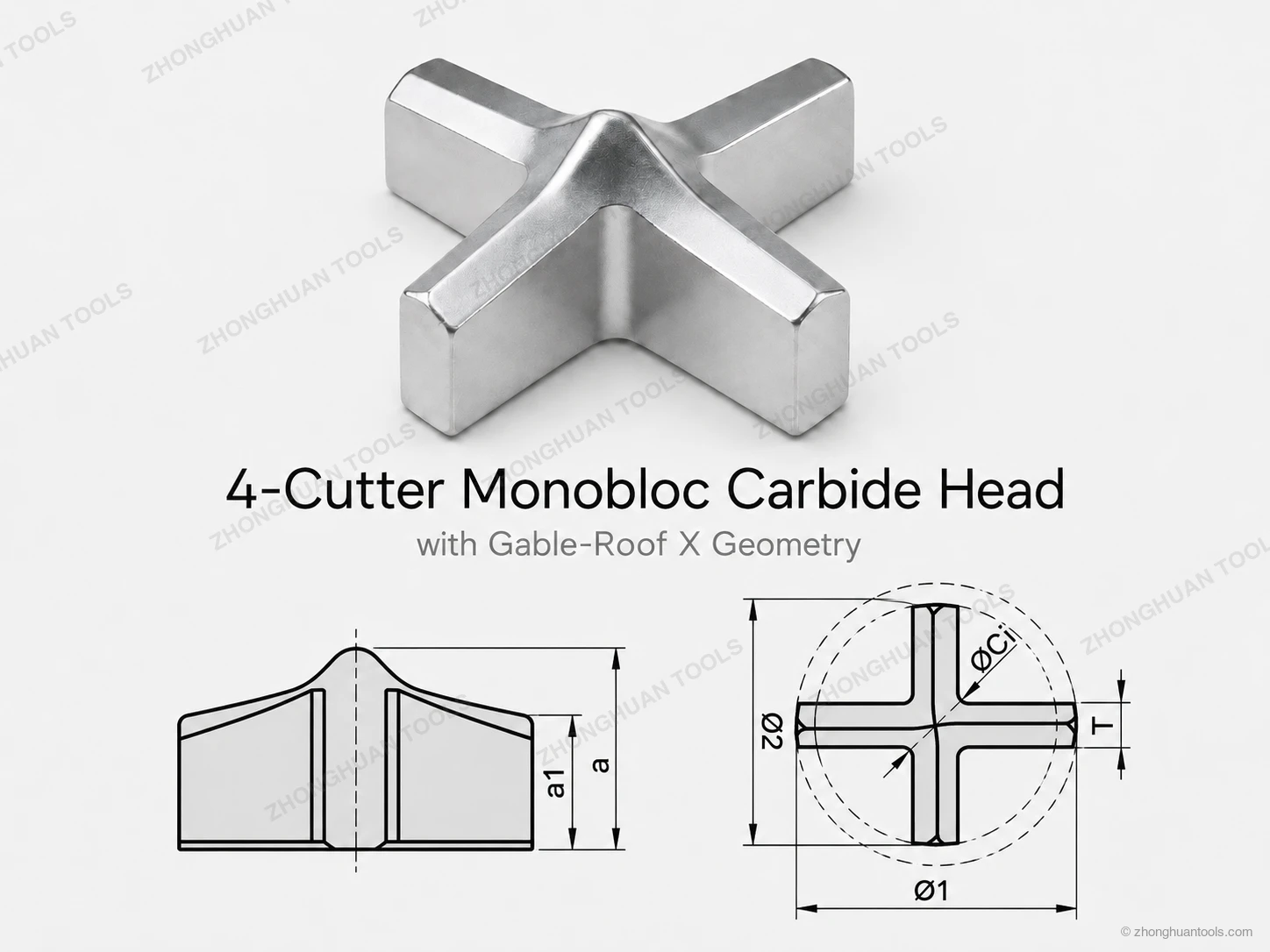
The code before the diameter identifies the tip geometry; the final CTM17-BC suffix identifies the carbide grade. BC20 is the catalog cross-reference for CTM17-BC, not a geometry and not an additional material grade.
Availability, origin, mill certificates and lot documentation must be confirmed against the supplier quotation for the specific order; the public catalog alone does not prove Zhonghuan's current stock or incoming-lot documentation.
YG Grade Names: A Starting Point for Specification
YG8C and YG11C are familiar WC-Co procurement names. The number describes a nominal cobalt level; the coarse-grain designation still needs a supplier-specific grain-size range, chemistry, hardness and transverse-rupture-strength test method. The finished SDS bit also depends on head geometry, steel body, joining and machine fit.
For a like-for-like comparison with a published CERATIZIT grade, request the actual grade sheet and batch record for the proposed YG material. A name alone does not establish equivalent wear, impact toughness or holes per bit. We prepare our OEM tip and bit specification around the approved grade range and sample cut rather than a public list of upstream factories.
Virgin and Zinc-Reclaimed WC-Co: Control the Process
Virgin WC-Co powder and zinc-reclaimed powder can both be processed into cemented carbide. In the zinc route, clean, grade-sorted WC-Co scrap is broken down and remilled without chemically converting the WC phase. CERATIZIT describes feedstock sorting and cleanliness as prerequisites for a high-quality reclaim.
Neither “virgin” nor “recycled” alone predicts a finished tip’s strength. Check the agreed cobalt and carbon window, grain distribution, impurity and oxygen limits, density, porosity, hardness and TRS on the actual sintered batch. Then assess the joined tip in the intended hammer and concrete. Recycled content can be specified or restricted by a customer program, but a blanket TRS deduction is not a reliable acceptance rule.
CTM17-BC / BC20 and YG8C: Compare Measured Properties
The CERATIZIT stone-working catalogue identifies CTM17-BC with BC20 as its catalogue cross-reference. Its composition table gives 8.5% cobalt, medium grain, density 14.65 g/cm³, HV10 1,420, HV30 1,400, HRA 90.4 and TRS 2,800 MPa. A hammer-tip application table lists a size-dependent TRS value, so quote the applicable row for the proposed tip.
| Property | CTM17-BC / BC20 catalogue reference | YG8C OEM sample |
|---|---|---|
| Cobalt and grain | 8.5% Co; medium grain | Confirm supplied grade and grain range |
| Hardness and TRS | HV10 1,420; HRA 90.4; TRS by catalogue row | Measure on the agreed batch by the same method |
| Finished-bit result | Requires the chosen head and joining route | Compare geometry, joint and target-concrete sample |
Published material data are useful, but they do not establish a field-life multiplier between differently constructed finished bits.
Who Uses BC20? Require Product-Level Evidence
A public carbide catalogue shows what the material supplier offers; it does not disclose the bill of materials of every finished Bosch, Hilti or distributor bit. A product page naming a grade is evidence for that specific SKU only. If origin or grade matters to your procurement program, request the supplied part number, lot marking and material declaration from the seller.
We use named premium tools as application benchmarks, then qualify the proposed OEM construction by drawing and sample. We do not infer a competitor’s private carbide source from its brand or factory location.
PGM Certification Verifies Geometry, Not Metallurgy
A persistent buyer misconception is that the Prüfgemeinschaft Mauerbohrer (PGM) mark requires Ceratizit BC20 or any specific grade. It does not.
PGM is a German industry association founded in 1978 that certifies a masonry drill bit produces holes within the geometric tolerances that European Technical Assessments require for DIBt- and ETA-approved anchors. The PGM directive (Dok200) checks cutting-tip diameter tolerance, symmetric tip placement, run-out and the manufacturer's quality management system. The PGM FAQ states explicitly: 'performance and tool life are not PGM criteria.' Carbide grade and supplier are agnostic.
The current PGM register lists 18 manufacturers. European holders include Alpen-Maykestag, BBW (Stanley Black & Decker), Bosch Ravensburg, Diager, DreBo, Dreps, Heller and Hilti (Kaufering and Kecskemét). Asian holders include Bosch Power Tools China and Japan's Miyanaga, alongside several Chinese contract manufacturers. The PGM mark was registered as the first EU Certification Mark on 9 March 2018 and is policed against counterfeits — Chinese raids have seized over 56,000 fake bits since 2009.
Beyond a Grade Label: Qualify the Material Program
For SDS tip procurement, compare candidate WC-Co programs by binder content, grain range, density, porosity, hardness, TRS test method, dimensional consistency and batch traceability. Ask how those values are controlled at the tip size you will buy, not only in a general catalogue.
The bit maker then has to match head geometry, joining area, body steel and heat treatment to the target hammer and substrate. We set acceptance criteria in the OEM drawing and witness sample before repeat orders; no public upstream supplier list is needed to make that comparison useful.
An Engineering Grade-Selection Framework
Start with substrate, aggregate and incidental rebar risk, then the rotary hammer’s impact energy and hole diameter. Select a carbide toughness/wear direction and head construction for that load path. Cobalt content, grain size, carbon balance, porosity and joint quality all matter; a single cobalt percentage or a linear “TRS per 1% Co” formula is not an acceptance specification.
For an OEM RFQ, record the grade or approved equivalent, binder and grain window, tip dimensions, hardness and TRS method, joining route, steel body, target machine and concrete class. Sample drilling should record start accuracy, hole gauge, chipping, tip retention and wear. The approved result becomes the repeat-order baseline.
What the Quoted Price Covers
Carbide blank price, tip mass, grade consistency, joining, dimensional inspection, traceability, packaging and distribution all contribute to the finished-bit quote. A catalogue grade name does not justify a universal blank-price or retail-price multiplier.
Compare quotations for the same diameter, length, head construction, carbide acceptance range, joining route, test plan and order quantity. Cost per accepted hole comes from a matched field or witness test, with rework and tool time included where relevant. Zhonghuan can quote the approved OEM construction and sample plan against that buyer specification.
Specify the Variables, Then Approve the Sample
CTM17-BC / BC20 is a documented reference material, and YG8C names a broad family of OEM supply options. The procurement decision is made by the actual grade sheet, batch evidence, tip geometry, joining and drilling result. Clean, controlled zinc-reclaimed feedstock can be an engineering option; neither recycled content nor virgin status alone guarantees a particular TRS or service life.
Send us the target machine, diameter and length, concrete and aggregate, expected rebar contact, approved carbide range and acceptance method. We will prepare a head-and-joint specification for sample approval and keep that construction tied to the repeat order.
Related Procurement Programs
If you are sourcing this product line for a distributor, importer, or private-label channel, these OEM and wholesale programs cover the procurement questions buyers usually ask next.
- SDS Drill Bits Manufacturer & Wholesale Supply for Distributors — OEM and wholesale SDS drill bit supply for importers, distributors, and tool brands: SDS-Plus, SDS-Max, carbide tips, 2-cutter and 4-cutter heads, packaging.
- SDS-Plus Drill Bits for Anchor Bolt Installation in Concrete — Precision SDS-Plus hammer drill bits for mechanical and chemical anchor holes in concrete and masonry.
- SDS Plus Drill Bit Sets Private Label & OEM Packaging — Private-label SDS Plus drill bit set program for retailers, importers, and online tool brands.
- 3-Cutter Full Carbide Head SDS-Plus Manufacturer — OEM / private-label for the one-piece full-carbide 3-cutter (120° Y) geometry.
- Y-Cutter SDS Drill Bits Manufacturer & OEM — the 3-blade 120° Heller-Trijet-class geometry, full-carbide-head only.


