

Cutting Mechanics & the Three Head Geometries
An SDS hammer bit drills by impact, not by twisting — so the carbide head geometry decides how fast it penetrates, how round and straight the hole stays, and how long the bit survives rebar and abrasive aggregate. Three head families cover almost all professional work: the 2-cutter, the 4-cutter cross head, and the multi-segment 4-cutter. They are a genuine progression in capability and cost, not interchangeable styles.
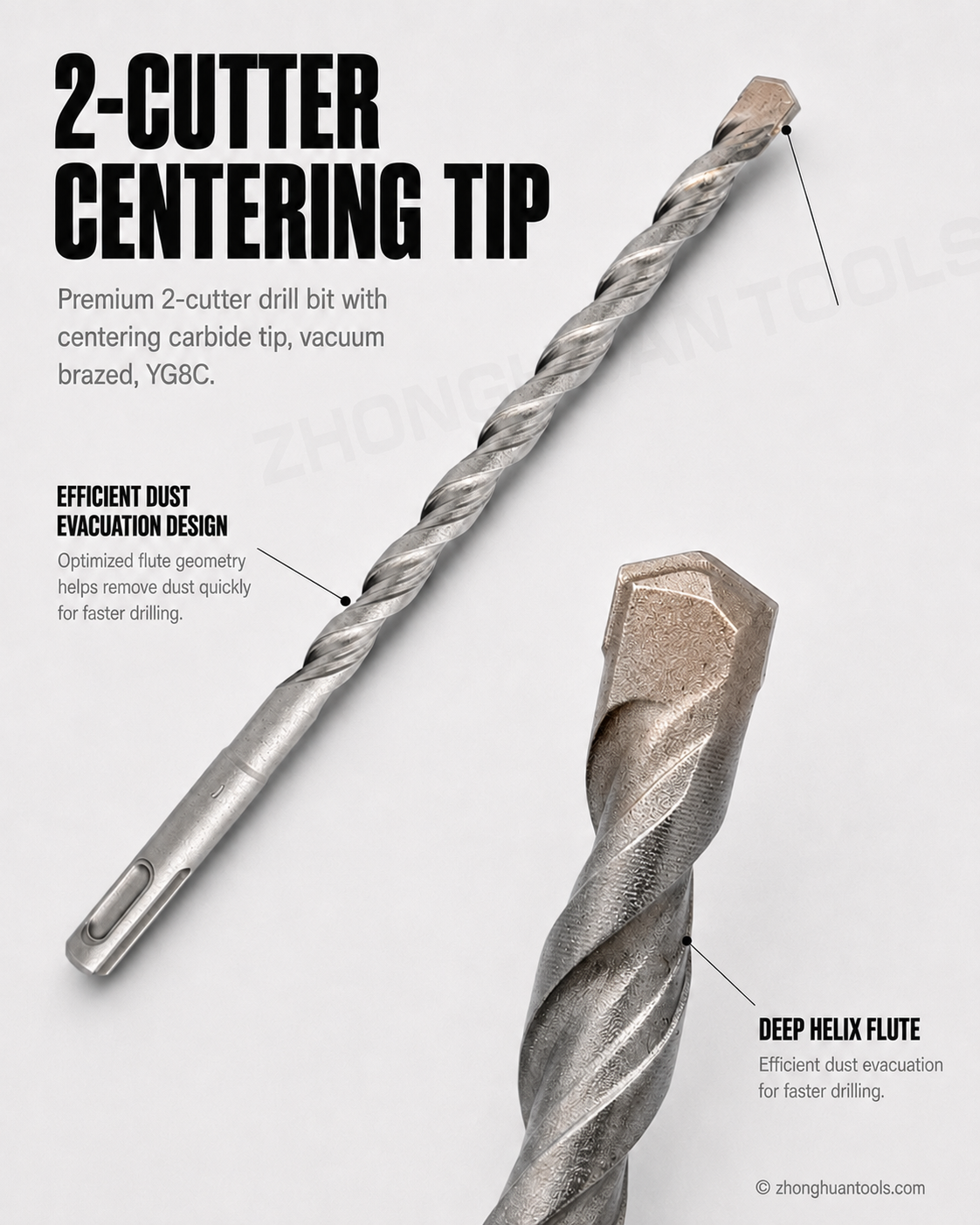
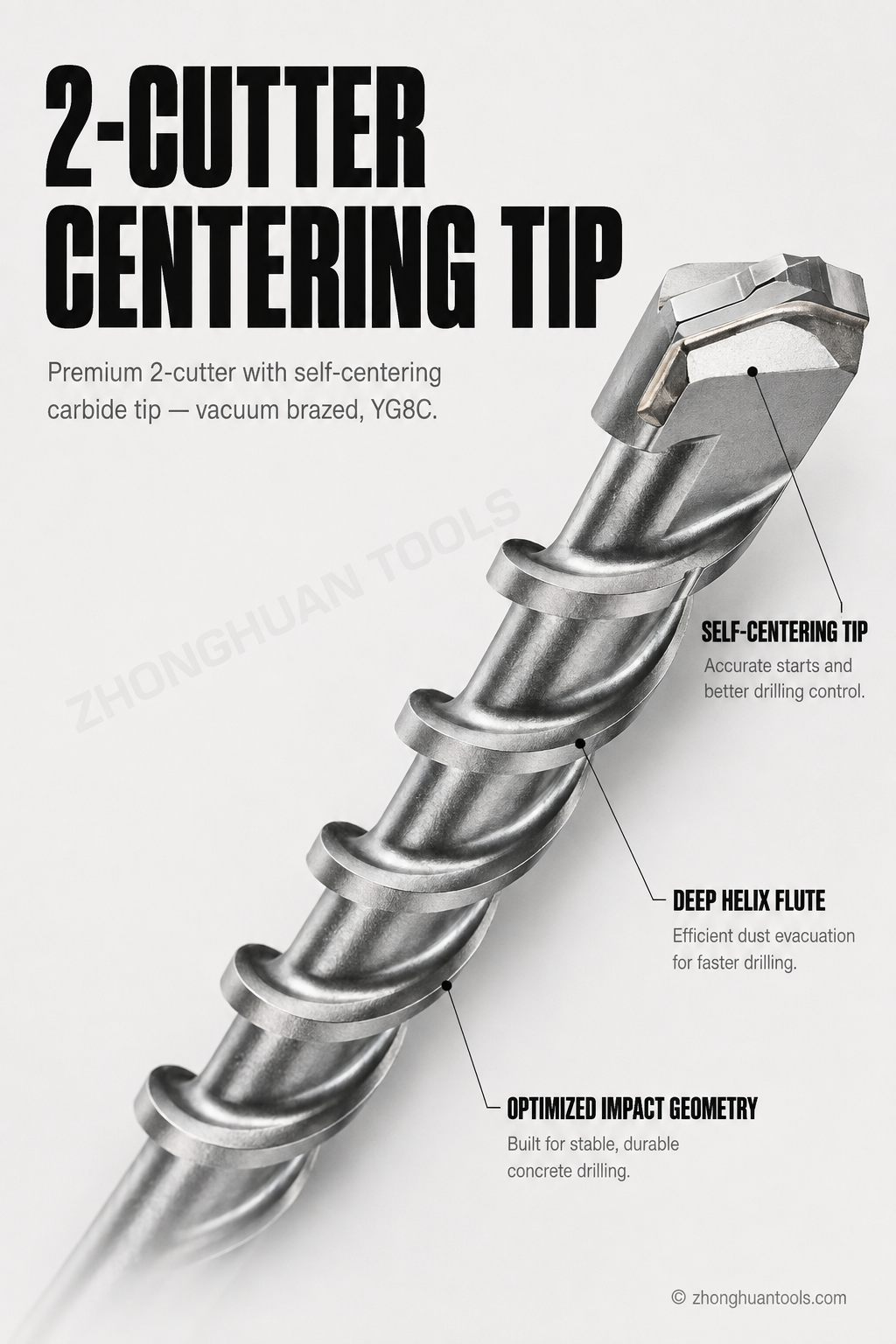
2-Cutter with Self-Centering Tip
A single carbide plate spans the full diameter — two cutting edges, one continuous tip. Concentrating every blow on one wide edge makes it the fastest geometry in brick, block and plain concrete, and the cheapest head to manufacture. Its classic weaknesses are hole-start accuracy and rebar: a flat two-edge tip can walk on smooth concrete and wants to deflect when one corner catches steel. Zhonghuan's 2-cutter fixes the first problem with a self-centering tip — a small central carbide point ground proud of the main edges (it looks like a little pacifier nub). It bites first and locates the hole, so the bit spots cleanly without a center punch and tracks straight from the first blow. See the deep-dive on the self-centering 2-cutter tip.
- Cutting angle: ~130–140°, force concentrated on one wide edge
- Self-centering tip: clean spotting, no walk on smooth concrete
- Flutes: deep twin flutes, fast chip evacuation
- Speed: fastest in brick, block and plain concrete
- Optimal RPM: 800–1200 RPM
4-Cutter Cross Head — ZHMAX-5X
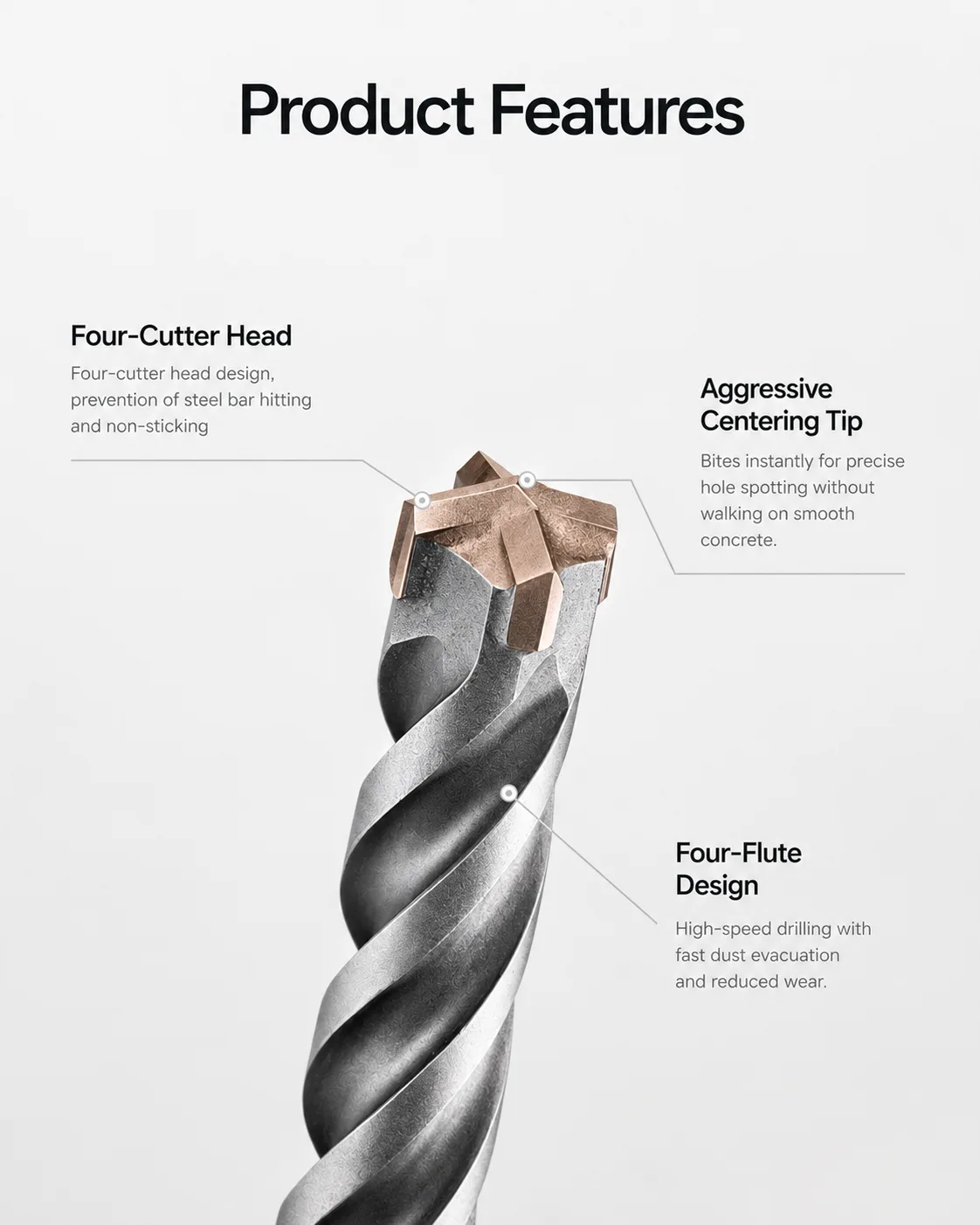
Two carbide plates set at 90° form a cross — four cutting edges in a "+" footprint. Splitting the work across four edges keeps the hole round, roughly halves the load each edge carries, and gives the bit four points of guidance, so it drifts far less than a 2-cutter. When one edge meets rebar, the opposing edges keep the bit tracking instead of deflecting. This is our ZHMAX-5X head: a symmetric brazed cross for accurate anchor holes in reinforced concrete. Versus a 2-cutter you trade a little speed in soft material and a higher price for roundness, drift control and rebar tolerance.
- Geometry: symmetric four-edge cross, even chip flow
- Guidance: four points of contact, rounder holes
- Rebar: strong drift resistance on steel contact
- Life: markedly longer than a 2-cutter in reinforced concrete
- Optimal RPM: 800–1000 RPM
Multi-Segment 4-Cutter — ZHMAX-7
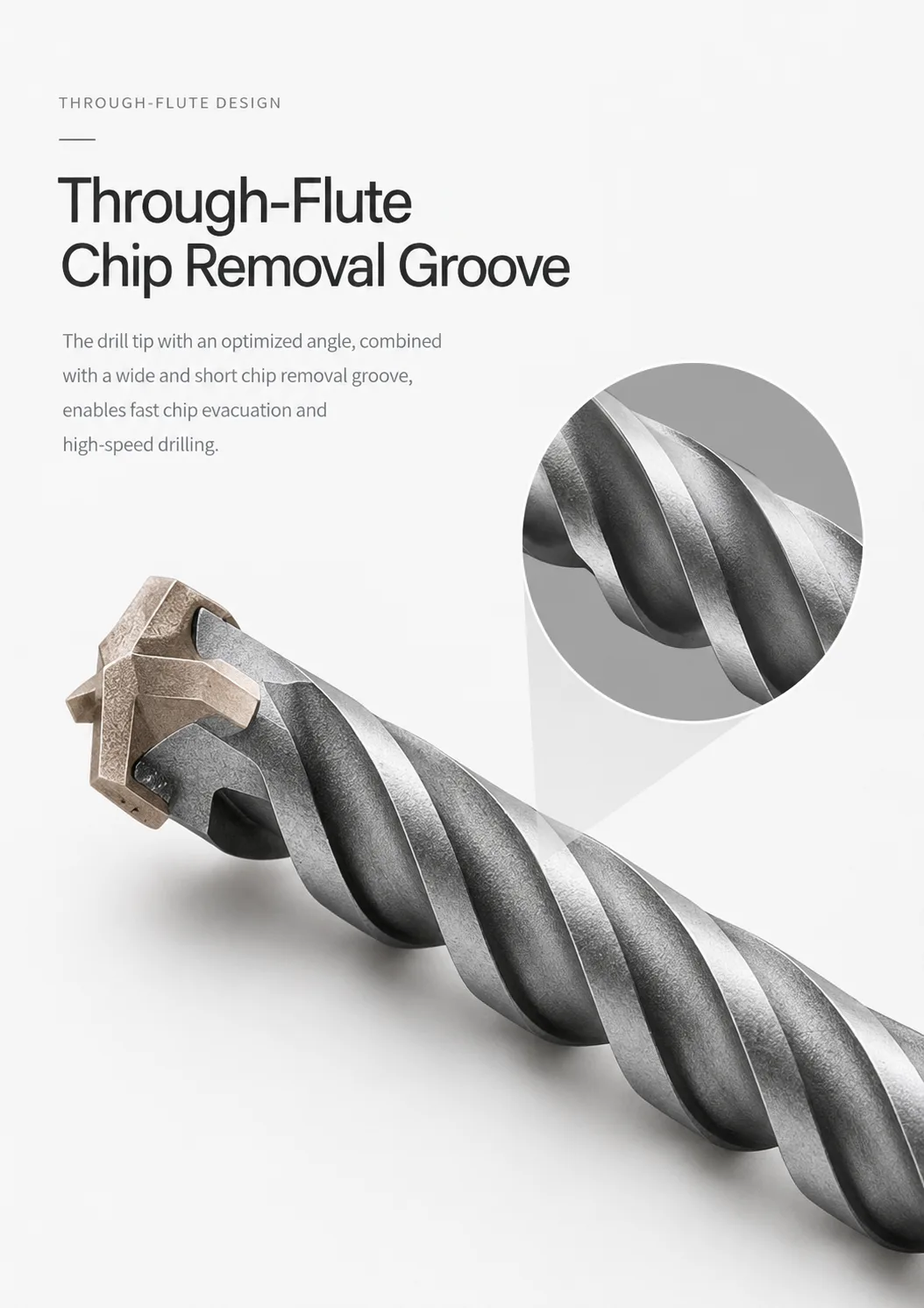
From the front this reads like a 4-cutter, but it is a different build: a full-width primary carbide blade flanked by two inclined side cutters — a multi-segmented carbide head, the geometry class Bosch sells as SDS max-7. The segmented edges shear hard, abrasive aggregate rather than only crushing it; the side cutters carry the gauge diameter deep into the bit's life; and the staged engagement clears cuttings fast in deep holes. This is our ZHMAX-7 head — the heavy-duty step up (primarily SDS-Max diameters) for hard or abrasive rock, deep holes and dense rebar, where a plain cross head dulls and loses gauge. The full geometry-tier map is in our ZHMAX-5X / 7 / 8 guide.

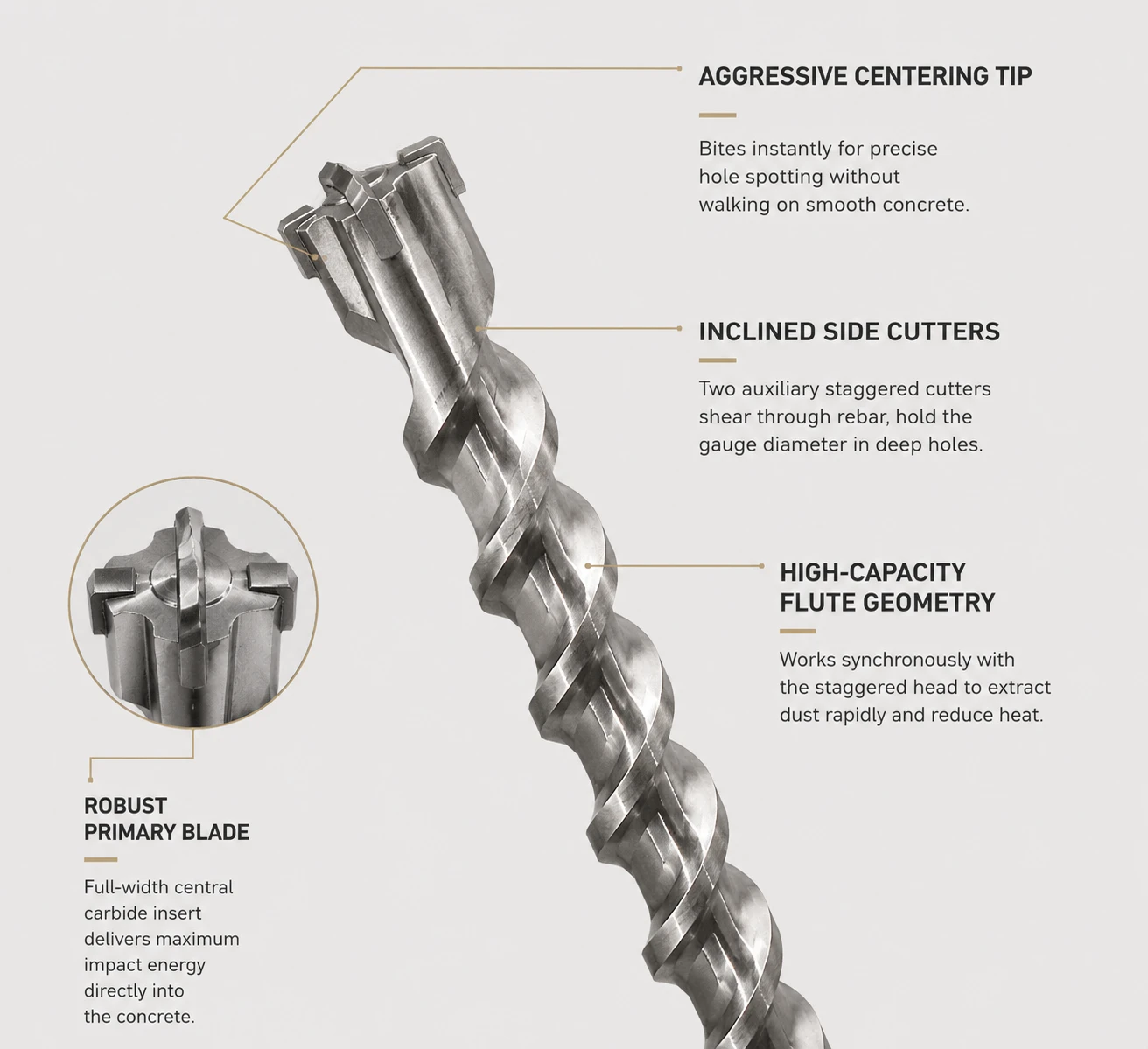
- Geometry: full-width primary blade + two inclined side cutters
- Hard rock: shears abrasive aggregate; holds gauge deep
- Deep holes: staged engagement clears cuttings fast
- Class: Bosch SDS max-7 geometry; controlled-atmosphere brazed YG11C
- Optimal RPM: 600–800 RPM (heavy SDS-Max work)
Performance Comparison Matrix
| Performance Metric | 2-Cutter (centering tip) | 4-Cutter Cross — ZHMAX-5X | Multi-Segment 4-Cutter — ZHMAX-7 |
|---|---|---|---|
| Speed — brick / plain concrete | ★★★★★ | ★★★★ | ★★★ |
| Speed — hard / abrasive rock | ★★ | ★★★★ | ★★★★★ |
| Hole start (anti-walk) | ★★★★★ | ★★★★ | ★★★★ |
| Hole roundness | ★★★ | ★★★★★ | ★★★★ |
| Rebar tolerance | ★★ | ★★★★ | ★★★★★ |
| Deep-hole gauge retention | ★★ | ★★★ | ★★★★★ |
| Cost efficiency | ★★★★★ | ★★★ | ★★ |
Application Scenarios & Parameter Tuning
Where each head wins
- 2-Cutter (self-centering tip) — brick, block and plain concrete; high-volume anchor pilot holes; any job where a fast, clean hole start matters. DIY and light trades.
- 4-Cutter cross / ZHMAX-5X — reinforced-concrete anchor work, MEP installation, equipment bases; wherever roundness and rebar tolerance pay off. The professional default.
- Multi-segment 4-cutter / ZHMAX-7 — hard or abrasive aggregate (granite, quartzite), deep holes, dense rebar and large SDS-Max diameters; heavy structural and demolition drilling.
Parameter tuning
- 2-cutter: 1000–1200 RPM, light pressure, fast feed
- 4-cutter (ZHMAX-5X): 800–1000 RPM, steady feed
- Multi-segment (ZHMAX-7): 600–800 RPM, let the impact do the work
Learn more about specifications: SDS-Plus Series, SDS-Max Series.
Exit Spalling (Concrete Blow-Out): Where Geometry Helps — and Where It Can't
Spalling — the cone of concrete that breaks off the back face as the bit punches through — is mostly physics, not a bit defect. The last few millimetres of a through-hole have no surrounding concrete to confine them, so the percussive impact and forward thrust shear that layer off before the carbide has finished cutting it. Some breakout is inherent to through-drilling; head geometry reduces the severity, it does not eliminate the effect.
Where the three geometries differ:
- 2-cutter: a single straight edge concentrates the impact on one line, so at break-through it tends to split the last layer off as a block. The self-centering tip is what earns its keep here — it locks the axis and holds runout low, so the exit stays round instead of being torn oversize by wobble.
- 4-cutter cross (ZHMAX-5X): four edges share the impact across four contact points, lowering the peak stress at each one — a gentler, smaller exit cone, which is why the cross head is the one to spec where exit quality matters.
- Multi-segment (ZHMAX-7): the same energy-distribution logic on the SDS-Max heavy end. This is primarily a hard-rock and deep-hole head, so it meets through-spalling far less often than the SDS-Plus heads above — but where it does break through, spreading the impact across segments still helps.
The honest part: the biggest lever is still the operator. Easing the feed over the last 5–10 mm so the bit cuts the final layer instead of punching it out does more than any tip pattern. A free-cutting flute (low required thrust) and low runout make that easy to do — they support good technique, they don't replace it. No carbide pattern legitimately "avoids" spalling; honest bits shrink the cone, and a sacrificial backing board or drilling from both faces finishes the job where the exit face is critical.
Embedded vs Brazed Carbide Heads: Why It Matters for Rebar
The carbide tip is the business end of every SDS drill bit, and how it is attached to the steel body determines whether the bit survives reinforced concrete or fails catastrophically. Understanding the difference between standard brazing and embedded (interlocked) carbide heads helps distributors stock the right product for demanding applications.
Traditional Brazed Tips
In standard construction, a flat carbide plate is silver-brazed onto a machined seat on the steel body. The braze joint alone carries all cutting forces. Under normal drilling in plain concrete, this works well. However, when the bit strikes rebar at high impact energy, the sudden lateral shock can exceed the braze joint shear strength. The result: the carbide tip detaches and the bit is destroyed instantly.
Embedded / Interlocked Carbide Heads
Premium bits (such as the Bosch 5X design philosophy) use a mechanical interlocking geometry — the carbide head is shaped with dovetail or T-slot features that slot into a matching pocket in the steel body. The head is then controlled-atmosphere brazed in place. This creates a dual-retention system: even if the braze weakens under extreme heat, the mechanical lock prevents head separation. The result is a bit that can survive repeated rebar impacts without losing its cutting head.
Controlled-Atmosphere Mesh-Belt Brazing vs Open-Atmosphere Brazing
Standard atmospheric brazing can trap gas bubbles and flux residue in the joint, creating voids and porosity that reduce shear strength. Controlled-atmosphere brazing eliminates atmospheric contamination: the braze alloy flows uniformly into the joint, producing a denser, stronger, and more consistent bond. For 4-cutter and multi-segment bits where each cutting edge must withstand independent impact loading, controlled-atmosphere brazing is the professional standard.
Practical Impact on Reinforced Concrete Drilling
When drilling reinforced concrete, the 4-cutter embedded design provides two critical advantages: first, the wider cutting diameter created by four edges clears rebar rather than catching on it, preventing the dangerous jam-and-kickback cycle; second, the interlocked carbide head withstands the repeated impacts of crossing rebar without separation. For installers working in reinforced structures daily, this translates directly to fewer broken bits, less downtime, and lower per-hole cost.
| Feature | Standard Brazed | Embedded Carbide |
|---|---|---|
| Attachment method | Silver braze joint only | Mechanical interlock + controlled-atmosphere braze |
| Bond shear strength | Baseline | 2–3× higher |
| Rebar impact resistance | Moderate — risk of tip loss on direct rebar hit | High — survives repeated rebar crossings |
| Head separation risk | Higher under extreme impact | Near zero with dual retention |
| Price premium | Baseline | 15–25% above standard |
| Recommended use | Plain concrete, block, brick | Reinforced concrete, structural drilling |
B2B Stock Recommendations for Distributors
For hardware distributors, construction supply houses, and tool import companies, stocking the right mix of SDS cutter types balances volume sales with high-margin specialty items:
| Segment | Recommended Type | Typical Customer | Stock Allocation |
|---|---|---|---|
| Volume / value | 2-cutter SDS-Plus (self-centering tip), YG8C carbide | DIY, light tradespeople, brick/block drilling | 50–60% of units |
| Mid-tier / professional | 4-cutter SDS-Plus — ZHMAX-5X, YG11C carbide | General contractors, MEP installers, anchor work | 30–35% of units |
| Specialty / premium | Multi-segment 4-cutter / SDS-Max — ZHMAX-7 | Structural engineers, post-installed anchors | 10–15% of units |
SKU depth by type:
- 2-cutter SDS-Plus: Full range 5–16mm is essential. Our self-centering tip is the value-add over a flat commodity 2-cutter — buy on price, but insist on YG8C minimum carbide spec to avoid returns.
- 4-cutter SDS-Plus (ZHMAX-5X): Stock 6mm, 8mm, 10mm, 12mm, 14mm, and 16mm as your core six sizes. These cover 90% of professional anchor installation work in reinforced concrete.
- Multi-segment 4-cutter / SDS-Max (ZHMAX-7): Stock selectively at 16mm, 20mm, 25mm and larger. Slower movers but high-value — for contractors drilling hard or abrasive ground, deep holes and dense rebar.
A distributor that supplies all three tiers — with matching technical data sheets — becomes a single-source partner for contractors who need the right tool for each job. This positioning commands higher margin and longer customer relationships than competing on price alone for commodity 2-cutter bits.
Related Procurement Programs
If you are sourcing this product line for a distributor, importer, or private-label channel, these OEM and wholesale programs cover the procurement questions buyers usually ask next.
- Self-Centering 2-Cutter SDS Drill Bits Manufacturer & OEM — Factory-direct premium 2-cutter SDS-Plus and SDS-Max bits with a self-centering tip, controlled-atmosphere brazed YG8C carbide, private-label programs.
- SDS Drill Bits Manufacturer & Wholesale Supply for Distributors — OEM and wholesale SDS drill bit supply for importers, distributors, and tool brands: SDS-Plus, SDS-Max, carbide tips, 2-cutter and 4-cutter heads, packaging…
- SDS-Plus Drill Bits for Anchor Bolt Installation in Concrete — Precision SDS-Plus hammer drill bits for mechanical and chemical anchor holes in concrete and masonry.
- SDS Plus Drill Bit Sets Private Label & OEM Packaging — Private-label SDS Plus drill bit set program for retailers, importers, and online tool brands: mixed masonry bits, chisels, plastic cases, blister cards, color …


