

Why Head Geometry Determines SDS-Max Performance
In a rotary hammer drill bit, the carbide insert at the tip does two things simultaneously: it cuts material under heavy impact energy, and it clears the resulting debris out of the hole so the next impact stroke lands on fresh material.
A standard SDS-Max shank delivers 8–20 joules of impact energy per stroke. At that energy level, the geometry of the carbide head — how many cutting edges it has, how they are oriented, and how the side faces are shaped — determines whether the bit converts most of that energy into forward progress, or wastes it on friction, deflection, and debris compaction.
This is why two SDS-Max bits with identical diameter, identical steel grade, and nominally identical carbide quality can produce dramatically different drilling speeds in reinforced concrete. The variable is not what the bit is made of. It is how the cutting geometry is arranged.
The ZHMAX series is built around three distinct carbide head architectures — each a different engineering answer to this problem.
The Three ZHMAX Tiers at a Glance
| Tier | Head architecture | Carbide | Industry class equivalent |
|---|---|---|---|
| ZHMAX-5X | Standard 4-cutter brazed tip | YG8C virgin | Bosch SDS max-4 class |
| ZHMAX-7 | Multi-segmented cutter + inclined side cutters | YG11C virgin | Bosch SDS max-7 / Drebo ZENTRO MAX 4 class |
| ZHMAX-8 | Full-head solid carbide, resistance-friction-welded | YG8C premium | Bosch SpeedXtreme class |
ZHMAX-5X: Standard 4-Cutter Brazed Geometry
ZHMAX-5X uses the conventional four-cutter brazed carbide geometry that has been the SDS-Max standard for two decades. A single carbide insert is controlled-atmosphere brazed into a four-slot head machined into the steel body.
What it does well. Reliable, predictable performance in general concrete, masonry, and stone. Ø12–25mm range, lengths 200–600mm. YG8C virgin carbide and controlled-atmosphere brazing give ZHMAX-5X a meaningful life advantage over mass-market bits that use recycled carbide and conventional furnace brazing — even though the geometry looks similar from the outside.
Where it reaches its limit. In heavily reinforced concrete, the flat four-cutter geometry produces increasing deflection when the cutting edges contact rebar, and debris evacuation slows at larger diameters. Drilling speed drops, bit temperature rises, and carbide tip wear accelerates. These are not quality defects — they are the physical limits of the geometry itself.
Best for: General construction, masonry anchoring, foundation drilling, applications where the concrete is not continuously reinforced and maximum speed is not the primary requirement.
ZHMAX-7: Staged Multi-Insert 4-Cutter Geometry
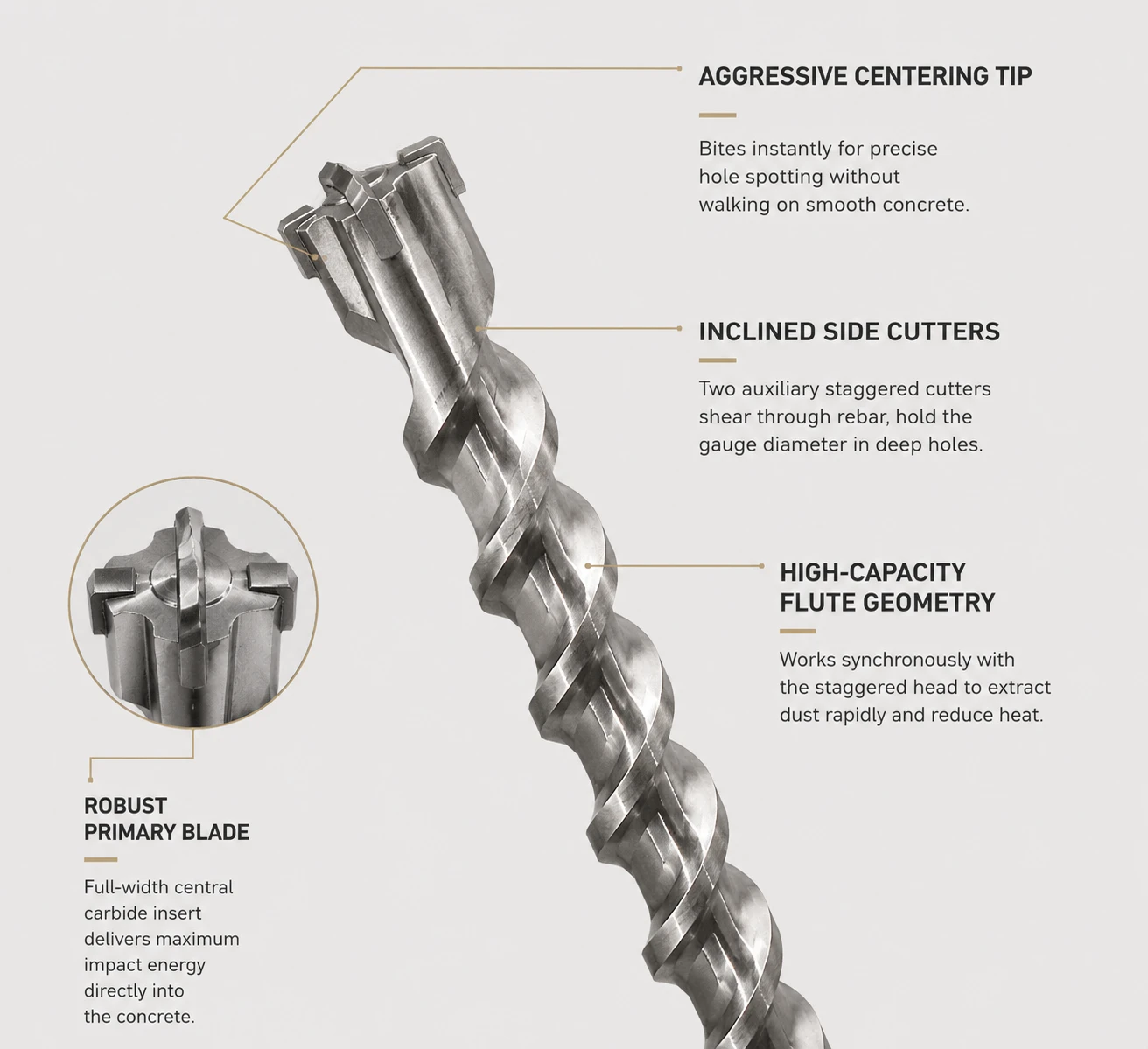
ZHMAX-7 is not a conventional symmetric cross head. It is a staged three-insert, four-effective-edge architecture: one full-width primary carbide blade sits forward and carries the leading impact, while two inclined side inserts are set back axially and follow around the gauge circle.
Primary blade first. The full-width blade creates two leading diametrical edges and preserves the direct penetration character associated with a two-cutter. It fractures the concrete before the side inserts reach full engagement.
Side inserts second. The two following YG11C inserts support peripheral cutting, stabilize the head, and maintain finished hole diameter. Their inclined placement creates progressive contact rather than forcing four equivalent wings to strike at the same axial level, reducing the tendency to snag when contact is uneven around rebar or hard aggregate.
Controlled flute volume. Open head pockets give crushed material a direct route into the helix. The flute remains large enough for deep-hole dust transport, but the 42CrMo body retains a substantial core and lands for impact transfer, torsional reserve, tracking, and fatigue resistance. Maximum-looking flute depth is not the goal; the complete load path is.
Controlled-atmosphere brazed multi-insert construction. The three separate YG11C carbide components are seated in dedicated body pockets and controlled-atmosphere brazed for repeated heavy-impact service. The design combines direct leading-edge penetration with four-edge gauge support and an open debris path.
| Factor | Standard 4-cutter (ZHMAX-5X) | Multi-segmented cutter (ZHMAX-7) |
|---|---|---|
| Drilling speed, reinforced concrete | Baseline | Higher penetration potential from staged engagement; validate in target concrete |
| Rebar contact behavior | Deflects, tip overheating risk | Better tolerance of incidental contact than a monobloc 4-cutter |
| Debris evacuation in deep holes | Adequate to 200mm | Effective to 600mm+ |
| Heat buildup at sustained drilling | Higher | Lower |
| Carbide grade | YG8C virgin | YG11C virgin |
Diameter range: Ø16–45mm, lengths 320–920mm; confirm the exact diameter-length combination by RFQ.
Best for: Reinforced-concrete service penetrations, large heavy-anchor holes, bridge and tunnel work, deep drilling in dense concrete, and hard natural stone where penetration, gauge retention, and torsional reserve matter together.
ZHMAX-8: full carbide head
ZHMAX-8 uses a one-piece carbide head joined to the steel body by our approved resistance-friction welding route. This removes braze seams between separate carbide inserts, but the carbide-to-steel joint still requires inspection. Our described SDS-Max range is Ø4–25 mm; this is our program, not an industry-wide diameter limit. Bosch lists EXPERT SDS max-8X full-carbide-head bits in Ø32 mm.
Provide hammer, diameter and length, concrete and rebar exposure, target hole tolerance and sample quantity. We define carbide, joint and inspection limits on the approved drawing and compare holes and wear in the intended duty.
Bosch EXPERT SDS max-8X Ø32 mm — reference for checking the full-carbide-head range by SKU.
Application Selection Matrix
| Application | Recommended tier | Reason |
|---|---|---|
| General masonry, light concrete, stone | ZHMAX-5X | No reinforcement, standard impact energy sufficient, cost-effective |
| Mixed concrete, occasional rebar encounter | ZHMAX-5X or ZHMAX-7 | Depends on rebar density; ZHMAX-7 is a modest step up, and for regular rebar contact compare ZHMAX-168 or ZHMAX-8 |
| Structural reinforced concrete, bridge, tunnel | ZHMAX-7 | Tolerates incidental rebar contact better than a monobloc 4-cutter and carries high debris load at depth; for frequent rebar contact compare ZHMAX-168 or ZHMAX-8 |
| Deep holes (>300mm) in hard concrete | ZHMAX-7 | Vibration-optimized helix maintains debris clearance at depth |
| Continuous heavy-duty drilling (>4 hrs/day) | ZHMAX-8 | Eliminates brazed-joint fatigue at highest sustained impact energy |
| Extra-hard concrete (>50 MPa), demolition interface | ZHMAX-8 | Solid carbide head absorbs peak impact without joint failure |
OEM Sourcing Note
For an SDS-Max range, select the construction by substrate, hammer and accepted drilling result. ZHMAX-5X uses the standard four-cutter brazed head; ZHMAX-7 uses a full-width primary blade and two set-back side inserts; ZHMAX-8 uses a full carbide head joined to steel by resistance-friction welding within our listed Ø4–25 mm SDS-Max range.
Send concrete and aggregate, rebar exposure, diameter, length, hammer model and order volume. Zhonghuan documents carbide grade, head geometry, joint, 42CrMo body, flute and inspection limits on the approved sample. Compare hole diameter, rate and wear on the actual machine before a repeat order.
Related Procurement Programs
If you are sourcing SDS-Max drill bits at distribution volumes, these programs cover the procurement questions buyers typically ask next.
- SDS Drill Bits Manufacturer & Wholesale Supply for Distributors — OEM and wholesale SDS drill bit supply for importers, distributors, and tool brands: SDS-Plus, SDS-Max, carbide tips, 2-cutter and 4-cutter heads, packaging options.
- Zhonghuan SDS-Max Product Range — Full ZHMAX-5X, ZHMAX-7, and ZHMAX-8 specifications, diameter and length tables, and OEM inquiry.


