

Read the blade and skid plate as one cutting system
These engineering illustrations explain the interface and cutting mechanism. They are technical visualisations, not factory-inspection photographs or machine assembly drawings.
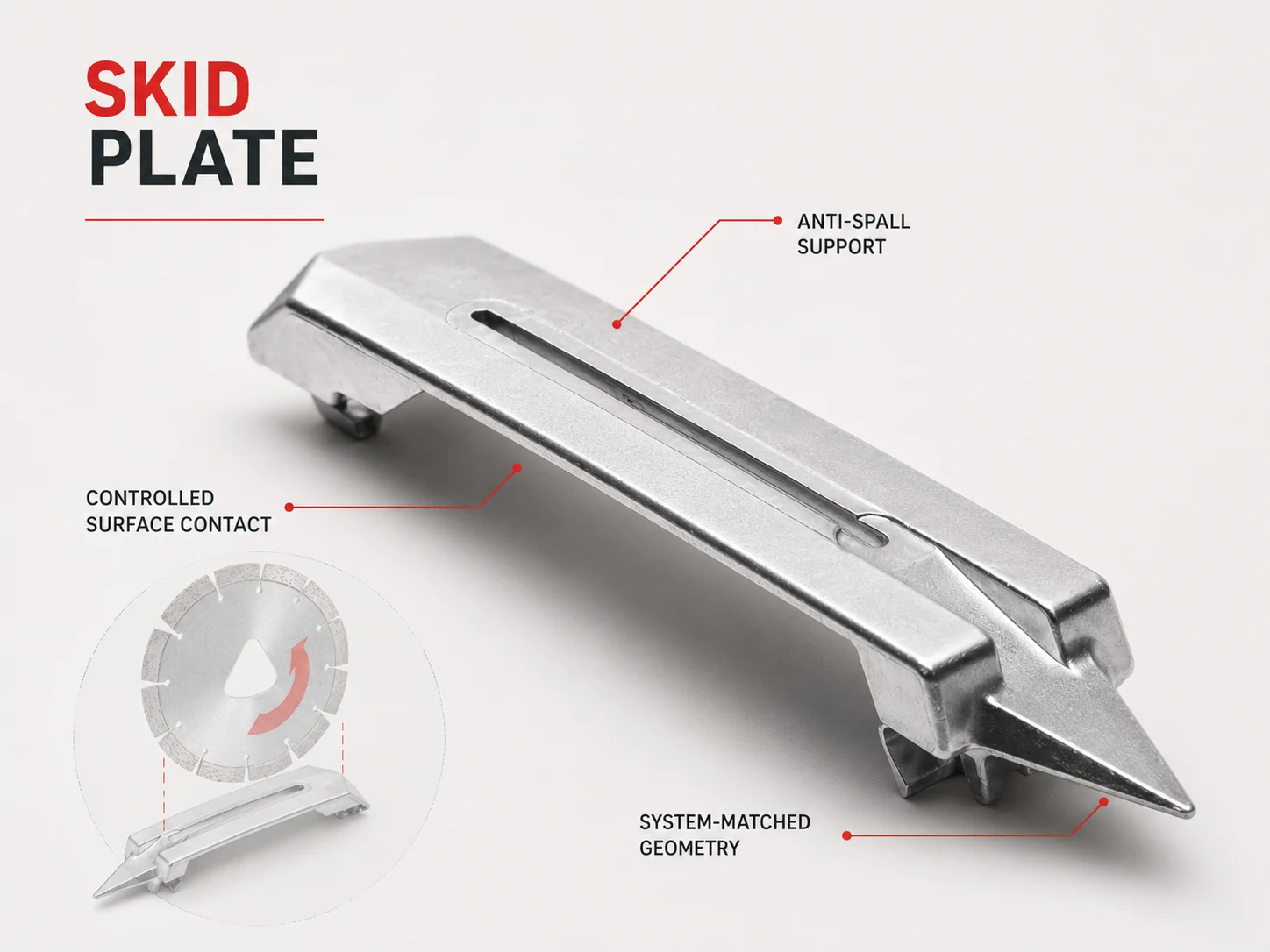
Skid plate condition controls edge support
The plate rides beside the blade path and maintains surface support. Slot clearance, flatness and free spring movement belong in the approval check.
- Surface contact
- Blade-slot clearance
- Machine-matched geometry
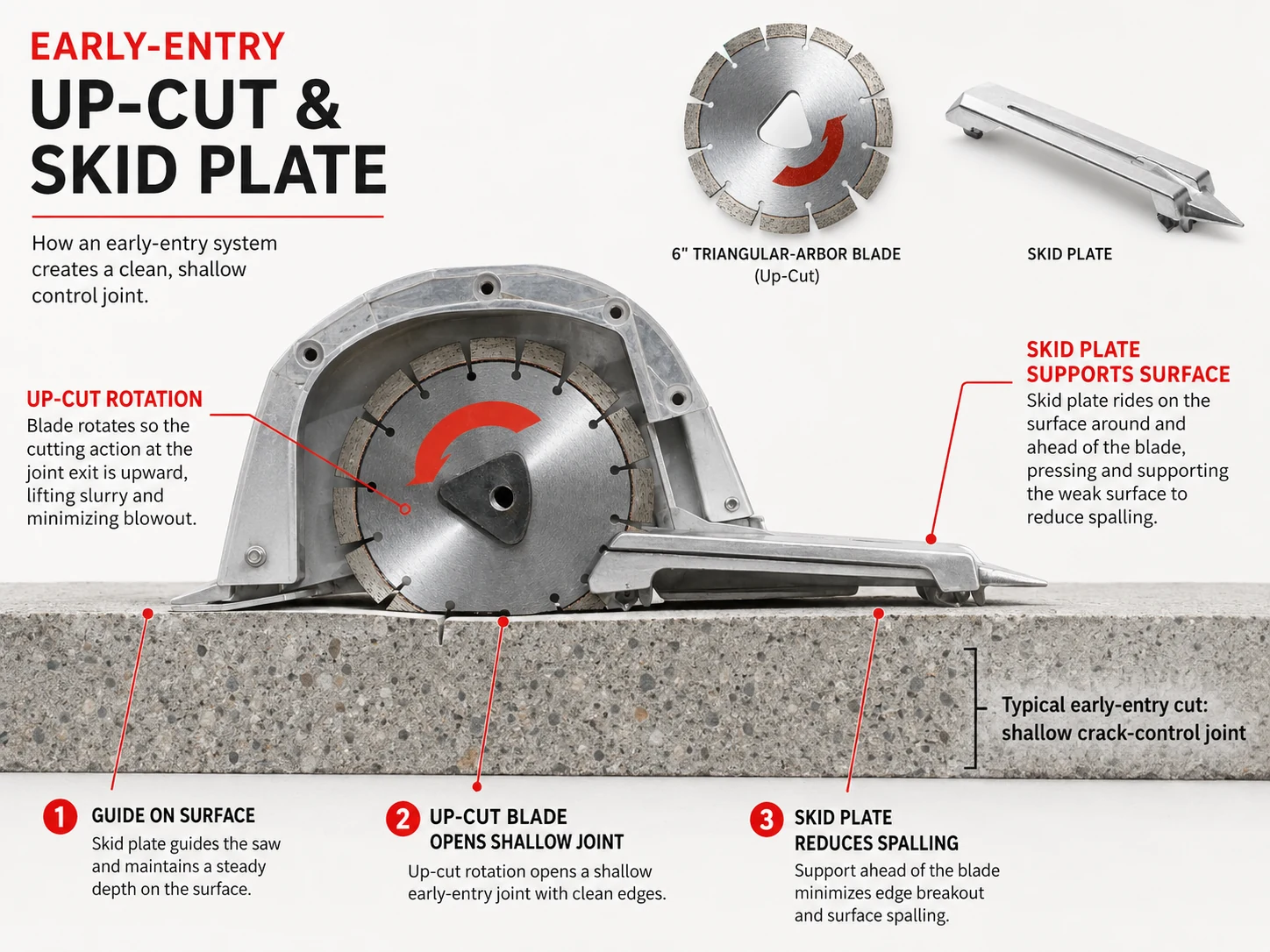
Up-cut rotation plus supported surface
The blade exits upward while the skid plate supports the weak surface around the joint, reducing the opportunity for paste and aggregate to lift out.
- Up-cut rotation
- Shallow contraction joint
- Reduced ravelling and spalling
Quick Answer: It Is a System, Not Just a Small Blade
Early-entry dry cutting creates contraction joints in green concrete soon after finishing, before shrinkage stress chooses a random crack path. The clean-cut result comes from a coordinated system: a light early-entry saw, an application-matched diamond blade, upward cutting rotation, a spring-loaded anti-ravelling skid plate and a machine-approved arbor/drive interface.
The blade cuts the joint; the skid plate does not keep the blade away from the slab. It supports the weak surface immediately around the blade path while the cutting edge exits upward. That local support is what helps keep paste and aggregate from lifting out of the joint edges.
The 1–4 Hour Window Is a Field Condition, Not a Timer Setting
The American Concrete Institute defines an early-entry dry-cut saw as a tool designed to begin joint cutting about 1–4 hours after finishing without ravelling the cut edges. The objective is to cut after the surface can carry the saw and skid plate, but before shrinkage stress produces out-of-joint cracks.
Actual timing moves with the mix, slab temperature, weather, finishing, bleed behaviour and set. ACI guidance also notes that hot conditions can require earlier cuts. The practical acceptance method is a short test cut: the surface must stay intact, the joint edges must remain supported and the cut must precede random cracking. A fixed clock value cannot replace that field check.
Why Green-Concrete Edges Ravel and Spall
In green concrete, aggregate is already hard but the surrounding cement paste has not developed full strength. If cutting force lifts material at an unsupported surface, aggregate can pull out with the paste around it. The edge then appears chipped, ragged or locally broken—described as ravelling, chipping or spalling depending on the pattern and severity.
Waiting longer makes the surface stronger, but it also spends the limited period before shrinkage stress creates random cracks. Early-entry engineering solves that conflict by supporting the surface while making a shallow contraction-joint cut at the right time.
How Up-Cut Rotation and the Skid Plate Work Together
Husqvarna describes the core mechanism directly: as the blade cuts in an upward rotation, the anti-ravelling skid plate applies pressure to the concrete surface to reduce chipping and spalling. The leading edge of the blade tends to lift material as it exits; the plate maintains close contact around that exit zone so the surface is supported rather than free to break away.
This is why an early-entry plate is more than a guide shoe. Its slot clearance, flatness, spring movement and position relative to the blade are functional cutting parameters. A correct blade with a worn or bent plate can still produce poor edges.
Why Arbor, Drive Feature and Kerf Must Match
Early-entry interfaces are machine families, not one universal hole. Diamond Products, for example, documents blades with a 1-inch arbor, drive-pin hole and triangle knockout. Other systems use their own bushings or approved patterns. The triangular feature helps transmit torque and locate the approved interface, but it is not permission to fit a visually similar blade to any saw.
Confirm the saw make and model, pilot bore, triangular bushing or knockout, drive-pin position, blade diameter, kerf, approved maximum RPM and skid-plate slot. A photo of the old blade and flange is often more useful than asking a buyer to name every interface dimension.
Skid-Plate Condition and Replacement
Inspect the plate before each cutting run. The blade must move freely through the slot without contacting the plate. The underside must be flat and free of burrs; the plate must not be twisted or bent; and the spring-loaded assembly must move freely enough to maintain surface contact.
Replacement practice is machine-specific. Some manufacturers require a new matched plate with each new blade, while others specify inspection or wear criteria. We do not publish a universal "two or three blades" rule or a universal 0.5 mm wear limit. The approved saw manual and signed blade/plate sample control the service decision.
Aggregate Matching Without Guessing a Colour
Hard aggregate tends to dull exposed diamond and usually pushes the specification toward a more self-sharpening matrix direction. Softer or more abrasive sand can erode the matrix faster and pushes in the opposite direction. Green concrete adds another variable because paste strength and abrasion change quickly during the cutting window.
Premium brands use colour-coded blade families, but their colour-to-aggregate maps are brand-specific. An OEM RFQ should name the aggregate class, sand abrasiveness, location or approved benchmark blade. Zhonghuan can then return a proposed matrix direction and private-label colour map for engineering confirmation and sample approval.
Low-Friction OEM RFQ Inputs
The buyer does not need to choose bond chemistry. Send five practical inputs:
- Saw make and model, or clear photos of the arbor, flange and old blade.
- Blade diameter and kerf, if known.
- Pour-to-cut window and whether the job is dry early-entry cutting.
- Aggregate or concrete-mix information, or job location and benchmark blade when the aggregate is not known.
- Supply scope: blade only, or matched blade + skid plate + private-label packaging.
Our engineering review owns the matrix, segment geometry, interface drawing and plate match. The approval package should return a signed SKU drawing, machine fitment, blade/plate pair, sample-cut acceptance and production marking.
Build an Early-Entry Blade + Skid Plate Program
Send the saw model or flange photo, blade size, cutting window, aggregate information and annual volume. We will return a machine-matched blade/plate proposal and sample plan.
Review Early-Entry ProgramEngineering References
- ACI Concrete Terminology—definition of early-entry dry-cut sawing.
- ACI: When should saw cuts be made?—timing, ravel control and cut-depth context.
- Husqvarna Soff-Cut technology—upward rotation and anti-ravelling skid-plate function.
- Diamond Products First-Cut blades—arbor, drive-pin, triangle-knockout and blade/plate supply format.


