

What DreBo Actually Is
DreBo is easy to misunderstand if you approach it like a retail-brand buyer.
Officially, DreBo presents itself as a German, in-house manufacturer of stone drilling tools and chisels, and more specifically as an OEM/private-label manufacturer. That immediately places it in a different bucket from Bosch, Heller, or Milwaukee.
This matters because when buyers ask "are DreBo drill bits good?" they are often asking the wrong first question. DreBo is not mainly trying to win with retail shelf visibility. It is trying to win with manufacturing credibility, product performance, and the ability to support customer brands.
On its own company pages, DreBo emphasizes three things again and again:
- "Made in Germany" and produced in-house
- OEM/private-label manufacturing role
- deep specialization in stone drilling tools and chisels
That is not generic marketing language. It is a very specific commercial identity.
Why Buyers Misread DreBo
Many buyers subconsciously evaluate every drill-bit company as if it were either a mass end-brand or a no-name factory. DreBo fits neither pattern cleanly.
It is not Bosch-style mass-market. It is not a generic exporter. It is a specialist German manufacturing platform that can sit behind labels, private-label programs, and OEM relationships.
That changes the evaluation logic.
If you judge DreBo by retail brand visibility alone, you will underrate it. If you judge it by German specialist manufacturing positioning, in-house production, and drilling-category depth, it becomes much more serious.
The Quality Case: Why DreBo Is Taken Seriously
DreBo's own official pages make a straightforward quality argument.
First, it presents itself as producing in-house in Germany across two locations, not as a trading shell. Second, it frames product quality around raw materials, steel treatment, process control, and long service life. Third, it highlights innovation work such as the DC-PLUS dustfree hammer drill system and other award-linked developments.
That combination matters because it shows DreBo is not only selling a finished product. It is selling a manufacturing platform and development capability.
For professional buyers, that is often more valuable than consumer-facing brand noise. A German OEM/private-label manufacturer that really controls materials, production, and drilling-tool design is a very different proposition from a label that mainly outsources and merchandises.
Where DreBo Is Strongest
DreBo is strongest in situations where the buyer cares about the manufacturer behind the line, not just the logo on the package.
- Private-label programs: DreBo openly positions itself for this business model.
- Specialist distributors: channels that sell on technical credibility can use DreBo's manufacturing story effectively.
- German manufacturing positioning: where "produced in-house in Germany" is commercially meaningful, DreBo becomes more interesting than a generic label.
- Broader stone-drilling category coverage: DreBo's scope is not just one SDS-plus line; it spans SDS-plus, SDS-max, chisels, modular tools, percussion tools, and rotary drilling tools.
That breadth matters because it signals real category depth. DreBo is not pretending to understand drilling. It is built around drilling.
Who Should Buy DreBo — and Who Shouldn't
DreBo makes sense if:
- you are evaluating German OEM/private-label manufacturing options
- your channel values manufacturing credibility more than mass end-user brand familiarity
- you want a supplier who openly understands packaging, private-label, logistics, and specialist drilling applications
- you care about the factory platform behind the product line
DreBo is less ideal if:
- you simply want the easiest end-brand premium line to resell globally, where Bosch is easier
- you want a specialist end-brand identity with more direct trade-brand personality, where Heller is easier to position
- you are judging only by end-consumer brand recognition rather than manufacturing capability
The blunt conclusion is this: DreBo is good, but not in the way casual buyers usually mean. It is not mainly a fame story. It is a manufacturing-capability story. For buyers who understand that distinction, DreBo is far more serious than its mainstream visibility suggests.
The ZENTRO MAX SDS-Max — and the Multi-Segment Head We Build as ZHMAX-7
DreBo's flagship SDS-max bit, the ZENTRO MAX, is the clearest window into what the company actually engineers. DreBo's own catalogue calls it a "robust, aggressive power pack, combining an innovative head geometry and an established flute geometry," built for reinforced concrete and natural stone on rotary hammers of 5 kg and up, in Ø12–52 mm. Strip away the brand language and it is a textbook multi-segment SDS-Max head — a symmetrical 4×90° solid-carbide geometry (four-cutter from Ø16 mm, two-cutter below), up to 50% more carbide, large curved secondary cutters, a 130° centering point, a patented reinforcing chamfer, and DreBo's reinforced-core (KVS) flute. Bosch markets a multi-insert head as SDS max-7 and Milwaukee as MX4; we build our own ZHMAX-7 multi-insert head from our own drawing.
Where it gets interesting is the symmetry. DreBo leads hard on its symmetrical 4×90° geometry, and symmetry buys something real: balanced cutting forces, low walk, and a clean, round hole. But symmetry is a trade-off, not a free win. A perfectly balanced layout takes an even, polite bite on every edge; an inclined, angled secondary cutter instead presents the carbide at an attack angle — generating asymmetric cutting torque that bites more aggressively and tends to clear the hole faster, with less feed force from the operator.
That is the call we make on the ZHMAX-7: our secondary cutters run a slight ~2–3° incline rather than sitting flat-symmetric, so the carbide attacks at an angle for a more aggressive, faster cut. Where the ZENTRO MAX optimises for symmetric balance, ZHMAX-7 optimises for speed inside the same multi-segment class. Neither is "wrong" — symmetry is smoother and more forgiving; the inclined cut is faster. For a buyer, that is the real spec question: not "does it have secondary cutters," but symmetric for balance, or inclined for speed.
| DreBo ZENTRO MAX | Zhonghuan ZHMAX-7 | |
|---|---|---|
| Secondary-cutter geometry | Symmetric 4×90° (balance, round hole) | Inclined ~2–3° (angled attack, faster cut) |
| Flute | Patented reinforced-core (KVS), large volume | Reinforced large-volume spiral |
| Carbide / body | High-grade alloy, soldered carbide, PGM-marked | YG11C carbide, 42CrMo body |
| Shank | SDS-Max | SDS-Max |
| Origin / channel | Germany, premium LONGLIFE line | Direct-from-factory OEM / private-label |
The ZENTRO MAX earns its place as a German-made, PGM-marked premium line. ZHMAX-7 is the same multi-segment head with an inclined-cutter bias toward speed, built to documented specification and supplied direct from the factory. For a distributor weighing a ZENTRO MAX position, the real question is less "is it good" (it is) and more: resell the German brand, or run the same class of head — tuned for speed — under your own label.
Our ZHMAX-7: A Factory-Direct SDS-Max Option
We manufacture ZHMAX-7 in the same multi-insert, four-cutter SDS-Max head category discussed above. Our construction combines a full-width primary carbide blade with two inclined, axially set-back side inserts and open debris pockets. Controlled-atmosphere mesh-belt brazed YG11C carbide and a heat-treated 42CrMo body form the basis of our OEM and private-label program.
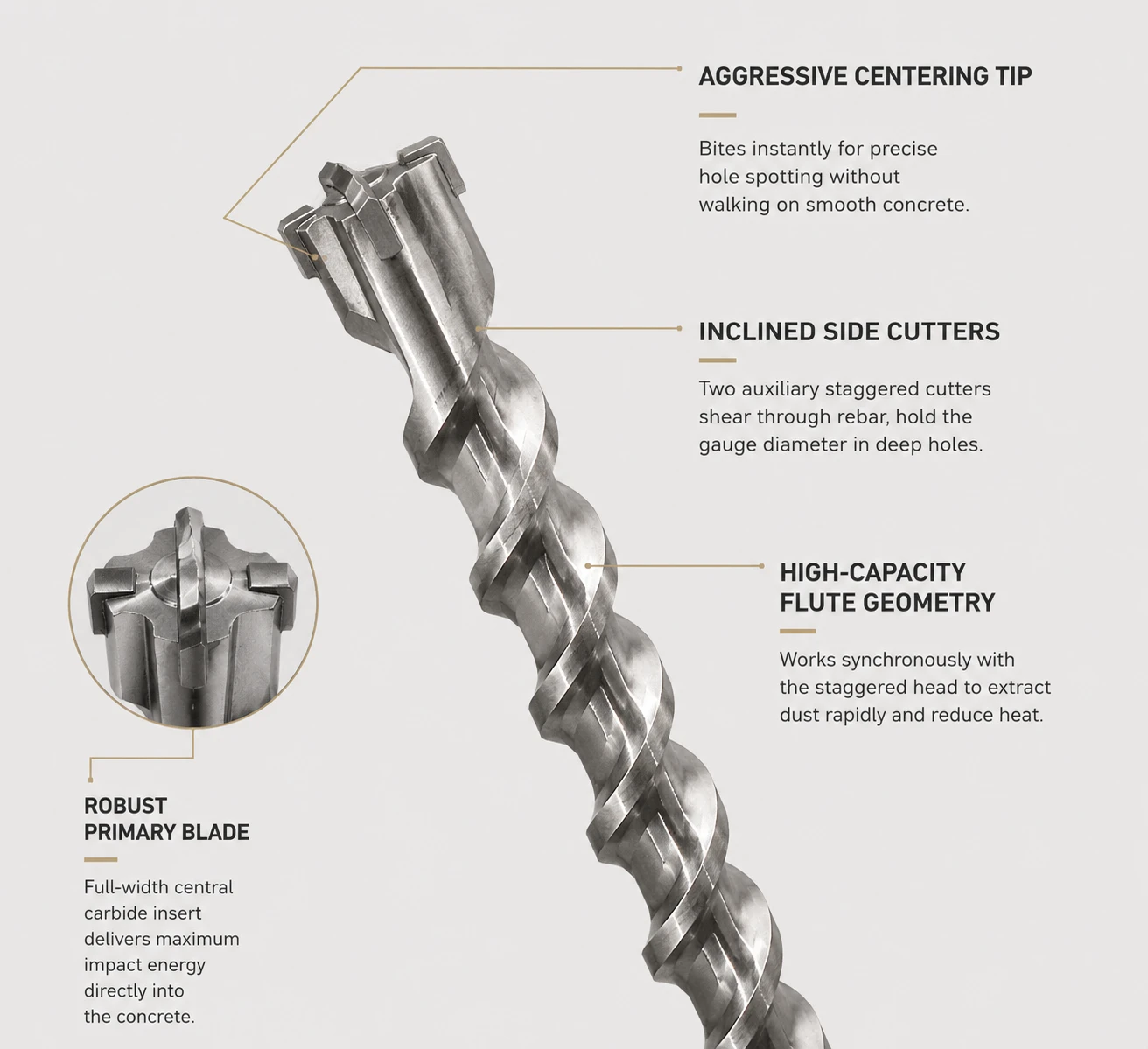
Cutting-head features
Full-width primary blade, centering point, inclined side inserts and flute geometry.
View full image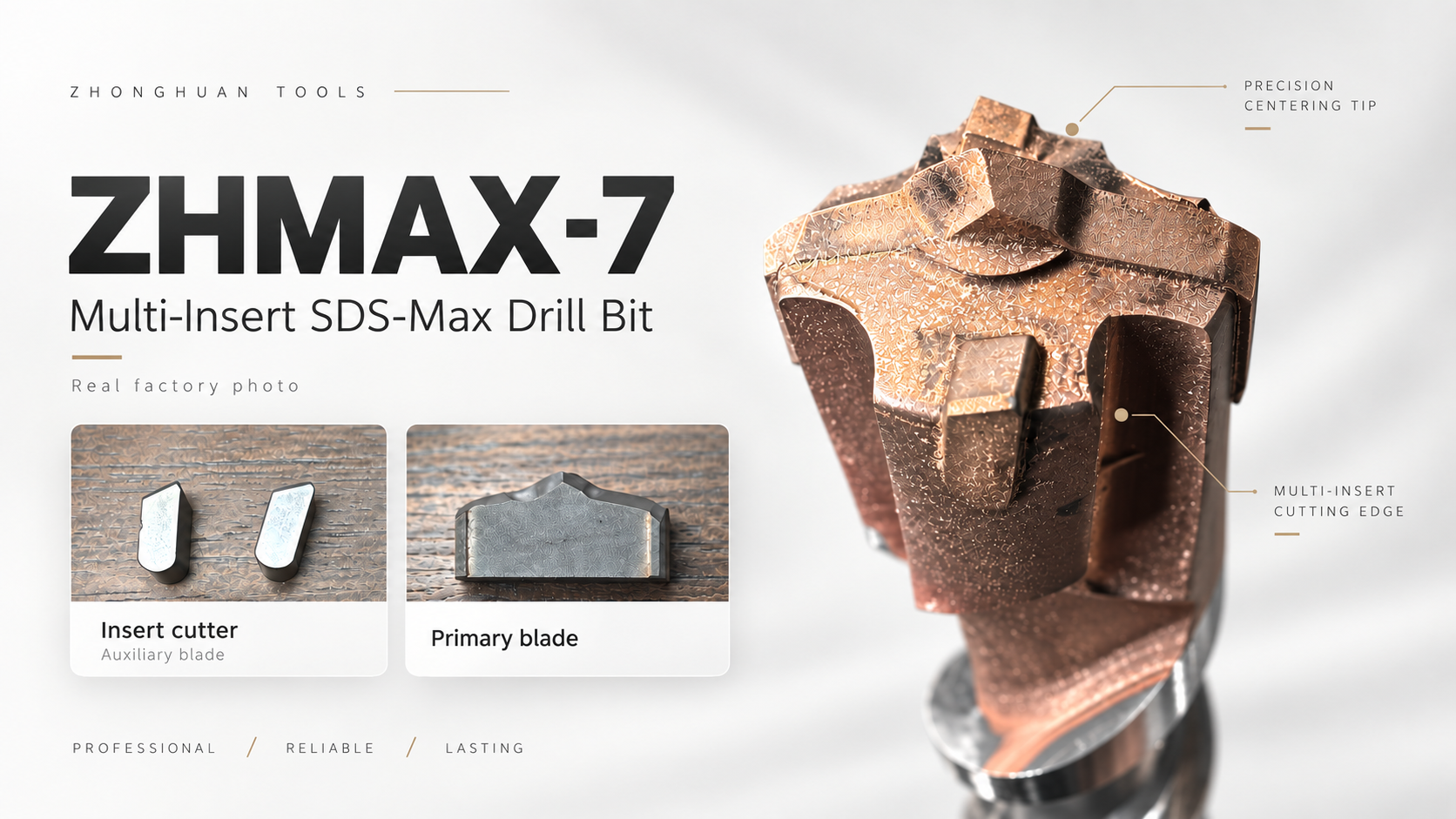
Product and separate carbide inserts
Our assembled ZHMAX-7 head alongside the primary carbide blade and two separate side inserts.
View full image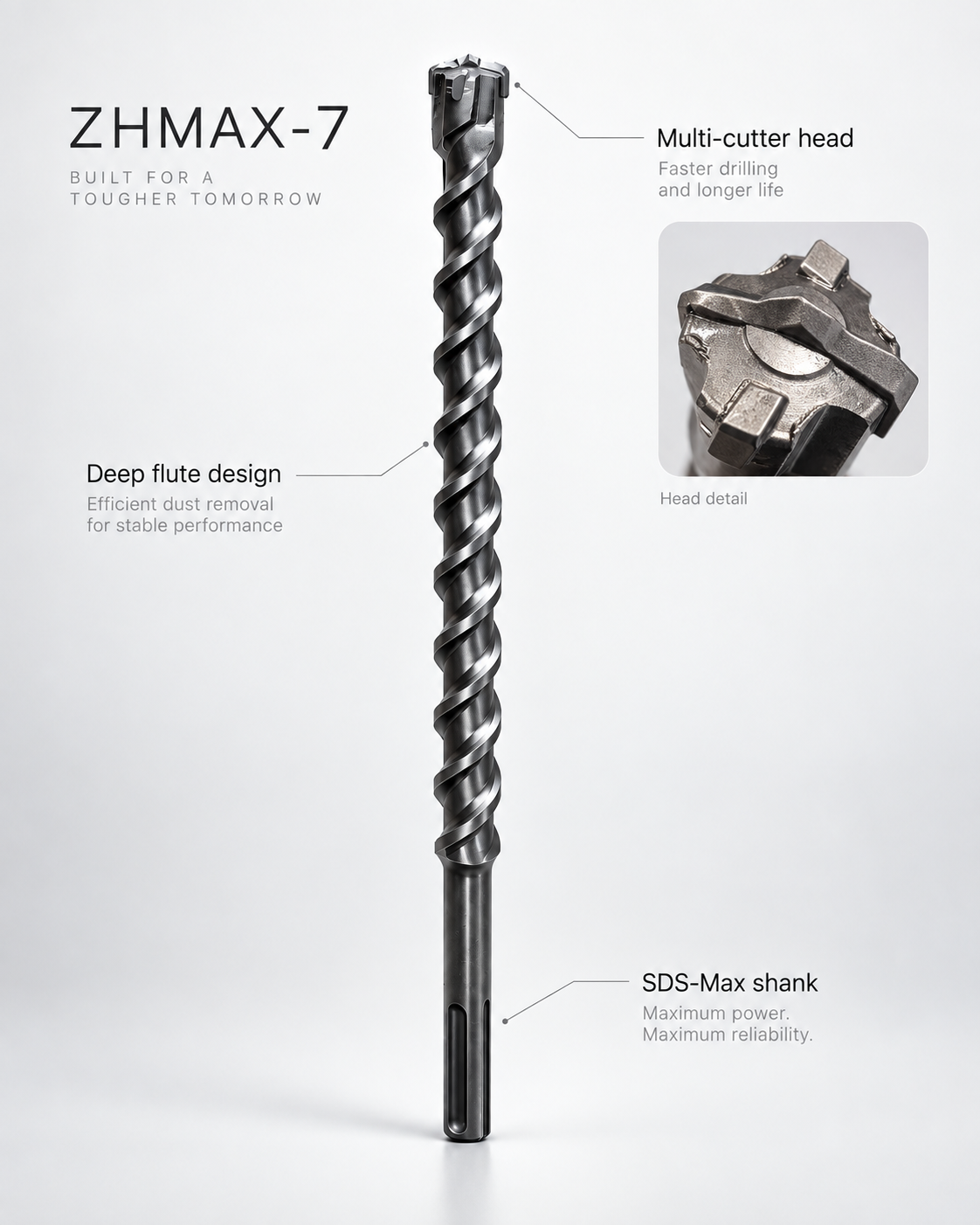
Finished drill after sandblasting
The finished SDS-Max drill with deep flutes, shank and cutting-head detail.
View full image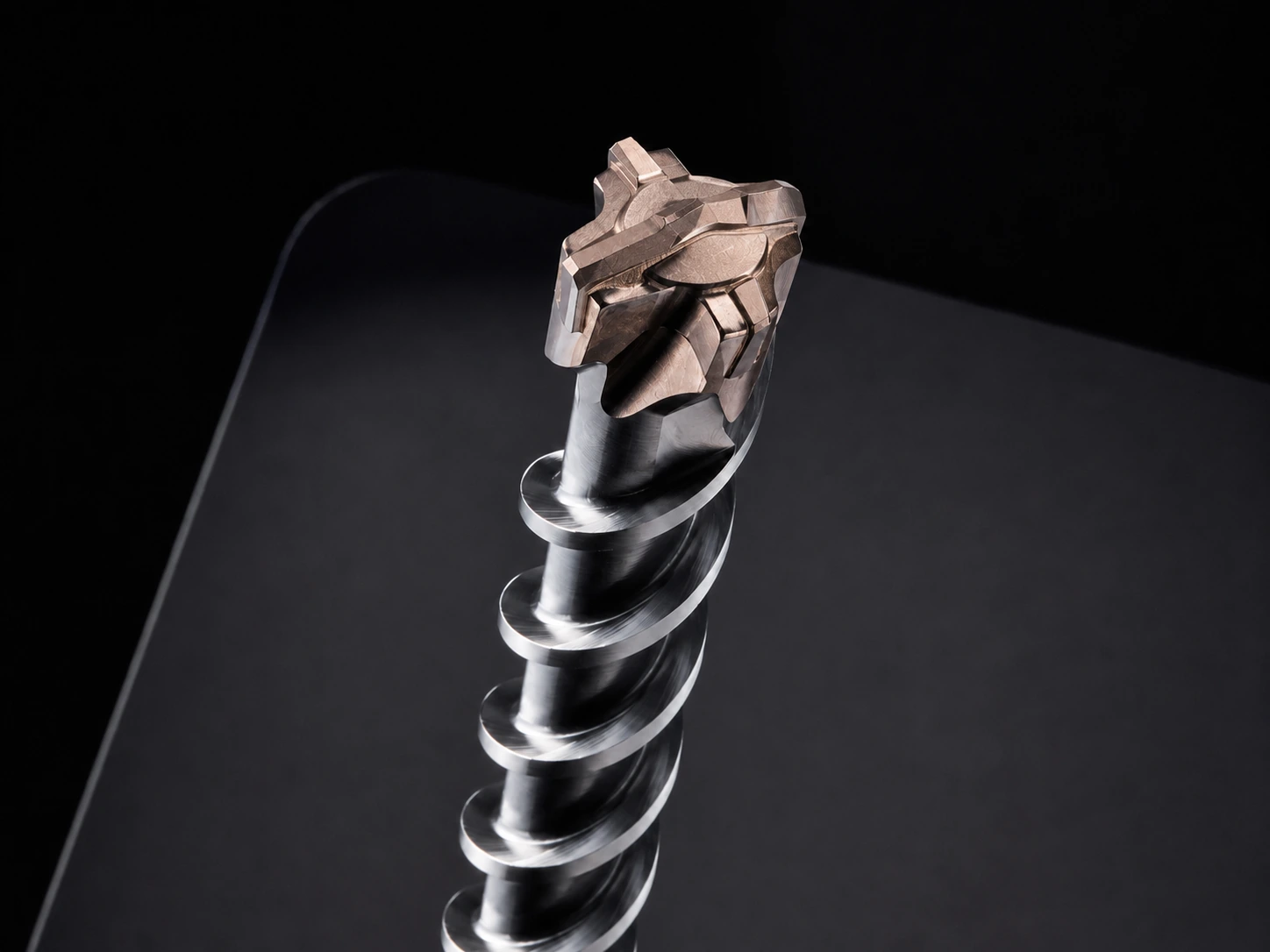
Multi-insert head close-up
A close view of the primary blade, axially set-back side inserts and open debris pockets.
View full imageSend your diameter, working length, overall length and quantity. We match the head specification and private-label packaging to your application.
Related Procurement Programs
If you are sourcing this product line for a distributor, importer, or private-label channel, these OEM and wholesale programs cover the procurement questions buyers usually ask next.
- SDS Drill Bits Manufacturer & Wholesale Supply for Distributors — OEM and wholesale SDS drill bit supply for importers, distributors, and tool brands: SDS-Plus, SDS-Max, carbide tips, 2-cutter and 4-cutter heads, packaging…
- SDS-Plus Drill Bits for Anchor Bolt Installation in Concrete — Precision SDS-Plus hammer drill bits for mechanical and chemical anchor holes in concrete and masonry.
- SDS Plus Drill Bit Sets Private Label & OEM Packaging — Private-label SDS Plus drill bit set program for retailers, importers, and online tool brands: mixed masonry bits, chisels, plastic cases, blister cards, color …


