
01
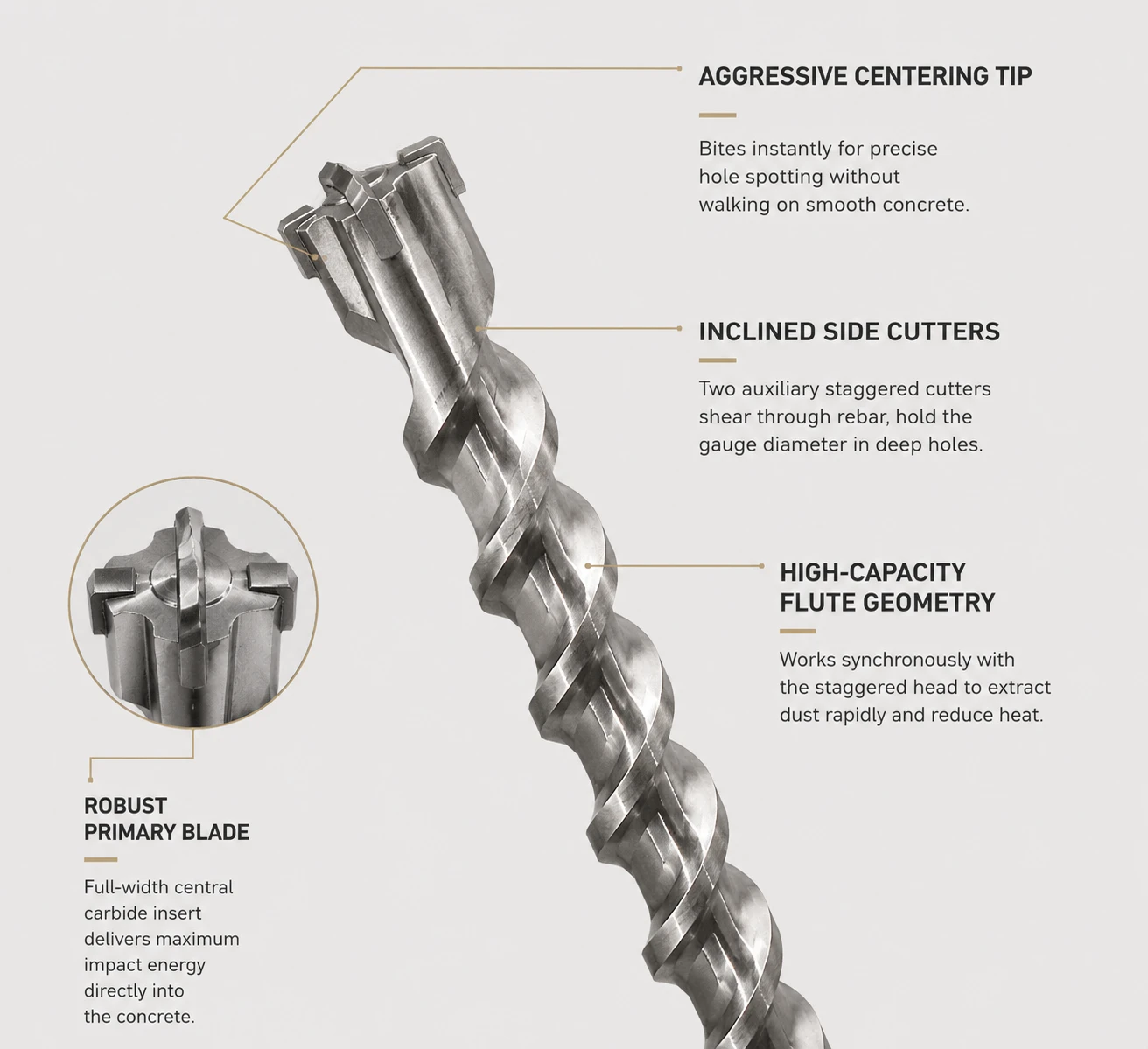
Dominant primary blade
One full-width YG11C plate forms the main two cutting edges and receives the first impact.
Highest drilling speed · longer life · more holes
Built for the highest drilling speed, longer working life than competing SDS-Max bits and more in-spec holes per bit. A full-width brazed carbide primary blade drives penetration; two inclined, axially set-back side inserts stabilize the bore and support gauge retention, while open head pockets feed debris directly into the flutes.
Highest drilling speed. Longer working life than competitors. More in-spec holes per bit.
Head architecture
ZHMAX-7 uses a dominant-primary-blade architecture: one full-width brazed carbide plate carries the main impact load, while two axially set-back side inserts sweep the gauge circle, stabilize the hole, and support peripheral cutting. Open head pockets between the three inserts feed drilling debris directly into the flutes, preserving the aggressive penetration character of a two-cutter while adding the roundness and gauge control of a four-cutter.
01
One full-width YG11C plate forms the main two cutting edges and receives the first impact.
02
Two independent inserts follow the primary blade and sweep the outer gauge circle.
03
The raised center geometry starts the hole and helps reduce walking during collaring.
04
The spaces between the inserts connect the cutting zone directly to the main flutes.
| Construction choice | What it does | Buyer-visible result |
|---|---|---|
| Full-width primary plate | Concentrates the main impact load | Aggressive penetration character |
| Two axially set-back side inserts | Cut and support the hole perimeter | Gauge retention and improved roundness |
| Separated insert pockets | Reduce the solid head area between cutters | More open entry for debris evacuation |
| Controlled-atmosphere mesh-belt brazed YG11C | Joins all three inserts in dedicated steel pockets | Premium tipped construction for high-impact duty |
Carbide geometry comparison
A conventional symmetric 4-cutter presents four equivalent cutting wings at substantially the same axial level. ZHMAX-7 uses three separate carbide components with deliberately unequal roles: the full-width primary plate creates the two leading diametrical edges, while two inclined side inserts sit axially behind it and follow around the gauge circle. The result is a staged 4-cutter architecture rather than four equal cutters engaging together.
| Geometry factor | Conventional symmetric 4-cutter | ZHMAX-7 staged multi-insert 4-cutter |
|---|---|---|
| Carbide construction | Four equivalent wings or edges in a cross/X arrangement | One full-width primary plate plus two independent side inserts |
| Axial engagement | Cutting edges are substantially coplanar and share contact | Primary edges lead; side inserts are deliberately set back |
| Cutting role | Four edges divide impact and guidance more evenly | Primary plate leads penetration; side inserts complete the gauge circle |
| Hole guidance | Symmetry supports roundness and steady running | Trailing outer inserts add peripheral support after the leading cut |
| Debris entry at the head | Head pockets depend on the cross-head support layout | Separated insert pockets leave direct openings into the flutes |
| Design character | A balanced four-edge cutting system | Two-cutter-like leading action with four-edge gauge support |
This is the defining logic of ZHMAX-7: the full-width primary blade leads, the inclined side inserts follow, and the four effective edges do not engage as one symmetric cross. The result combines direct two-edge penetration with added peripheral support, gauge control and open debris entry at the head.
Flute architecture
The Bosch Speed-X-style benchmark makes the open, deeply relieved flute the visual hero. That creates an immediate impression of maximum dust capacity, but an SDS-Max concrete bit is not a wood auger. Every extra section removed from the helix is steel no longer available in the core and lands to carry repeated impact and torsional load. Once the flute already has enough transport area for crushed concrete dust, more empty volume is not automatic proof of more drilling speed.
ZHMAX-7 takes the more balanced route: open head pockets give debris a direct exit from the cutting face, while a right-sized helix preserves a more substantial load-bearing body. The flute is still aggressive enough to move dust; it simply does not sacrifice core and land section for the sake of looking extreme.
| Design factor | Deep-flute benchmark | ZHMAX-7 balanced flute |
|---|---|---|
| Visual priority | Maximum open-channel appearance | Continuous head-to-body load path |
| Steel distribution | More aggressively relieved core and lands | More substantial core and helical land section |
| Dust strategy | Rely on maximum flute cavity | Open head pockets plus a right-sized transport channel |
| Engineering trade-off | Prioritizes void volume | Balances evacuation, impact transmission and torsional support |
| Design conclusion | Deeper looks more aggressive | Enough evacuation without making empty space the product |
Bosch can make a deep flute look powerful. That does not make maximum void the correct engineering target. ZHMAX-7 is designed around the complete load path—carbide engagement, impact transfer, torsional support and dust evacuation—not around the deepest-looking groove.
Engineering schematic
The axial height difference is intentional. The primary blade reaches the material first and carries the dominant impact load. The side inserts follow at the perimeter, while the open spaces between all three carbide pieces provide direct entry into the main flutes.
| Head element | Position in the cut | Engineering function |
|---|---|---|
| Full-width primary blade | First contact across the main diameter | Dominant penetration and direct impact transfer |
| Two set-back side inserts | Follow at the hole perimeter | Peripheral cutting, gauge retention and bore stability |
| Shared swept circle | All four effective edges reach the design diameter | Roundness and consistent hole size |
| Open head pockets | Between all three carbide inserts | Direct debris entry into the main flutes |
Current program
The configured program covers distributor and OEM requirements across deep structural drilling. Confirm the final head drawing and available size at RFQ.
| Head | One full-width primary plate + two set-back side inserts |
|---|---|
| Carbide | YG11C virgin tungsten carbide |
| Joining | Controlled-atmosphere mesh-belt brazed in three dedicated steel pockets |
| Interface | SDS-Max |
| Diameter | Ø16-45 mm, confirm by RFQ |
| Length | 320-920 mm, working and total length stated per SKU |
| OEM | Laser marking and private-label packaging |
ZHMAX-7 is not a dedicated structural-rebar cutting system. Confirm reinforcement location before drilling. Intentional reinforcement intersections require project approval and a validated cutting plan.
Send the diameter, working length, total length, machine and target material. We will return the size confirmation and sampling plan.