

Bosch SDS-Max R-Tec Sharp / PRO max-5C and PRO SDS plus-5C are two distinct flat-chisel configurations. They share a self-sharpening, ribbed design approach, but the connection, working dimensions and pictured head profiles differ. Start with the hammer you need to fit, then match the working end to the job.
SDS-Max and SDS-Plus: the comparison at a glance
| Specification | R-Tec Sharp / PRO max-5C | PRO plus-5C |
|---|---|---|
| Reference part number | 2608690124 | 2608690548 |
| Shank | SDS-Max | SDS-Plus |
| Edge width × overall length | 25 × 400 mm | 20 × 250 mm |
| Pictured working face | Long, near-parallel axial ribs and recesses | More flared, converging rib-and-groove profile |
| Machine fit | Matching SDS-Max holder | Matching SDS-Plus holder |
The dimensions are edge width × overall length. Both tools require a machine that supports chiselling with rotation stopped. The shanks are not directly interchangeable. The 5C designation does not identify a common shank size. Bosch max-5C · Bosch plus-5C
What actually differs in the working-end geometry?
In the supplied R-Tec Sharp reference, the working zone is elongated and its longitudinal ribs run relatively straight and parallel. The SDS-Plus reference has a more flared transition and a different distribution of ribs and recesses. Its reverse face shows two shorter raised features near the edge. These are observations of the pictured profiles; the enlarged views are not a dimensional drawing.
The Max reference combines a 25 mm edge with 400 mm overall length; the Plus reference combines a 20 mm edge with 250 mm length. Width changes the contact zone and reach changes handling. Compare them on their intended machine platforms and tasks, rather than assigning a speed advantage from appearance alone. Neither the 5C label nor the pictured ribs define a universal concrete-strength limit.
Read the model before comparing the name
| Reference product | Interface | Published size | Useful distinction |
|---|---|---|---|
| Bosch HS1470 Viper | SDS-Plus | 3/4 in × 10 in | Bulldog Xtreme flat chisel with additional breakout wedges |
| Bosch PRO SDS plus-5C, 2609390394 / 2608690548 | SDS-Plus | 20 × 250 mm | Self-sharpening ribbed flat chisel |
| Bosch PRO SDS max-5C, 2608690124 | SDS-Max | 25 × 400 mm | Ribbed flat chisel with RTec element; also documented as R-Tec Sharp |
The sizes are cutting width × overall length. HS1470’s imperial dimensions are approximately 19.05 × 254 mm; do not silently turn them into an exact 20 × 250 mm specification. Bosch HS1470 product family, Bosch plus-5C, Bosch max-5C
Bosch’s older catalogue identifies 2608690124 as R-Tec Sharp, while the current page lists the same part number as PRO SDS max-5C. That continuity helps buyers reconcile older packaging and current product names. Bosch accessory catalogue
Viper Teeth are additional working wedges
The supplied detail images show a long-ribbed face and another face with shorter raised features close to the edge. The manufacturer’s supplied Viper callout points near the leading region of the main product view. Read the complete head before assigning a feature name to one isolated protrusion. The cutting edge remains broadly straight; “teeth” does not establish a sawtooth or fork-shaped cutting line.
Bosch describes the HS1470 family as using additional wedges to increase breakout. Mechanically, local protrusions change where the material contacts the head as it enters. They can add fracture initiation and wedging action around the primary edge. A smaller contact can raise local stress for a comparable force, but this simple relationship does not predict a fixed removal-rate gain. Bosch Bulldog Xtreme hammer steel
The four detail photos below concern SDS-Plus 5C and HS1470 Viper. Their shared two-face arrangement should not be confused with the separate SDS-Max profile in the comparison image.


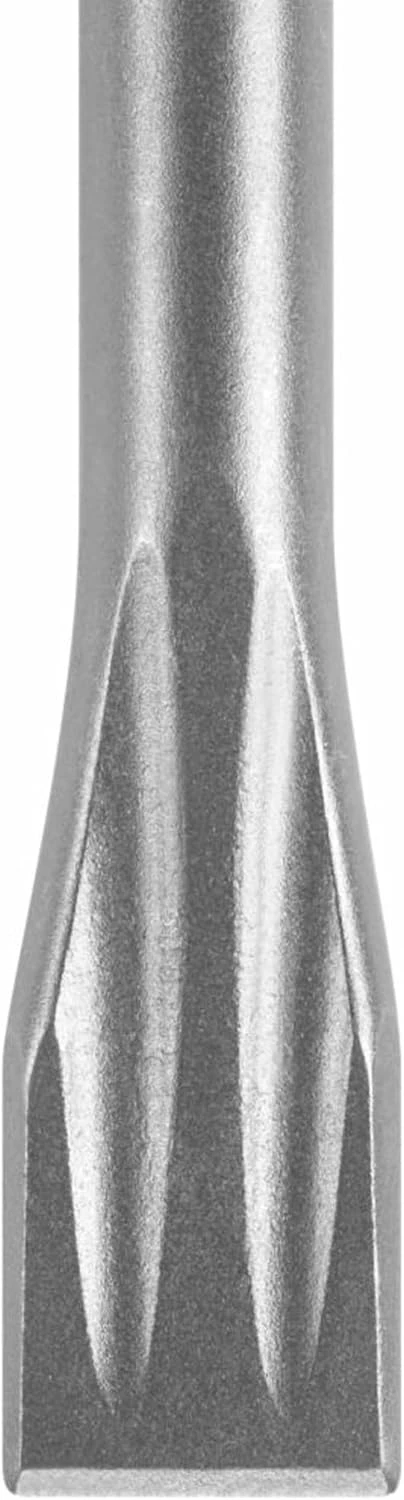
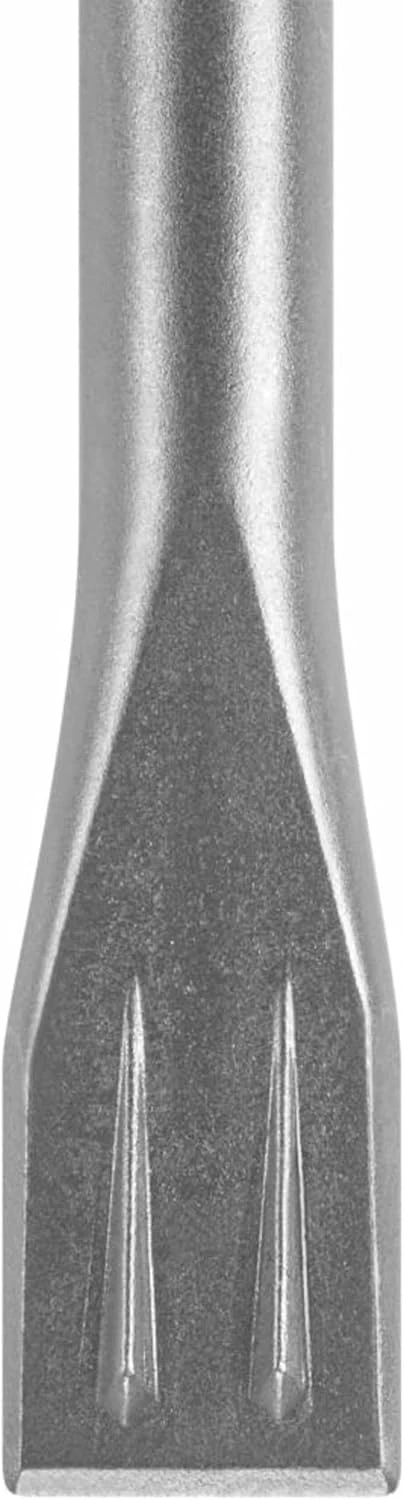
Reference photographs: each model has both faces. Images are for profile inspection, not a common dimensional scale.
PRO 5C is already a self-sharpening ribbed design
The current SDS-Plus 5C description includes self-sharpening geometry and ribs that promote lateral and vertical cracks. The SDS-Max 5C adds the RTec description. Therefore, “Viper versus 5C” is not a universal comparison between toothed premium geometry and a basic smooth flat chisel.
Compare both faces, the side profile, rib termination, edge width and remaining section. A different photograph or regional name alone does not establish a different performance level. A plain conventional flat chisel is a separate baseline. Bosch PRO SDS plus-5C, Bosch PRO SDS max-5C
Match the application and machine
For local concrete adjustment and channel edges, examine blade width, access and removal control. For sustained breaking, examine penetration, surrounding breakout and the time needed to free the tool. For tile or bonded surface layers, consider an appropriate angled tile chisel, spade or scraper.
SDS-Plus and SDS-Max require their matching holders. Use a supported chiselling mode with rotation stopped. A small Viper SDS-Plus chisel does not become a heavy structural-demolition tool because of its name, and no pictured profile establishes a universal concrete-strength threshold.
Where reinforcement interrupts the work, follow the project’s removal plan and use the appropriate tool for the steel. Select by the actual substrate, aggregate, machine duty and access.
Steel and heat treatment make a premium alternative repeatable
At Zhonghuan Tools, our premium chisel program uses 42CrMo chromium-molybdenum alloy steel. We match the working-end design, body section and treatment requirements to the intended hammer duty, then define the interface and acceptance criteria.
The useful Chinese supply-chain advantage is coordination: material, forming, treatment, dimensional finishing and OEM supply can be developed as one production specification. Buyers receive a direct path from sample feedback to a repeatable order, with the sizes and identification their range requires.
For a Viper-style or ribbed-flat project, agree the complete geometry rather than copying a silhouette. Review steel requirements, edge and transition dimensions, hardness measurement locations, shank fit and comparative sample results. We use Tier-1 products as application benchmarks and build the delivered tool around our own agreed material and process specification. Why we use 42CrMo
Make the comparison commercially useful
Use the same hammer, operating mode, material and working method. Record material removed, time spent freeing the tool, edge condition and total operator time. Keep each manufacturer’s numerical claim attached to its stated model and baseline; service life and removal rate are different measures.
An effective purchase decision is based on cost per accepted task, including consumable and labor costs. This connects head geometry to the contractor’s result and gives the distributor a defensible premium product position.
Frequently asked questions
Are SDS-Max max-5C and SDS-Plus plus-5C directly interchangeable?
No. Their shanks, nominal dimensions and intended holders differ. Select the chisel for the exact machine interface and a supported chiselling mode.
Is Viper always better than PRO 5C?
No universal ranking follows from those names. Compare the exact products and their complete profiles on the intended machine and material.
Are HS1470 and 2609390394 / 2608690548 the same specification?
They are separately identified Bosch SDS-Plus products with different published nominal dimensions. Confirm the drawing and order specification before treating them as interchangeable SKUs.
Is every 5C flat chisel an SDS-Max tool?
No. Bosch offers SDS-Plus and SDS-Max 5C flat chisels. The interface must match the machine.
Develop a high-quality alternative with our factory
Send products, sizes and quantities, the destination country and planned container type or size. Add a reference model or a photo when available. We will match the application and define a premium 42CrMo chisel specification for your program.


