

What Are We Comparing?
Bosch Bulldog Xtreme and Freud / Diablo Rebar Demon are useful premium references for distributors sourcing SDS-Plus concrete and reinforced-concrete drill bits. The supplied 3/8-inch images make the question practical: one head presents a compact, faceted shape, while the red Diablo head has a more pronounced cross outline.
That difference is worth examining, but the first comparison is construction. Both named programmes include full-carbide-head hammer bits. A cross outline does not turn a one-piece carbide head into a conventional slotted insert bit.
The Ohio Power Tool article dated 18 August 2020 provides the historical context for the photo comparison. Here we separate those reference images from current model listings, then translate the comparison into a professional OEM specification.
The hero illustrates head configurations. “Monobloc four-cutter,” “full-carbide head” and “cross-type” describe different properties and can apply to the same head; the labels are not mutually exclusive product tiers.
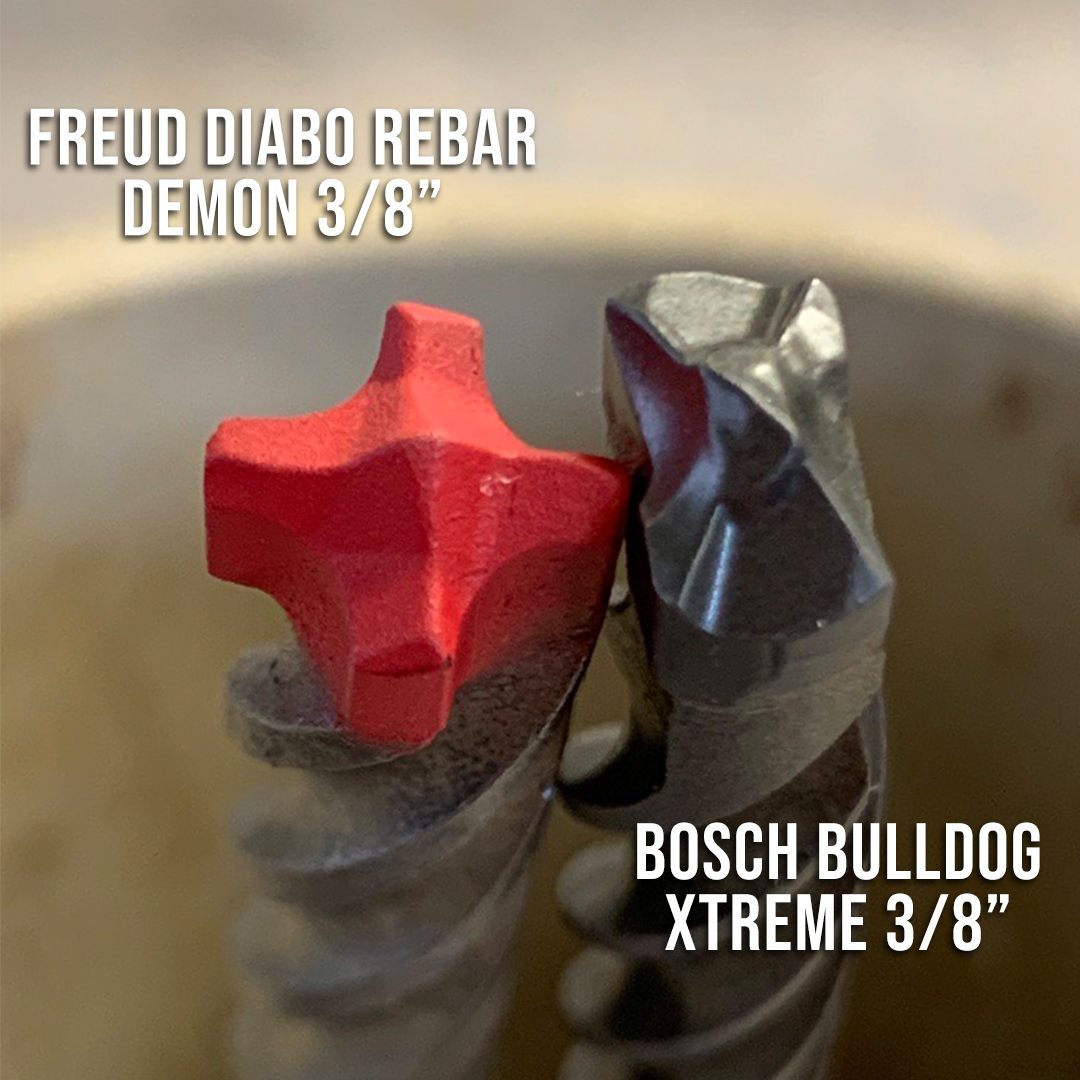
Labelled 3/8-Inch Head References
The supplied reference identifies the red tool as Freud / Diablo Rebar Demon and the silver tool as Bosch Bulldog Xtreme. Paint and visible outline identify the photograph, not a carbide grade or test result.
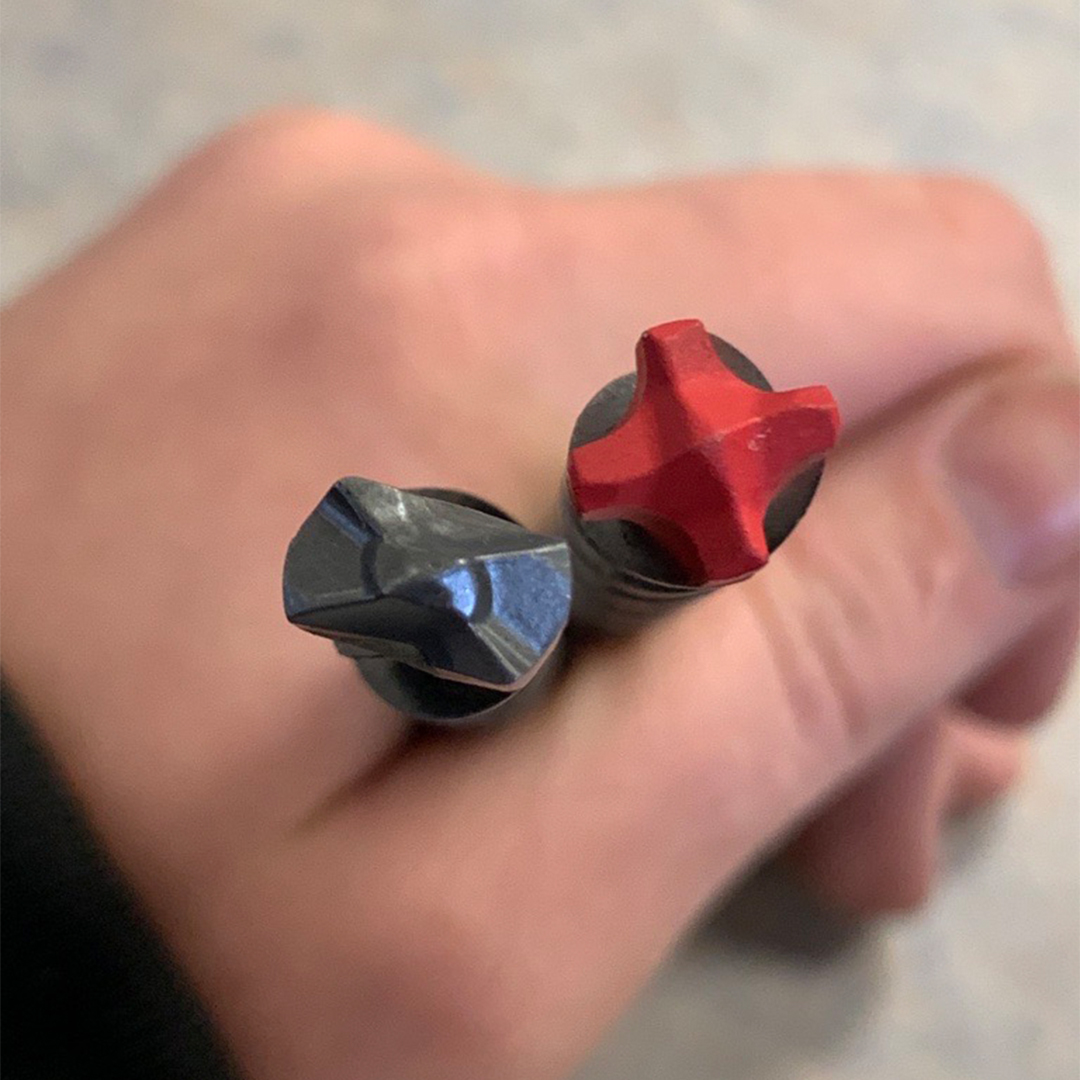
End Views: Compact Facets and a Cross Outline
Different centering, relief and outer-edge contours are visible. The view does not provide a common measurement scale for carbide volume or hidden joint geometry.
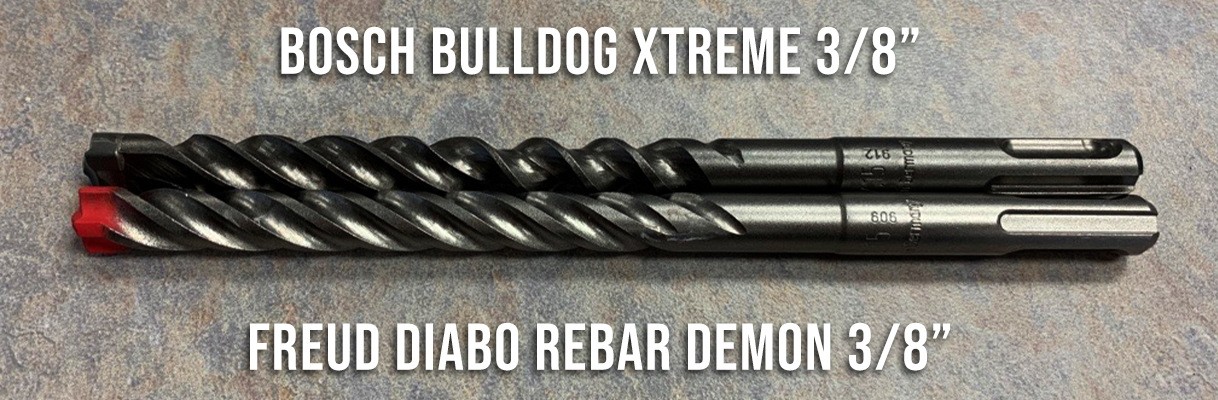
Complete Bits and SDS-Plus Connection Ends
The side-by-side view includes the body, flute and shank. Match actual diameter and lengths before treating similar overall appearance as the same specification.
Cutter Count and Full-Carbide Construction Are Different Fields
| Term | What it describes | What to specify separately |
|---|---|---|
| 2 / 3 / 4 / 6 / 8 cutters | The number and arrangement of active cutting edges | Carbide-component count, material, steel support and attachment |
| Full-carbide head | A carbide cutting head rather than separate cutting inserts in a steel tip | Head shape, grade and head-to-steel joint |
| Cross / X-type | The end-view edge layout | Whether it is one-piece carbide or a multi-insert assembly |
| Monobloc | One-piece cutting geometry in the product description | Actual carbide component and connection to the body |
A two-cutter can be a brazed plate or a full-carbide-head design. A four-cutter can use separate inserts, a carbide cross or an entire one-piece head. The number alone cannot rank drilling speed, hole shape or useful life.
The 2020 retail guide is helpful for choosing a tool around the job. Its half-inch discussion is not a universal engineering threshold: 1/2 in is 12.7 mm, and the right construction still depends on substrate, reinforcement, machine and hole requirements. Three- and six-edge geometries also have specific centering, support and impact-layout roles.
Carbide volume supplies material at the wearing edges. Useful life also depends on grade, grain/binder, supported section, the joint and the drilling cycle. Assess that wear reserve together with dust flow and machine fit rather than using size alone as a durability score.
Read the 3/8-Inch Head Geometry
| Visible field | Bulldog reference | Diablo reference | Buying implication |
|---|---|---|---|
| Head outline | Compact, faceted head with a prominent centre in the supplied image | More pronounced four-arm cross outline | Compare the actual cutting drawing, not the paint |
| Centering and relief | Visible point and ground faces | Raised centre and relieved cross faces | Check how the head starts and tracks the selected material |
| Outer gauge edges | Corners and peripheral cutting faces define the envelope | Four outer arm regions are visible | Measure fresh and worn cutting diameter and finished-hole geometry |
| Flute transition | Head-to-flute transition visible on the silver tool | Transition visible below the red head | Compare dust clearance on the complete bit at the same depth |
3/8 in converts exactly to 9.525 mm. It identifies nominal hole diameter, not the maximum rebar size. The pictured compact head must not be relabelled as a current two-cutter solely because its outline looks narrow. Use the documented product code and diameter.
Keep the Product Code and Generation in the Comparison
The following are official catalogue examples at 3/8 inch, not an identification of the exact SKUs in the historical photographs. Working length and overall length are separate fields.
| Official programme / example | Interface | Listed head construction | Working length | Overall length |
|---|---|---|---|---|
| Bosch Bulldog Xtreme · HCFC2061 | SDS-Plus | Four-cutter full-head carbide in the HCFC family description | 4 in / 101.6 mm | 6 in / 152.4 mm |
| Diablo Rebar Demon · DMAPL4140 | SDS-Plus | Four-cutter full-carbide head | 4 in / 101.6 mm | 6 in / 152.4 mm |
| Bosch Bulldog Xtreme8 · HC8C2061 | SDS-Plus | Separate eight-cutter carbide-head programme | 4 in / 101.6 mm | 6 in / 152.4 mm |
Bosch describes the HCFC family with full-head carbide, a centering tip, wear indication and a variable 4-2-2 flute. Diablo describes Rebar Demon as a four-cutter full-carbide programme and names Tri-Metal Fusion Welding for its connection. Those are product-specific descriptions.
Bosch’s separately listed Bulldog Xtreme8 uses HC8C model codes and is described as eight-cutter. A current Xtreme8 listing cannot silently replace the construction shown in a 2020 Bulldog Xtreme photo. Confirm the product generation before benchmarking.
Bosch HCFC · Bosch HC8C · Diablo DMAPL4140
Shared Group Context Does Not Establish an Identical Bit
Freud’s official company history states that it has been part of the Bosch Group since 2009. Bosch’s corporate brand portfolio also lists Diablo. This explains the group relationship, but does not establish that two drill-bit SKUs use identical head drawings, carbide, joints or production revisions.
For procurement, the model and its documentation decide the specification. If origin is part of the brief, confirm it for the selected SKU and shipment. Shared ownership or similar flutes alone does not identify the same production plant or prove that one bit is simply a differently coloured version of another.
Watch the Official Diablo Rebar Demon Demonstration
Watch the official video on YouTube
What Happens at Rebar and Packed Cuttings?
A full-carbide hammer bit for reinforced concrete follows the specified drilling mode of its exact model. The full head provides a different carbide-support arrangement from separate inserts, but it still needs the right machine, feed and debris clearance.
Packed concrete dust and steel fragments can slow progress at a bar even when the head is suitable. Follow the bit, machine and extraction instructions, clear the hole as required and check the edges if progress changes. A marketing name does not make the tool immune to heat, wear or grabbing.
Our dedicated crown rebar cutter is a different tool: drill the concrete pilot hole, switch off hammer action, cut steel in rotation only, then return to the concrete bit. Intentional reinforcement cuts follow the approved hole path. Do not transfer that crown-cutter mode to every full-carbide hammer bit.
Rebar Cutter / Full-Carbide Head
Compare the Completed Hole, Not Just the Purchase Price
| Buying situation | Main comparison | Useful decision |
|---|---|---|
| Plain concrete, brick or block | Start accuracy, completed-hole time and appropriate wear resistance | Select a professional two-cutter or another construction matched to the actual task |
| Repeated reinforced-concrete holes | Steel engagement, stalls, wear and valid holes per bit | Compare the selected full-carbide models on matched reinforcement crossings |
| Dimension-sensitive anchor holes | Nominal diameter, working reach, wear indication and hole cleaning | Use the exact anchor installation requirements and approved bit specification |
| Deep or battery-powered work | Dust packing, flute clearance, battery condition and time per completed hole | Compare the complete head/body/machine setup |
Neither “4X” nor “7X” is a universal comparison between these two brands. A life multiplier belongs to the manufacturer’s named reference and test basis; it does not become a Zhonghuan result or an automatic ratio between Bulldog Xtreme and Rebar Demon.
For an engineering comparison, use matched diameter and working length, the same machine, concrete batch, aggregate, reinforcement and extraction. Alternate the order and record completed-hole time, stalls, fresh/worn gauge and valid holes before the agreed replacement point. Compare tool consumption plus drilling and changeover labour.
Turn the Brand Reference into a Zhonghuan OEM Programme
At Zhonghuan, we translate these premium references into a head-specific OEM programme. Our SDS-Plus offer includes professional self-centering two-cutters, brazed four-cutter crosses and three- or four-cutter full-carbide heads, with selected one-piece heads joined to steel through our resistance-friction-welding route.
Specify the carbide head and steel support separately from edge count. We coordinate head geometry, carbide and body material, joining, nominal gauge, working and overall lengths, batch inspection and private-label marking. This keeps the benchmark in the engineering brief while the customer builds a distinct professional range under their own brand.
Start with application, diameter × working length and quantity. A machine model or reference product helps us confirm the configuration, packaging and lead time.
Request a Zhonghuan Full-Carbide OEM Quotation
Product and Historical References
- Ohio Power Tool · 2020 comparison
- Bosch Bulldog Xtreme · HCFC family
- Bosch Bulldog Xtreme8 · HC8C family
- Diablo Rebar Demon · DMAPL4140
- Freud company history
- Bosch brand portfolio
Frequently Asked Questions
Are Bulldog Xtreme and Rebar Demon just different colours of the same bit?
Shared group context does not establish identical SKUs. Compare the exact head drawing, diameter, working and overall lengths, flute, joint and product generation.
Does a red cross head mean a conventional brazed insert?
No. Cross describes an edge layout. Diablo Rebar Demon is described as a four-cutter full-carbide-head programme.
Is the compact Bosch head necessarily a two-cutter?
Not from the image alone. The current HCFC Bulldog Xtreme family is described by Bosch as four-cutter full-head carbide; the separate HC8C Xtreme8 family is eight-cutter. Confirm the code and generation.
Does 3/8 inch mean the tool cuts only 3/8-inch rebar?
No. 3/8 inch is the nominal hole diameter, equal to 9.525 mm. Rebar diameter, crossing and reinforcement arrangement are separate application conditions.
Should I switch off hammer action at rebar?
Follow the exact tool instructions. A reinforced-concrete hammer bit uses its specified mode; our dedicated crown cutter requires rotation only with hammer off.
Does full-carbide always beat every insert-head bit?
Choose by substrate, machine, hole geometry and completed-hole cost. Head construction matters, but grade, support, joining, flute and operating conditions belong in the comparison.
What should an OEM buyer send?
Application, diameter × working length and quantity, with a machine model or benchmark when available. We confirm head construction, materials, joining, dimensions, marking, packaging and lead time.


