

A rebar cutter and a full-carbide head drill bit solve the same interruption—steel inside the hole—with different cutting architectures and working sequences. For contractors and distributors, the useful comparison is how each tool completes the job.
This guide compares a rotation-only carbide-tooth crown cutter with a full-carbide head hammer drill bit rated for reinforced concrete. We supply both SDS-Plus constructions, so the choice starts with reinforcement contact, the machine and the required hole.
The Comparison at a Glance
| Selection point | Rotation-only rebar cutter | Full-carbide head hammer drill bit |
|---|---|---|
| Main duty | Dedicated cutting through embedded reinforcing steel | Drilling reinforced concrete, including reinforcement contact |
| Cutting head | Hollow steel crown with brazed carbide teeth | One-piece solid-carbide cutting head joined to a steel body |
| Concrete drilling | Use a separate concrete bit before and after the steel | The rated bit drills concrete and steel in the same hole |
| Mode in this comparison | Rotation only; hammer action off | Rotation plus hammer, as specified for the selected bit |
| Tool changes | Concrete bit → cutter → concrete bit | One bit through the specified drilling cycle |
| Typical range role | Companion cutter for crews already using concrete bits | Core drilling range for repeated reinforced-concrete work |
| Debris handling | Clear steel chips and the cut slug by the model instructions | Clear drilling debris by the bit and machine instructions |
| Machine check | SDS-Plus fit, rotation-only mode and suitable capacity | SDS-Plus fit and suitable hammer-drilling capacity |
Different Cutting-Head Architectures
A crown rebar cutter uses sharp carbide teeth around a hollow steel head. The teeth cut steel and the crown provides space for chips and the separated slug. It works as a dedicated steel-cutting tool within an existing hole. Hilti's SDS-Plus carbide rebar cutter explicitly specifies rebar duty and rotation-only operation.
A full-carbide head bit carries a solid-carbide cutting head on a fluted steel body. The head is designed for the specified reinforced-concrete hammer-drilling duty. Bosch EXPERT SDS plus-7X is an established example of a four-cutter full-carbide head for reinforced concrete.
Four-cutter and full-carbide describe different things: one is the edge arrangement, the other the head construction. Confirm both when comparing products.
In this SDS concrete-drilling context, “solid” refers to the cutting head. The drill body and SDS shank are steel; the entire drill bit is not made from solid carbide.
Operating Mode Follows the Exact Tool
For our carbide-tooth crown cutter, switch hammer action off. Its operating mode is rotation only. The full-carbide reinforced-concrete bit uses its specified hammer-drilling mode.
A shared SDS-Plus connection does not make operating instructions interchangeable. Check the exact model's mode, usable length and machine capacity. Cutting reinforcement follows the project's approved drilling and reinforcement-cutting plan.
When to Choose a Dedicated Rebar Cutter
A dedicated cutter fits a crew that already drills concrete with a separate bit and needs a controlled route past encountered steel. The cutter becomes a companion tool, changed into the pilot hole for the steel stage.
Specify the matching nominal hole diameter, usable cutting reach, chip/slug clearance and a machine with rotation-only mode. Where a concrete bit has stopped at reinforcement, this planned changeover gives the crew a steel-cutting tool for that stage of the job.
When to Choose a Full-Carbide Head Bit
A rated full-carbide bit fits repeated reinforced-concrete drilling where changing tools at each steel encounter interrupts the working cycle. It drills concrete and the encountered reinforcement with the same bit in the specified operating mode.
Confirm head geometry, head-to-body joining, diameter, working length and machine duty. Bar diameter, steel position and the surrounding concrete all influence the cut; hole-diameter coverage alone does not define every reinforcement condition.
Two Drilling Workflows
Rotation-only crown route: drill the concrete pilot hole → stop at steel → fit the same nominal-diameter cutter and switch hammer action off → cut the steel → return to the concrete bit and finish the hole.
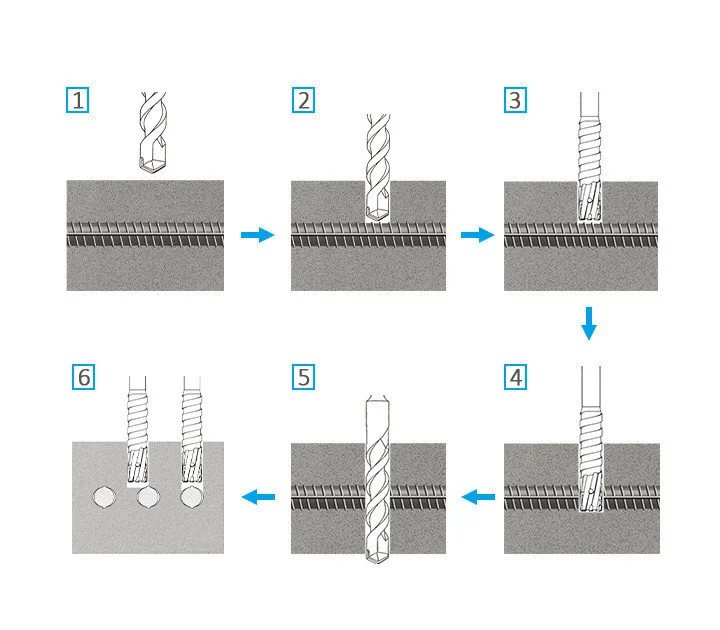
Full-carbide head route: start with the rated reinforced-concrete bit → drill through concrete and reinforcement in its specified mode → finish to the required depth. Follow the tool's feed and debris-clearance instructions, and inspect it if cutting behavior changes.
For anchor work, finish with the hole-cleaning procedure required by the selected anchor system. Cutting through steel does not replace hole cleaning.
Compare the Complete Hole, Not Just Tool Price
A cutter adds changeover and steel-stage clearing to a concrete-bit workflow. A full-carbide bit can reduce those changes in repeated reinforced-concrete work. Neither description alone establishes a universal speed or life advantage.
Compare tool consumption, drilling time, tool changes, clearing and the number of usable holes on the actual job. For distributors, organize the range by workflow: concrete bits paired with dedicated cutters, or a full-carbide drilling range with companion cutters where the selected job requires them.
Our Two SDS-Plus Lines
Our Rebar Cutters & Full-Carbide Rebar Bits range includes rotation-only carbide-tooth crown cutters in Ø12–32 mm and a separate full-carbide head drilling line in Ø6–25 mm. These are current hole-diameter ranges, not maximum reinforcing-bar sizes.
The crown line uses brazed carbide teeth. Our full-carbide line uses a one-piece carbide head joined to the steel body by resistance friction welding (RFW). Choose the complete construction and machine fit, then confirm working and overall lengths separately.
Frequently Asked Questions
Can a rebar cutter drill the whole concrete hole?
A dedicated rotation-only crown cutter is for the steel stage. Drill the concrete first, cut the approved reinforcement, then return to the concrete bit. Use a full-carbide reinforced-concrete hammer bit for the specified one-bit workflow.
Can I use hammer mode with a rebar cutter?
Our carbide-tooth crown cutter requires rotation only with hammer action off. Other products must follow their exact model instructions; the SDS-Plus shank alone does not establish the operating mode.
Is every four-cutter bit a full-carbide head bit?
No. Four-cutter describes cutting-edge arrangement. A bit can have brazed carbide inserts or a one-piece full-carbide head; check the head construction as well as the cutting-edge count.
What does “solid carbide head” mean?
In this SDS concrete-drilling context, “solid” refers to the cutting head. The drill body and SDS shank are steel; the entire drill bit is not made from solid carbide.
Does a full-carbide head pass every rebar size?
Select the specific bit for the hole, reinforcement and machine. The advertised hole-diameter range is not a universal maximum bar diameter or a guarantee for every steel intersection.
Should a distributor stock both constructions?
Both can fit one professional range: full-carbide bits for the reinforced-concrete drilling workflow and dedicated crown cutters for the steel-cutting changeover workflow. Match the size mix to customer jobs.
Order the Right Construction
Send hole diameters, rotary hammer model and quantities. We confirm the suitable construction, working and overall lengths, packaging and delivery. Rebar cutters are supplied against normal purchase orders; there is no separate sample service.
View our rebar cutter OEM program or request an order quotation.


