

Where Twister Plus 110 Fits
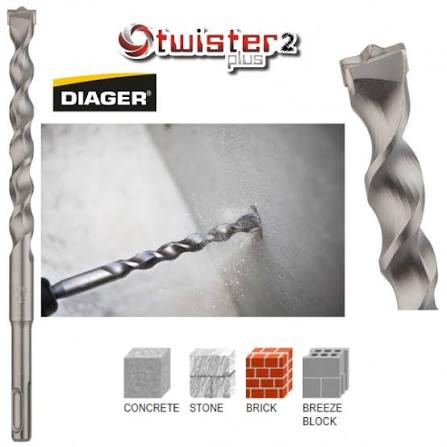
Diager Twister Plus 110 is built around a practical professional-drilling combination: a carbide concrete-breaker tip for penetration, a Z-line centre for starting the hole, and a variable helix for carrying dust away. Diager positions the range for fast drilling in concrete and other building materials.
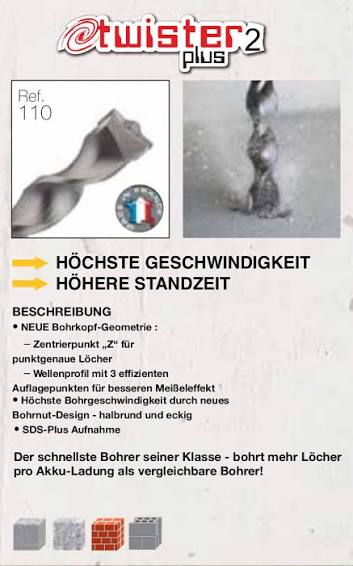
The Twister 2 Plus name also appears on product literature and packaging. Diager lists the family as Twister Plus reference 110. The original tip, helix and packaging views below show the construction and dimensions relevant to purchasing.
Two Cutting Edges and a Z-Line Centring Tip
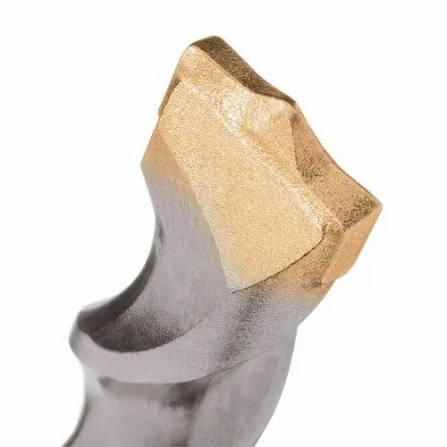
A two-cutter head has two main cutting edges across the carbide tip. The centre and cutting profile make a meaningful difference to how that head starts and breaks the material. On Twister Plus, Diager calls these features the concrete-breaker tip and the “Z” line centring tip.
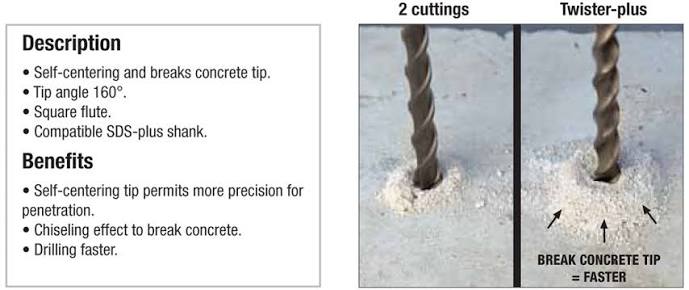
The centre concentrates the initial contact so the bit can establish the hole position. The surrounding carbide edges break the concrete under the hammer action. When comparing samples, examine the centre-point profile, the supported carbide section, the cutting edges and the transition into the flutes at the same nominal diameter.
The English overview labels three contact points on the carbide tip. These describe the tip’s contact geometry; Twister Plus 110 is classified by its two cutting edges.
TRI-ZONES: Three Jobs Along the Helix
Read the supplied TRI-ZONES diagram from the carbide head towards the shank. Diager gives the three regions different tasks along the debris path:
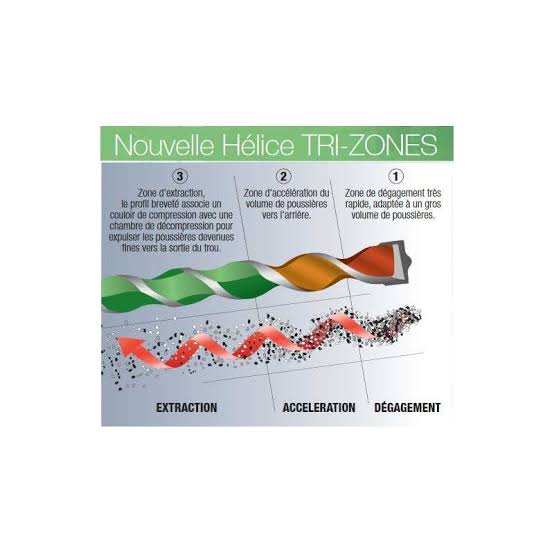
| Zone in the original diagram | Position / role | What it contributes |
|---|---|---|
| 1 — Clearance | Immediately behind the cutting head | Space to clear a high volume of broken material from the cutting face |
| 2 — Acceleration | Following transport region | Moves drilling dust towards the rear of the bit |
| 3 — Extraction | Rearward part of the illustrated helix | The maker describes a compression/decompression profile that helps carry fine dust towards the hole exit |
“Three zones” describes the helix along the bit. It is separate from the two cutting edges at the tip. For an OEM sample, compare groove depth, pitch, core section and the transitions between regions together; these determine whether the head and flute work as a complete drilling system.
Match the Bit to the Concrete and the Hammer
Diager lists concrete, stone, brick and breeze block for Twister Plus. Its catalogue illustrates the SDS-Plus platform with rotary hammers below 5 kg; use the hammer manufacturer’s permitted diameter range to select the actual machine. For hollow or fragile masonry, choose the drilling mode and feed to suit the material and the anchor instructions.
For routine concrete and masonry holes, the two-cutter combines straightforward starting geometry with an open dust path. Where repeated rebar contact dominates the job, compare a head intended for reinforced concrete, such as Diager RockFaster, and review the planned bar intersections before drilling.
| Drilling task | Selection focus |
|---|---|
| Routine concrete / masonry holes | Accurate starting, completed-hole time, dust clearance and worn hole diameter |
| Deep holes | Available working length, straightness, flute transport and the hammer’s capacity |
| Frequent reinforcement encounters | A reinforced-concrete head architecture and the project’s approved drilling method |
Diameter, Overall Length and Working Length
The reference table on the official product page covers Ø4–30 mm, with selected overall lengths from 110 to 1000 mm. These are the family’s endpoints, not every possible diameter/length pairing.
On the page, L totale means overall length and L utile means working length. For example, 110D06L0260 is Ø6 mm, 260 mm overall and 200 mm working length; 110D08L1000 is Ø8 mm, 1000 mm overall and 940 mm working length. Read all three fields from the selected SKU.
| Item code | D (mm) | Overall length (mm) | Working length (mm) |
|---|---|---|---|
| 110D04L0110 | 4 | 110 | 50 |
| 110D05.5L0160 | 5.5 | 160 | 100 |
| 110D06L0260 | 6 | 260 | 200 |
| 110D06.5L0210 | 6.5 | 210 | 150 |
| 110D08L0410 | 8 | 410 | 350 |
| 110D08L1000 | 8 | 1000 | 940 |
| 110D10L0610 | 10 | 610 | 550 |
| 110D12L0310 | 12 | 310 | 250 |
| 110D16L0460 | 16 | 460 | 400 |
| 110D25L1000 | 25 | 1000 | 940 |
| 110D30L0460 | 30 | 460 | 400 |
Selected references from Diager’s official table. Use the exact item code when ordering or comparing samples. Diager Twister Plus 110.
Single Bits, Bulk Packs and Mixed Sets
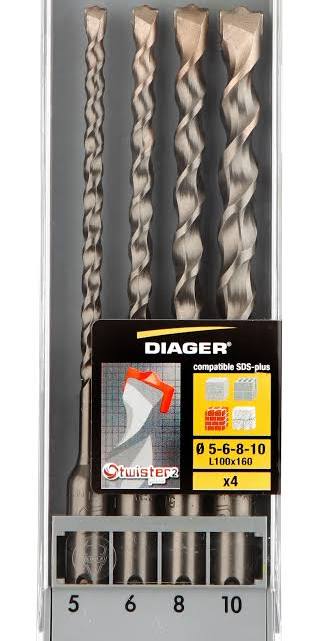
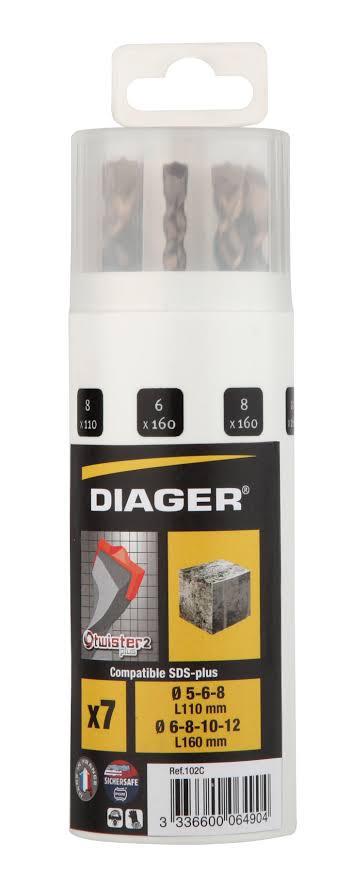
The pictured 100C four-piece set contains Ø5, 6, 8 and 10 mm bits, all 160 mm overall. The 102C seven-piece set combines Ø5, 6 and 8 mm at 110 mm overall with Ø6, 8, 10 and 12 mm at 160 mm overall. The repeated diameters have different reaches.
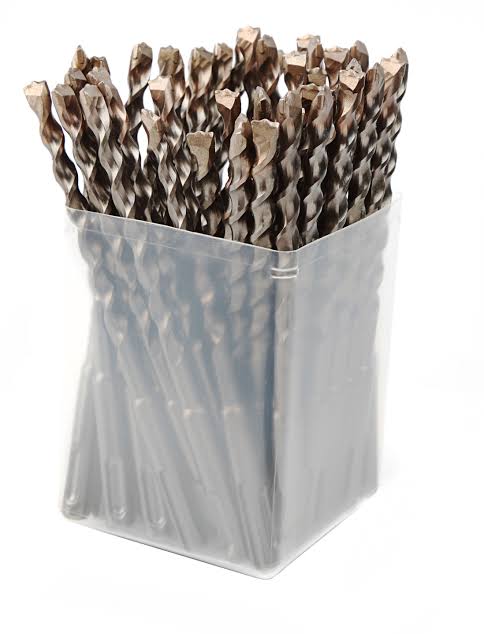
Choose a mixed set for a contractor’s working assortment, and single-SKU or bulk packs for replenishing heavily used sizes. Keep set reference, quantity, diameter and length mix distinct in a distributor’s stock list.
Developing a Zhonghuan OEM 2-Cutter Range
At Zhonghuan, we manufacture self-centring two-cutter SDS drill bits for distributors and tool brands. We coordinate the carbide tip, steel support, brazed joint and dust-transport geometry around the intended drilling task. Your approved drawing and sample define the supplied construction.
Proposed configuration A: a self-centring two-cutter SDS-Plus range for routine concrete and masonry, with the size mix and packaging selected for your market. Proposed configuration B: an application-tuned range for abrasive stone or deeper holes, with carbide, flute transitions and sample-drilling criteria confirmed by our engineering team.
Send the required diameters and working lengths, hammer model, target material and quantity. We can confirm the sample plan, marking, packaging and quotation. See our self-centring 2-cutter OEM programme for the manufacturing route.
Discuss a 2-cutter SDS-Plus OEM range
Frequently Asked Questions
Is Diager Twister Plus a two-cutter or a three-cutter?
Twister Plus reference 110 is a two-cutter SDS-Plus family. TRI-ZONES refers to three regions of the helix, not three cutting edges.
What does the Z-line centring tip do?
It is the shaped centre of the carbide tip used to establish the hole position during the start. Diager combines it with a concrete-breaker cutting profile.
What does 110D06L0260 mean?
The official table identifies it as a 6 mm bit with 260 mm overall length and 200 mm working length. Confirm the full SKU rather than treating all printed lengths as drilling depth.
Which sizes are in the 100C and 102C sets?
100C has Ø5, 6, 8 and 10 mm at 160 mm overall. 102C has Ø5, 6 and 8 mm at 110 mm overall, plus Ø6, 8, 10 and 12 mm at 160 mm overall.
How should we compare an OEM two-cutter sample?
Use the same substrate, hammer, diameter and hole depth. Compare starting accuracy, completed-hole time, debris clearance, edge condition and finished-hole dimensions after a defined drilling interval.
Official Sources
- Diager — Twister Plus 110 features and size table
- Diager 2026 French catalogue — current Twister Plus range
- Diager English catalogue — original TRI-ZONES diagram
- Diager — 100C four-piece set
- Diager — 102C seven-piece set
References checked on 26 October 2026. Packaging imagery is retained in its original language; use the selected article number for the order.


