

Two factory-direct SDS programs for two different jobs
Do not force one head architecture across every application. Build the range around the material, machine class and hole requirement: IZ for fast SDS-Plus work without planned rebar contact, and ZHMAX-7 for high-load SDS-Max drilling.
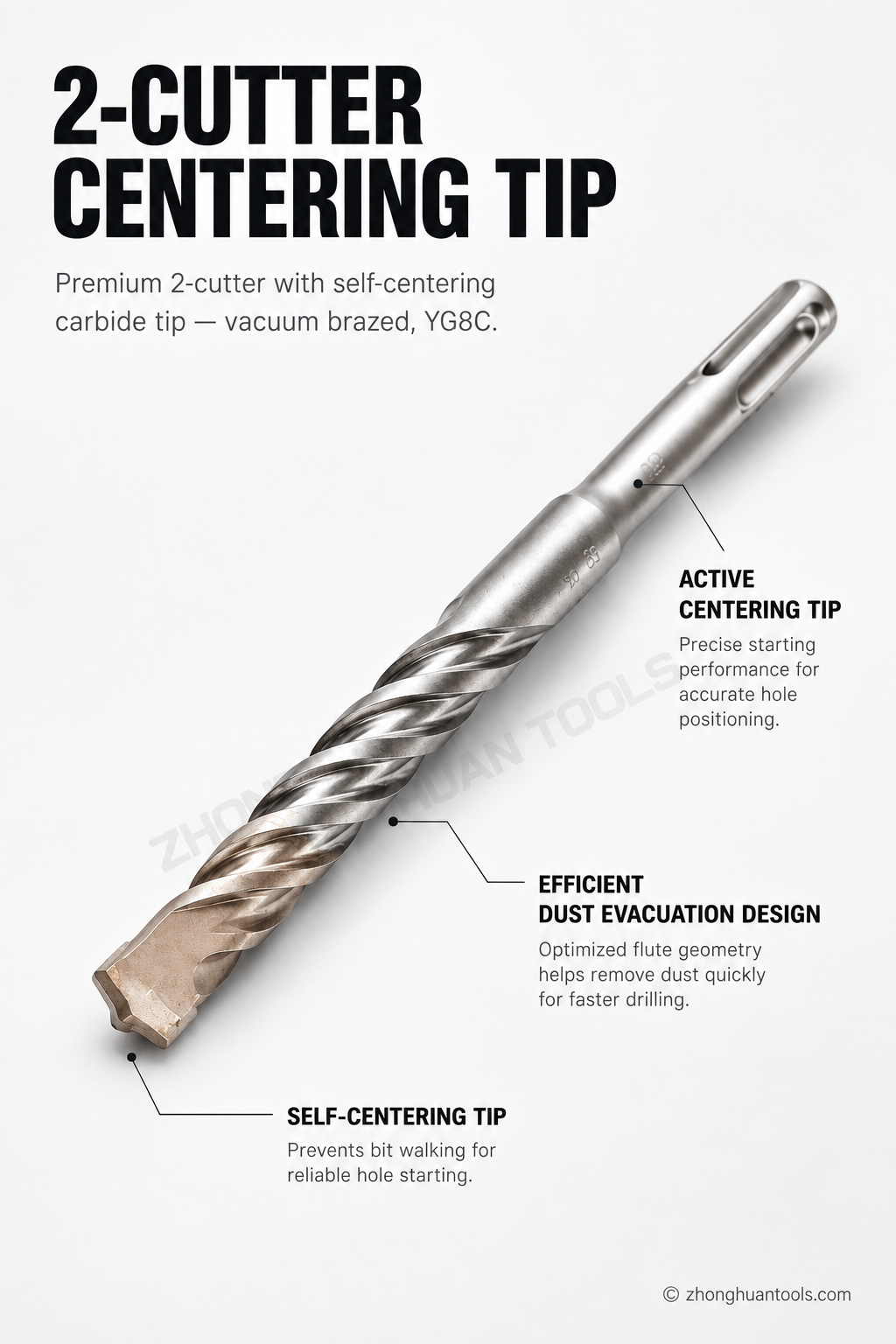
2-Cutter IZ SDS-Plus Drill Bit
The self-centering IZ tip bites on the mark for accurate hole starting, while the open flute carries dust away quickly. It is the fast, commercially strong choice for plain concrete, brick, block and masonry where reinforcement is not expected.
- Self-centering 2-cutter IZ carbide geometry
- YG8C carbide, controlled-atmosphere brazed
- Ø5–16 mm · 110–400 mm
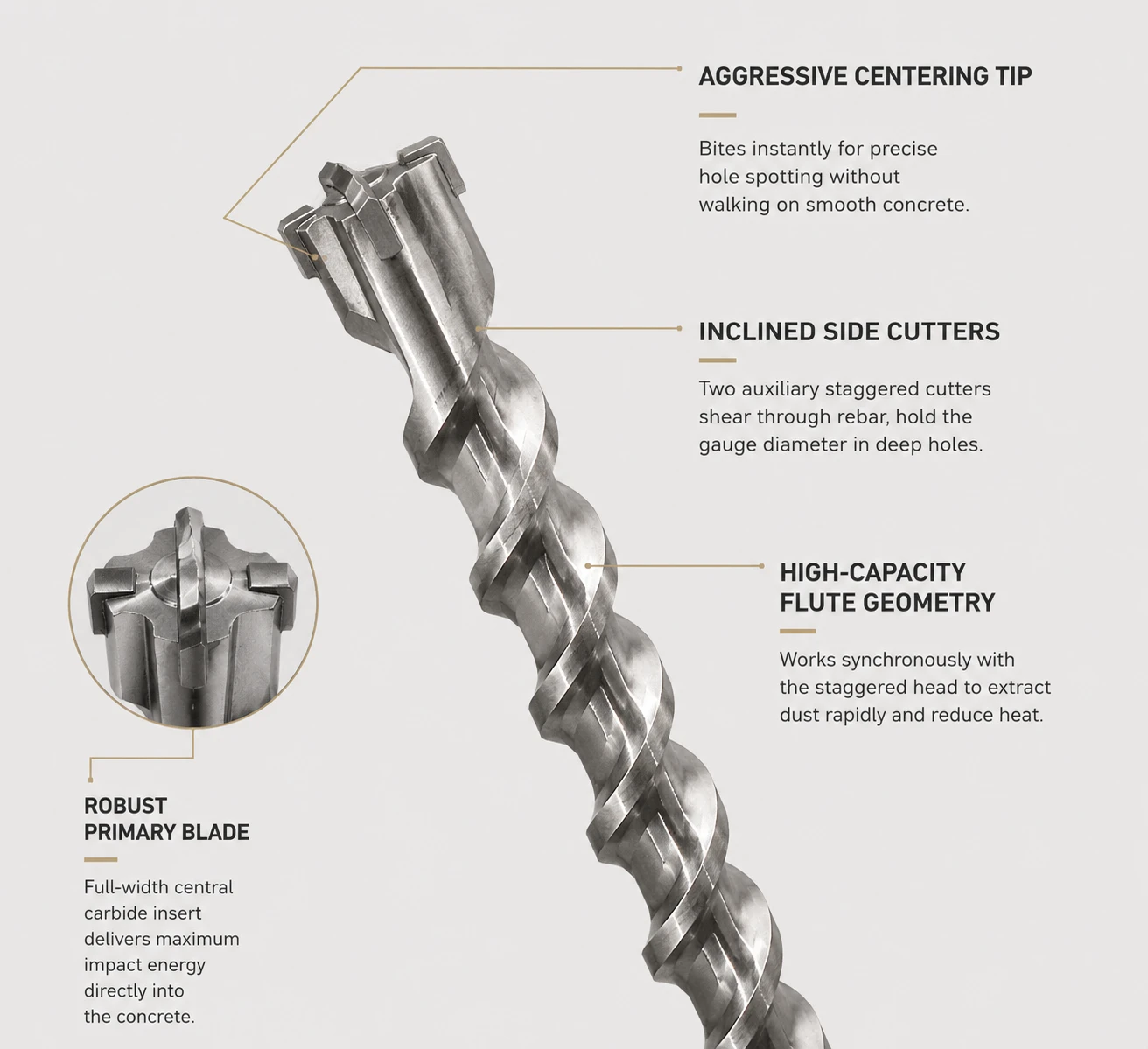
ZHMAX-7 Multi-Insert 4-Cutter SDS-Max Drill Bit
A full-width primary carbide blade delivers the main impact, while two inclined, axially set-back side inserts support stable cutting and gauge retention. Specify ZHMAX-7 for heavy reinforced concrete and deep structural holes where penetration, head stability and debris removal drive the buying decision.
- One full-width primary blade plus two side inserts
- YG11C carbide, controlled-atmosphere brazed
- Ø16–45 mm · 320–920 mm
The best SDS drill bits come from manufacturers using premium tungsten carbide (YG11C or K20-K30 grade), 40Cr or 42CrMo4 alloy steel bodies, controlled-atmosphere brazed carbide-to-body joints, and DIN 8035 shank tolerance. At the brand layer, the leaders are Bosch, Hilti, Milwaukee, DeWalt, and Diablo; at the production layer, the leaders are major Chinese OEM factories that already supply those brands. The right answer for your purchase depends on whether you are buying for a single job, a project, or two years of repeat OEM volume — this article breaks the answer down by application, brand benchmark, and factory specification.
What Makes an SDS Drill Bit Truly the Best?
The useful answer depends on who is asking. A contractor buying one pack at a local dealer wants a different answer from a distributor building a private-label SDS range for two years of repeat orders.
If the job is anchor installation in reinforced concrete, premium lines from Hilti, Bosch, Milwaukee and Diablo deserve serious attention. If the job is general brick, block and light concrete, a strong mainstream 2-cutter or standard 4-cutter line may be the more rational buy. If the buyer is an importer or tool brand, the question changes again: the best SDS drill bit is the one whose specification, test method, packaging and cost structure fit the channel.
That is why the question should not stop at who makes the best SDS drill bits. A procurement team should ask: best for which material, which hole diameter, which machine class, which anchor requirement, which failure risk, and which landed-cost target?
Brand Names vs Factory Specifications: Which Wins for B2B Buyers?
Brand-name SDS bits buy more than steel and carbide. They buy a known quality ceiling, packaging confidence, user familiarity, published performance language, and a lower perceived risk for contractors. That matters. A Hilti or Bosch bit can be the easier decision on a jobsite because the crew already trusts the name.
Factory-direct SDS sourcing solves a different problem. It gives importers and distributors a way to build a controlled line around their own market position. Instead of paying for the brand system, they specify the working variables: carbide grade, cutter geometry, body steel, brazing or welding method, dimensional tolerance, packaging and batch inspection. The risk moves from brand selection to specification control.
The mistake is comparing a premium retail bit and an OEM bit only by unit price. That comparison is usually meaningless. A price is only comparable when the diameter, working length, head design, carbide grade, body steel, joining process, inspection standard, packaging, order quantity and Incoterm are comparable.
Which SDS Drill Bit Is Best for Each Application?
| Use case | Best practical choice | What to specify or benchmark |
|---|---|---|
| Anchor holes in reinforced concrete | Premium 4-cutter or full-head SDS-Plus | PGM or anchor-oriented dimensional control, wear mark, round holes, strong rebar behavior |
| Rebar-heavy drilling | Full-carbide or solid-head 4-cutter design | Tougher carbide, stable head-to-body joint, geometry that reduces lock-up |
| Brick, block and light concrete | Good 2-cutter or standard 4-cutter SDS-Plus | Cost per hole, dust removal, shank fit, basic carbide consistency |
| Large or deep holes | SDS-Max with tougher body and carbide grade | 18 mm shank fit, YG11C-level toughness, heat treatment records, brazing strength |
| Private-label distributor range | Two-tier OEM program | Value 2-cutter line plus professional 4-cutter line with clear packaging separation |
This split is more useful than a universal ranking. A product that is best for rebar-heavy work may be overpriced for daily plug holes. A product that is perfect for a retail value line may create complaints in professional anchor work.
What Are the Leading SDS Drill Bit Brands Actually Selling?
The leading SDS brands are useful benchmarks because they show what the market rewards at different price levels.
| Brand line | Procurement meaning | When to benchmark it |
|---|---|---|
| Bosch EXPERT SDS plus-7X | Premium full-carbide-head story, reinforced-concrete focus, strong European benchmark | When you need a high-end all-round SDS-Plus reference for rebar and professional installers |
| Hilti TE-CX / TE-YX | System confidence, anchor workflow, jobsite accountability, premium technical support | When failed holes, documentation and installer assurance matter more than bit unit price |
| Milwaukee MX4 | Strong value-premium case: 4-cutter geometry, rebar guards, standards language, broad trade appeal | When buyers want premium architecture without the full Hilti-style system premium |
| Diablo Rebar Demon | Rebar-specific shelf story, full-carbide design language, aggressive performance positioning | When the sales message is reinforced concrete, heat, vibration and rebar strikes |
| DeWalt SDS lines | Distribution strength, mainstream contractor familiarity, but line selection matters | Compare Elite/full-head carbide lines for premium work; do not force older 2-cutter lines into a premium rebar comparison |
The brand lesson is not that OEM factories should claim to be Bosch or Hilti. The lesson is that serious buyers can see what the premium market values: carbide volume, head geometry, reliable joining, anchor-oriented dimensional control, wear indicators and visible quality promises.
Zhonghuan benchmarks this top tier directly. The three premium lines built on a one-piece solid carbide head — Bosch EXPERT 7X, Milwaukee MX4 and Diablo Rebar Demon — sit in the same construction class as our own full solid-carbide head, joined to the body by resistance friction-welding: a welded head with no brazed joint to crack under rebar impact, supplied factory-direct. We do not claim to be those brands; we match the head class they sell on and quote it as an OEM or private-label line.
Why a Full Carbide Head Beats a Brazed Tip
The reason this head class commands a premium is structural. A standard hammer bit silver- or copper-brazes carbide plates into machined slots in the steel tip; under rebar impact and the heat it generates, that brazed joint is the first thing to fail — the plate shears loose or the brazing alloy softens (silver braze loses strength from roughly 600 °C). A full carbide head takes the joint out of the cutting zone: the whole head is one solid piece of sintered carbide, welded to the steel shank behind the edges, so there is no brazed seam inside the head to crack when you strike steel.
That one change drives the benefits the premium brands advertise:
- No weak joint under impact. Bosch calls the EXPERT 7X head a single piece of the toughest metal that presents no weakness on impact; Diablo markets its Rebar Demon weld as keeping the full carbide head intact under extreme impact. Same principle — nothing brazed to shear off when the bit hits rebar.
- More carbide, more life. The whole head is wear material, not a thin plate, so it survives far more rebar contact before it dulls. The brands claim 3–7× the life of a standard 2-cutter and 'up to 2× more carbide' — treat those as their figures, but the direction is real.
- Heat tolerance. With no braze alloy in the cutting zone to soften, the head shrugs off rebar-strike heat better than a brazed tip can.
- 4-cutter, no jamming. The solid head is ground into a 4-cutter cross that takes smaller bites of rebar and self-clears, instead of catching and snapping the way a 2-cutter does.
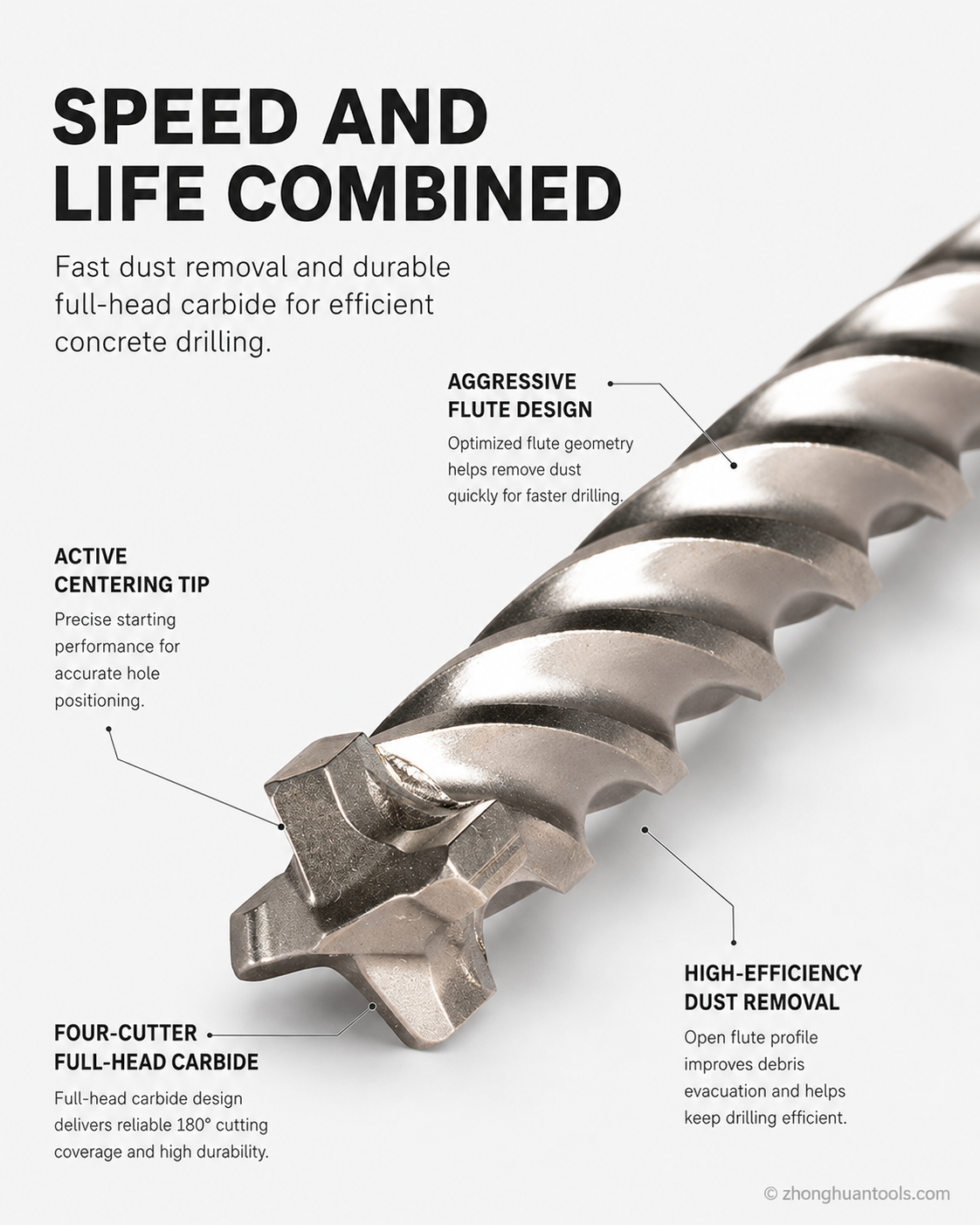
Zhonghuan builds the head the same way — one piece of carbide in our YG8C full-carbide-head grade, resistance friction-welded to a hardened body — so a distributor can carry the full-carbide-head tier without the brand markup. We do not borrow the trademarked weld names or the headline multipliers; we make the head on the same principle and let the buyer's own rebar test settle it.
What Specifications Actually Determine SDS Drill Bit Quality?
From a factory and RFQ perspective, five variables decide whether an SDS drill bit is a serious product or a low-price lookalike.
- Carbide grade: YG8C-level carbide is a common professional baseline for concrete. Higher toughness grades such as YG11C become more relevant for larger SDS-Max diameters and rebar-heavy work.
- Head geometry: 2-cutter, 4-cutter, multi-segment 4-cutter and full-carbide head designs do not fail the same way. Buyers should specify the geometry instead of asking for a vague premium bit.
- Joining method: brazing, controlled-atmosphere brazing, friction welding, resistance friction welding and mechanical interlock designs have different risk profiles. Ask what process is used and what test record can prove it.
- Body steel and heat treatment: 40Cr or 42CrMo body steel with controlled hardness is not the same product as plain carbon steel with a similar surface finish.
- Dimensional control: anchor holes care about actual drilled diameter, runout and wear state. That is why PGM or comparable hole-accuracy testing matters more than a brochure claim.
For more detail on the engineering side, read the full-carbide head welding comparison and the SDS-Plus and SDS-Max buying guide. Those two topics explain why two bits that look similar can have very different cost-per-hole results.
When Should Buyers Choose OEM Over Brand?
OEM sourcing makes sense when the buyer controls the channel and can define the specification. Typical examples include hardware distributors, construction-tool importers, buying groups, private-label brands and online tool sellers that want a stable SDS family instead of a one-off spot purchase.
The best OEM opportunities are not usually the absolute cheapest products. They are the middle and upper-middle tiers where a distributor can specify honest carbide, consistent geometry, suitable packaging and batch QC while still keeping enough margin to support the channel.
OEM sourcing is weaker when the buyer needs brand trust more than product economics. If the contractor account is tied to a specified anchor system, if the job requires named-brand documentation, or if the volume is too fragmented to control production batches, a premium brand may still be the better procurement decision.
Spec-parity OEM sourcing inquiries welcome
Zhonghuan Tools manufactures SDS-Plus and SDS-Max drill bits for distributor and private-label programs. For useful pricing, send the diameter range, working length, head type, carbide target, packaging format, order quantity, inspection requirement and Incoterm. We quote against comparable supply conditions, not isolated unit-price screenshots.
How Should You Write an RFQ for SDS Drill Bits?
Before comparing prices, send the supplier a complete RFQ. At minimum, include:
- System: SDS-Plus or SDS-Max.
- Size range: diameter, working length and overall length.
- Application: masonry, plain concrete, reinforced concrete, anchor holes, deep holes or demolition support.
- Head type: 2-cutter, 4-cutter, multi-segment 4-cutter or full-carbide head.
- Material target: carbide grade, body steel and heat-treatment expectation.
- Process expectation: brazing, controlled-atmosphere brazing, welding method or documented supplier standard.
- Quality evidence: sample test method, hardness record, runout check, brazing or joint test, and batch traceability.
- Commercial terms: MOQ by SKU, packaging, private-label artwork, shipment quantity, Incoterm and target delivery date.
This is also the fairest way to handle price comparison. If another supplier quotes a lower number, ask whether it is for the same carbide, same body steel, same head type, same packaging, same inspection record and same delivery term. If not, it is not the same product.
Conclusion: Buy the Result, Not Just the Name
Bosch, Hilti, Milwaukee, Diablo and DeWalt all make credible SDS drill bits, but each brand is strong for different reasons. Hilti sells system assurance. Bosch and Milwaukee sell strong premium SDS architecture with broad market trust. Diablo sells an aggressive rebar story. DeWalt sells distribution strength and, in selected lines, premium full-head carbide options.
For OEM and private-label buyers, the best SDS drill bit is not defined by a logo. It is defined by whether the specification produces the hole quality, bit life, packaging fit and repeat-order consistency your channel needs. Start with the application, then specify the product, then compare price. That order prevents most bad SDS sourcing decisions.


