

The Verdict: The Reputation Is Real, the Generalisation Is Wrong
The low end of Chinese SDS supply has a product problem that importers recognise immediately: undersized carbide, uneven joints, poor dust clearance and cartons that perform differently from the approved sample. When those shortcuts reach a jobsite, the importer pays for replacement bits, complaints and interrupted work. The factory ships the saving; the distributor inherits the bill.
Zhonghuan serves the professional side of this market. Our product range starts with the application and the head construction, from engineered two-cutter geometries to multi-insert and full-carbide-head systems. Buyers should be able to see what they are paying for and order that same specification again.
Our blunt conclusion: bottom-tier Chinese SDS bits deserve criticism. Treating every Chinese bit as the same product hides both the factories that make the problem and the buyers who keep specifying it.
What the Reviews Actually Say
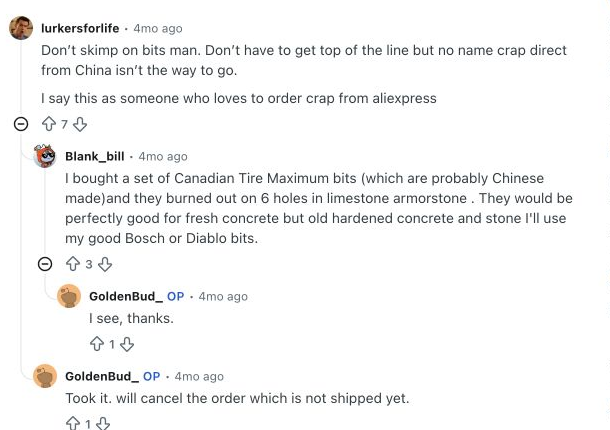
In a public r/Tools discussion about an AliExpress LAVIE set, the original poster had not tested the bits. A commenter warned against no-name product direct from China. A second commenter reported that a Canadian Tire Maximum set - described only as probably Chinese-made - burned out after six holes in limestone armorstone. The buyer then cancelled the unshipped order. This is not a laboratory comparison, but it is powerful voice-of-customer evidence: China origin alone was enough to stop a sale.
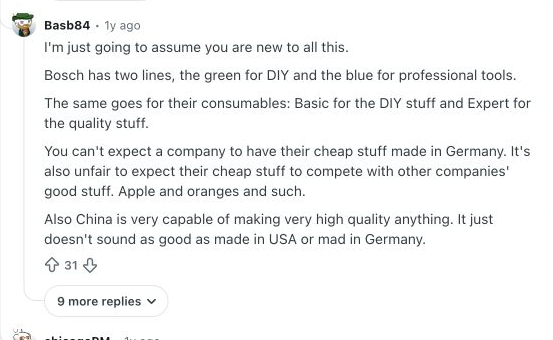
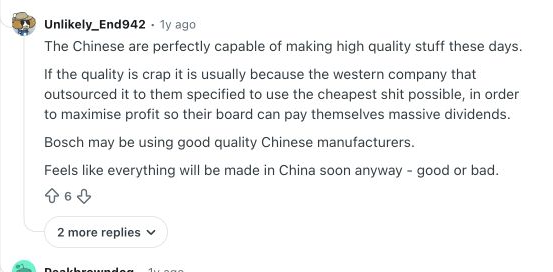
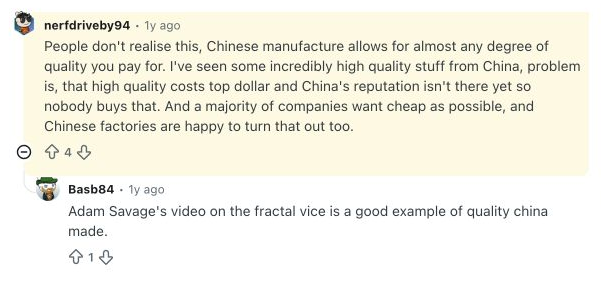
Another r/Tools thread starts with a sweeping claim that China-made masonry bits are garbage. The highest-value replies do two things: they distinguish Basic and Expert product tiers, and they say China can make very high quality product. That is the correct procurement frame. Comparing a low-tier SKU with a premium 7X/full-head product and then attributing the result only to country is an apples-to-oranges test.
Field Evidence: What Stable Drilling Looks Like
The DP1-I7 shown here uses Zhonghuan's I7 2-cutter geometry, not the ordinary flat 2-cutter commonly sold as a generic market construction. One profiled carbide tip forms two primary cutting edges and a centering point. Those two edges carry the impact load while drilling two visually different natural-stone blocks under continuous dry hammer action, making stable tracking and continuous dust discharge especially meaningful.
This is not a four-cutter demonstration with four edges sharing the impact. In both clips, the 2-cutter tracks straight without obvious visible orbital wobble, dust clears continuously around the flutes, and no immediate edge chip or head detachment appears during the recorded interval. That behavior is consistent with controlled head symmetry, centering geometry, body straightness, flute design and a carbide-to-body joint that works together under load. It is a notably high-spec field result for Zhonghuan's I7 2-cutter geometry, not a claim about every 2-cutter construction.
The footage demonstrates visible behavior in these two natural stones; quantified run-out and batch-life verification remain separate controlled tests.
Why Some Old Concrete Is Harder to Drill
The phrase fresh concrete in the first screenshot is technically wrong. Fresh concrete is plastic, uncured material. The commenter almost certainly meant newer or ordinary cured concrete. Anchors should not be installed by treating uncured concrete as an easy drilling medium.
Age can still correlate with drilling difficulty in some structures:
- Hydration and strength development. Concrete gains strength rapidly in its early life and may continue developing beyond the conventional 28-day test point, especially with supplementary cementitious materials. The American Cement Association notes that 28 days is a standard comparison point, while 56- or 90-day strength is sometimes specified for slower-reacting mixes.
- The bit is striking aggregate, not just cement paste. Coarse aggregate occupies most of the volume. Flint, quartzite, granite or dense limestone can control penetration and edge impact. Rotary-percussion research links drilling rate to rock hardness, abrasion and compressive strength.
- Carbonated surface layers can be denser. Carbonation can precipitate calcium carbonate and increase surface microhardness. Research on carbonated cement paste reports surface densification and higher microhardness, although carbonation does not make every old slab uniformly stronger.
- Dry abrasive dust raises the thermal load. A fully dry hole that clears poorly makes the head regrind dust instead of attacking fresh material. Heat and abrasion rise together.
- Old structures contain surprises. Dense patches, previous repair mortar, larger aggregate and reinforcement can abruptly change the load on one cutting edge. Rebar must be located and structural approval obtained before intentional cutting.
Age alone is not the deciding variable. Old, cracked, freeze-thaw-damaged or poorly cured concrete can be softer. A professional comparison must control compressive strength, aggregate, reinforcement, moisture, bit diameter, hammer energy and drilling depth.
Why a Bit Chips or Dies on the First Holes
| Observed failure | Likely process or application causes | What to verify |
|---|---|---|
| Small edge chip / spalling | Carbide too brittle for impact, insufficient support behind the edge, grinding damage, one-edge overload from run-out, hard aggregate or rebar contact | Carbide grade and volume, edge geometry, symmetry, run-out, substrate and hammer energy |
| Whole insert or head detaches | Contaminated joining face, wrong braze gap, insufficient filler coverage, overheating, weak weld or joint geometry | Fracture surface, filler coverage, joint preparation, process temperature/parameters and shear test |
| Bit wobbles and drills oversize | Head eccentricity, body straightness error, poor post-heat-treatment correction, shank/head misalignment | Tip symmetry and measured circular run-out after straightening |
| Shank or body fractures | Steel/heat-treatment mismatch, brittle groove root, excessive bending, jammed dust or incompatible tool setup | Steel certificate, hardness profile, shank geometry, flute clearance and failure location |
This is why hammer straightening is not a cause of carbide chipping by itself. Straightening is a normal post-heat-treatment operation. The acceptance question is measured run-out and repeatability, not whether the correction force came from a manual, pressure or roller method. A crude manual method may increase variation; it does not create a direct technical link to a detached carbide head.
How Lowest Price Created the Reputation
The Chinese factory is only one half of the system. For decades, many European and North American purchase orders asked for lowest price and competitive price without locking carbide volume, joint method, run-out, heat treatment or application. A factory that removes material, inspection and process time wins the order. Repeated orders keep that production model alive.
The result is a self-reinforcing loop: the buyer rewards the lowest unit price; the commodity factory survives by making exactly that grade; inconsistent product reaches the market; users call it Chinese rubbish; and the capable Chinese factory is asked to match the same price because its better product has not yet earned trust.
Why Life Varies Inside the Same Box
Service life inside the same box can feel like a lottery when a supplier controls averages instead of distributions. The first few pieces may pass while variation remains in carbide placement, filler coverage, furnace temperature, body hardness and straightness. Different production shifts or subcontracted blanks can make different cartons behave differently; an unstable process can even make pieces from the same lot fail at very different hole counts.
This is more damaging than simply making a low-tier product. A clearly specified DIY bit can be rational for ten holes a year in soft brick. A product labelled professional but changing from piece to piece destroys a distributor's reputation, warranty budget and repeat order.
How Zhonghuan Intends to Break the Bias
We put the specification into the cutting system: carbide dimensions and head geometry, the correct joining route, body and shank requirements, and a clear path for drilling dust. Our brazed-insert programs and resistance-friction-welded full-carbide heads are different constructions for different jobs. We make those differences visible before the order.
For importers, the commercial value is a range that can be sold and reordered with confidence. Send the competing sample, target material, machine and size mix. We will propose the appropriate Zhonghuan construction and the checks that let you compare finished holes, wear and consistency. You get a product line to build a brand around, with the approval points for the next order already defined.
| Commodity habit | Zhonghuan specification-first response |
|---|---|
| Quote from photo and length only | Lock shank, diameter, working/overall length, head construction, carbide, body steel and intended substrate |
| Approve one golden sample | Define the same measurable acceptance items for samples and production: geometry, symmetry and run-out |
| Call every break bad carbide | Diagnose by failure location: edge, joint, body, shank or application |
| Lowest unit price wins | Compare cost per accepted hole, consistency, returns and channel positioning |
The RFQ That Separates Quality from Country
- State the application: brick, ordinary concrete, hard aggregate, reinforced concrete, anchor holes or natural stone.
- Specify SDS-Plus or SDS-Max, every diameter, working length and overall length.
- Lock 2-cutter, 4-cutter/cross, multi-cutter or full-carbide-head construction.
- Define carbide grade/volume and body-steel/heat-treatment requirements appropriate to the diameter.
- Name the joining method and the evidence required for the joint.
- Set acceptance for cutting diameter, cutter height, symmetry and circular run-out.
- Define sample substrate, hammer, hole depth, hole count and failure criteria.
- Require production-lot inspection records for the agreed measurable characteristics.
If two suppliers cannot answer this RFQ at the same level, they are not quoting the same SDS drill bit. Country labels are easy. A locked, measurable product is harder - and far more useful.


