

Where the Diablo 2-Cutter Fits
Diablo’s SDS-Plus 2-Cutter is a carbide-tipped rotary-hammer bit for concrete and masonry anchor holes. Its design combines a pointed centre, two principal cutting edges and a four-flute body. The useful engineering question is how these features work together to start the hole, fracture aggregate and clear the cuttings.
Start with the material and reinforcement exposure, then the SDS-Plus hammer model and its rated diameter range. A routine anchor hole in concrete, brick or block presents a different load from a hole crossing reinforcement. Diameter, working length and drilling depth should suit the machine and anchor specification.
Read the Head, Body and SDS-Plus Shank
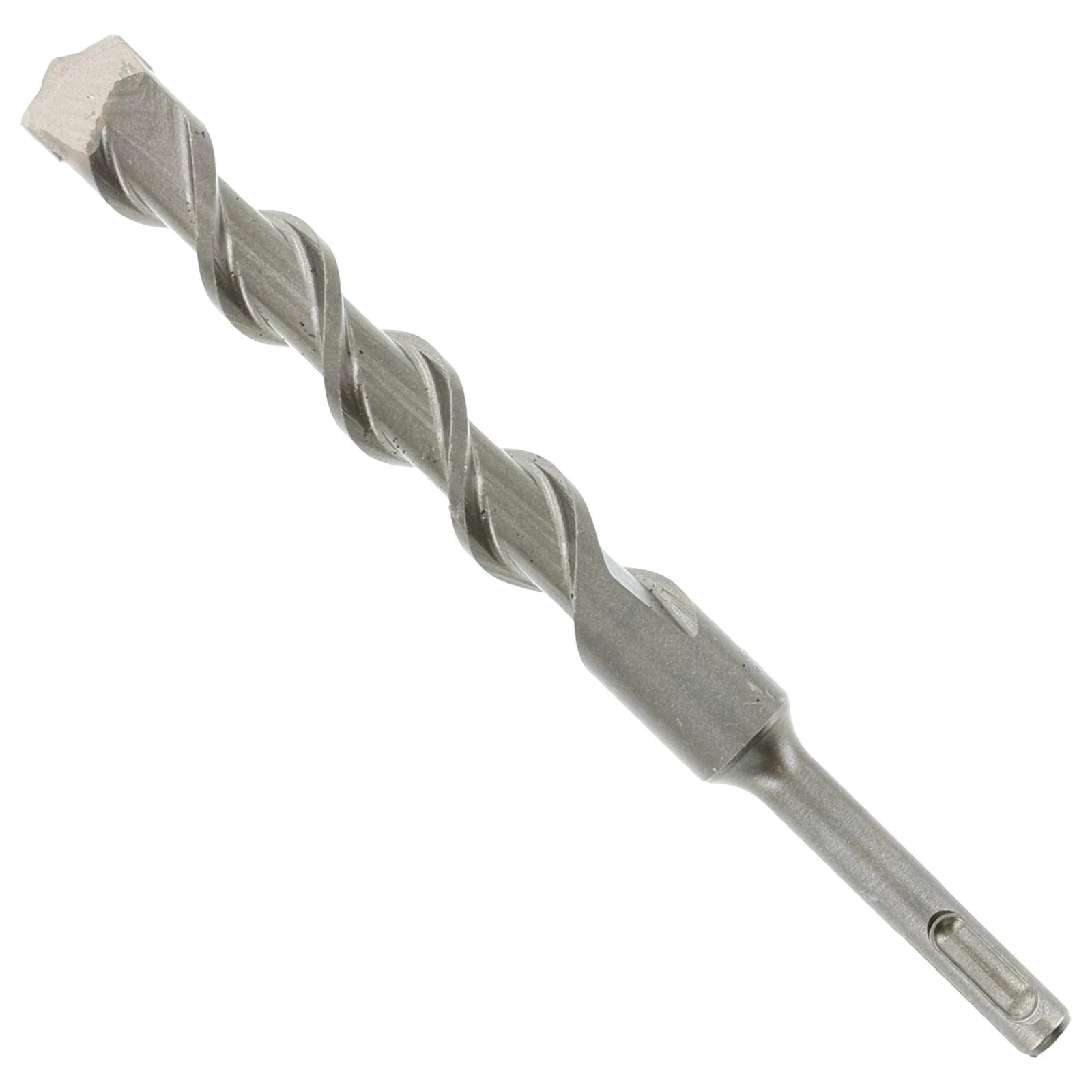
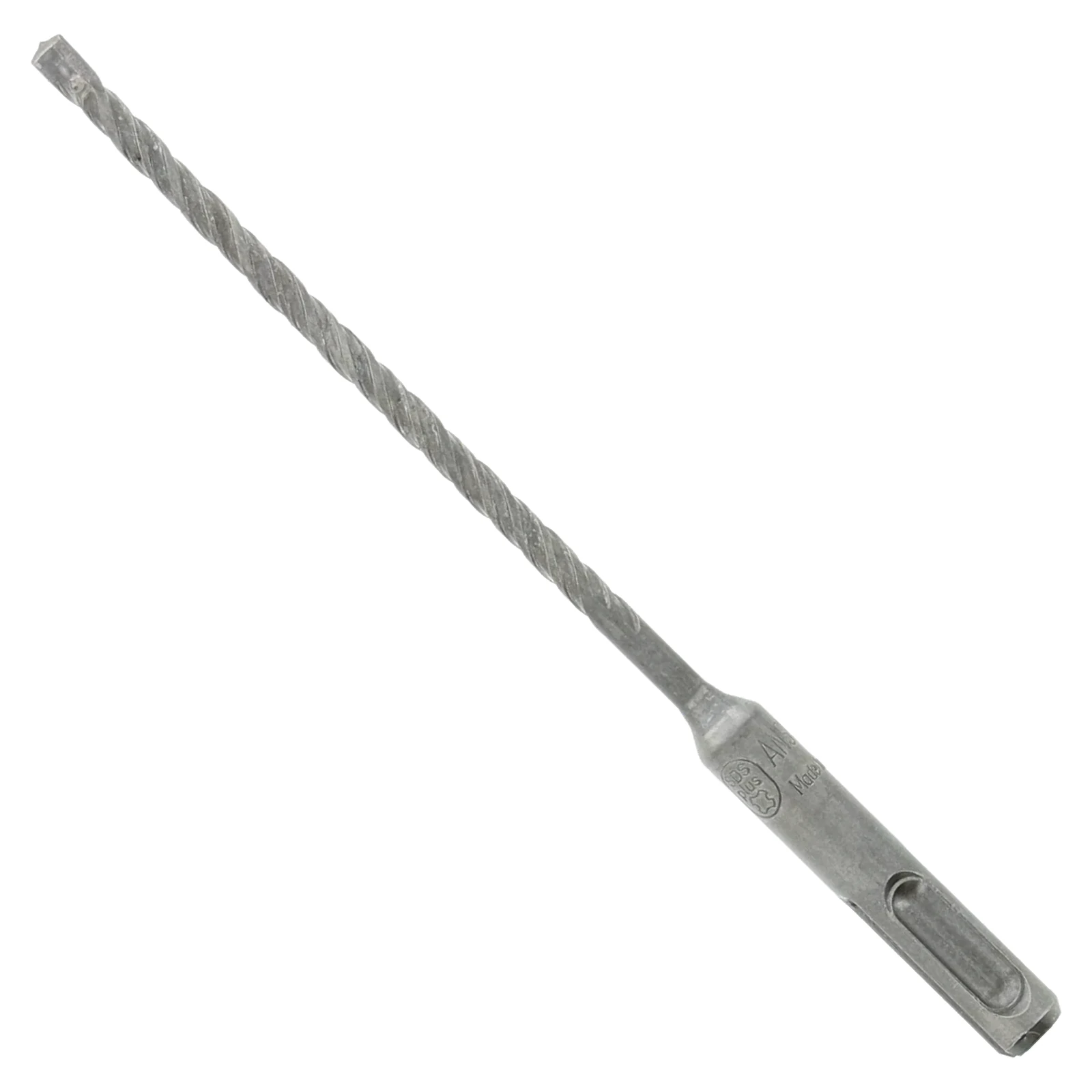
The supplied images show a carbide cutting insert supported by a steel head, a spiral body and an SDS-Plus connection. Two main cutting edges lie on opposite sides of the centre. The body transfers rotation and hammer blows, while the spiral passages lead the crushed material out of the bore.
Keep cutting-edge count, carbide-component count and flute count as separate specification fields. The four-flute body does not turn the head into a four-cutter. Likewise, a carbide-tipped head is a different construction from a one-piece full-carbide head joined to steel.
What Does Peak Point Tip Actually Do?
Diablo’s official term is Peak Point Tip. “Peak center tip” is a useful informal description, but the named feature is the peaked starting geometry visible at the middle of the carbide insert. Diablo associates it with aggressive starts and clean, fast holes.
Our mechanical reading of the geometry is straightforward: the central peak concentrates the first contact into a small area. Under axial hammer blows it helps form a local starting seat; the surrounding cutting edges then enlarge that seat as the bit rotates. This can help the operator establish position before the whole tip is engaged.
The peak is part of the same carbide tip. It is neither a separate pilot drill nor an additional third cutting insert. Starting behaviour still depends on point symmetry, edge condition, bit runout, the surface and controlled feed. A sharp central feature works best with stable peripheral edges and adequate carbide support.
Why a 2-Cutter Can Have Four Flutes
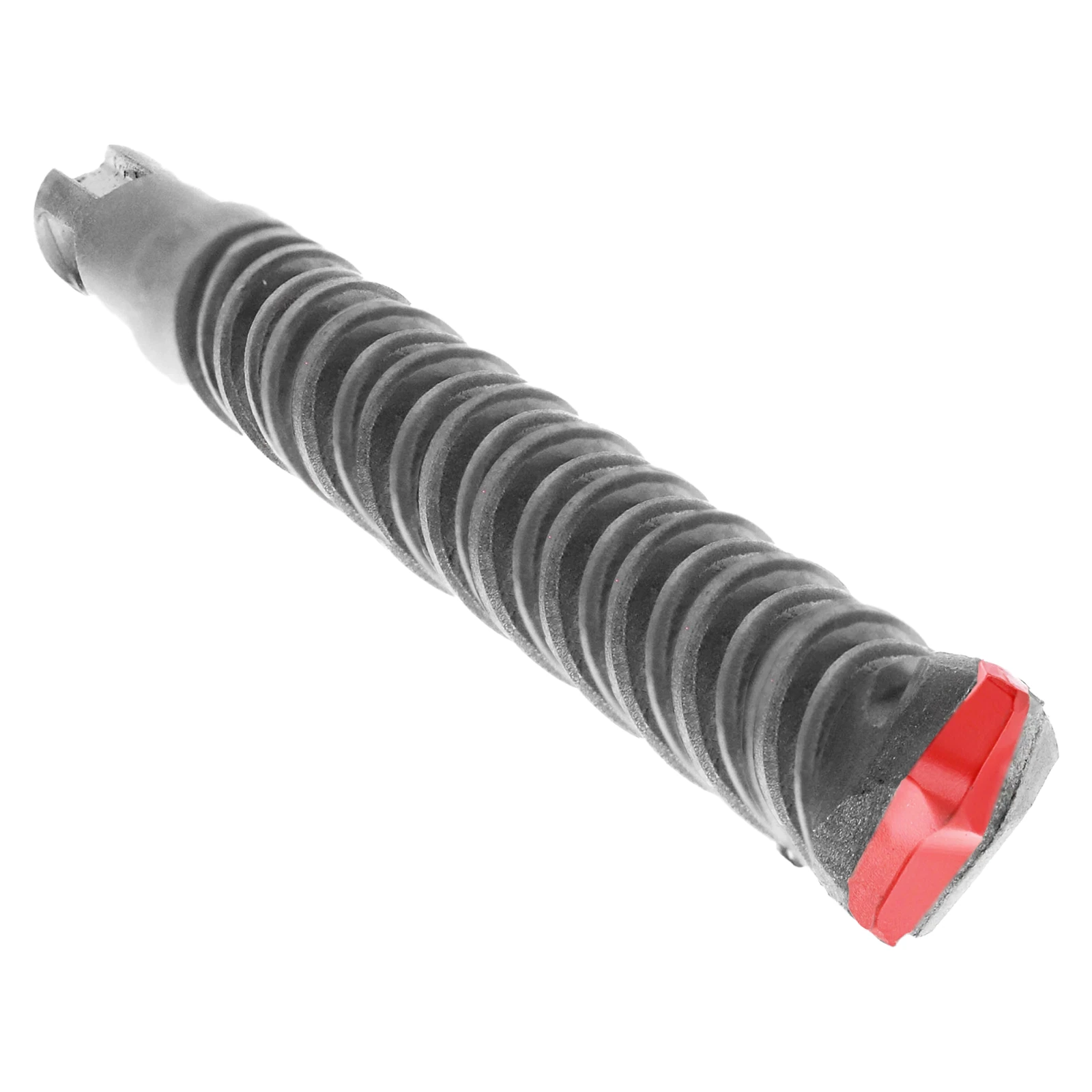
Diablo describes an optimized four-flute design. The cutting head creates fragments; the flute system provides their exit path. This is why flute count and cutter count can differ on the same tool.
As a hole deepens, packed cuttings can make the head rework crushed material, increasing friction and resistance. Flute volume, pitch and the transition behind the carbide tip influence how readily debris moves away. Diablo links its flute design with faster dust removal and cooler tips; comparative speed or temperature should be checked in a matched drilling test.
A flute transports debris inside the hole. It does not collect airborne dust like a vacuum system. Use the specified dust-control arrangement and follow the anchor’s hole-cleaning instructions; a visually clean bore is not an installation procedure.
Dura-Carbide, Brazing and Hardening
Dura-Carbide is Diablo’s material branding. The official product description pairs it with resistance to impact and heat, and separately identifies optimized brazing and hardening. These are complementary parts of the system: carbide edge behaviour, steel support and joint integrity all affect useful service life.
Impact energy travels from the hammer through the steel body and joint into the carbide. The head and joint also carry reaction and bending loads at the cutting end. Edge chipping, insert movement, local steel deformation and flute packing are different failure modes and need different remedies.
For a manufacturing comparison, specify carbide toughness and wear resistance, insert seating, joint coverage, steel heat treatment and finished runout. A brand material name does not specify an ISO grade, cobalt percentage or brazing temperature. Confirm those fields through the approved drawing and sample programme.
2-Cutter vs Rebar Demon Full-Carbide Head
Diablo separates the two-cutter carbide-tipped family from Rebar Demon four-cutter full-carbide-head products. Peak Point starting geometry should not be treated as equivalent to the Rebar Demon head and joining system.
For repeated reinforcement contact, compare the dedicated reinforced-concrete family under the intended hammer, hole diameter and rebar condition. A central peak alone does not establish rebar performance. Planned cutting of structural reinforcement also needs the project’s approved drilling location and cutting plan.
| Feature | SDS-Plus 2-Cutter | Rebar Demon 4-Cutter |
|---|---|---|
| Head | Two main edges on a carbide-tipped head | Four-cutter full-carbide head |
| Named starting / construction feature | Peak Point Tip; brazing and hardening | Full-carbide head; Tri-Metal Fusion Welding |
| Application emphasis | Concrete and masonry anchor-hole drilling | Concrete and reinforced-concrete drilling |
| Procurement comparison | Starting accuracy, drilling rate and tip retention | Rebar engagement, gauge retention and head integrity |
Read DMAPL2220 Dimensions and the Package
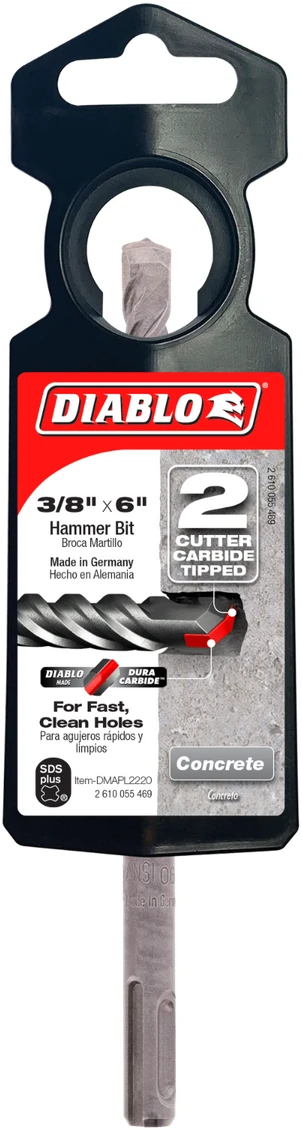
The supplied retail package clearly reads DMAPL2220, 3/8 in × 6 in, 2 Cutter Carbide Tipped. The official model page resolves the intermediate dimension: 4 in working length. Read the specification as diameter × working length × overall length.
The pictured DMAPL2220 package is marked Made in Germany. That is useful identification for this reference pack. For purchasing, match the exact part number, packaging, shank marking and production lot; an online marketplace’s country field is weaker evidence than the marked product in hand.
The unlabelled compact and long drill images illustrate geometry and reach. Use the SKU specification for dimensions rather than assigning every reference image to DMAPL2220.
Both models are listed as SDS-Plus, carbide-tipped, two-cutter bits. The metric values below are direct inch conversions.
| Official model | Diameter | Working length | Overall length |
|---|---|---|---|
| DMAPL2220 | 3/8 in · 9.525 mm | 4 in · 101.6 mm | 6 in · 152.4 mm |
| DMAPL2060 | 3/16 in · 4.7625 mm | 6 in · 152.4 mm | 8 in · 203.2 mm |
Turn the Reference into an OEM Specification
At Zhonghuan, we translate a brand reference into an application-led specification for our own SDS-Plus programme. The buying decision should connect the substrate, reinforcement exposure and hammer platform to the head, materials, joining and acceptance plan.
For sample approval, compare the same diameter, working length, hammer, concrete and drilling depth. Record start-position error, drilling time per completed hole, finished diameter, edge damage and head retention. Track hole quality and usable life alongside purchase price.
| Proposed programme | Configuration to confirm | Acceptance focus |
|---|---|---|
| A — Premium brazed 2-cutter | Self-centering carbide insert, supported brazed joint and an application-matched flute | Starting position, drilling rate, finished diameter and tip retention |
| B — Full-carbide-head upgrade | Our four-cutter full-carbide head joined to steel by resistance friction welding; choose the diameter and length for the application | Reinforcement engagement, joint integrity, wear and gauge retention |
Send us the target material, diameter × working length and estimated quantity, with your rotary-hammer model or benchmark when available. We confirm the sample specification and private-label packaging through an OEM quotation. Explore our SDS-Plus range and the broader two-cutter centering guide.
View the full-size Diablo feature graphic
Official Sources and Image References
The five product images used here were supplied for this analysis. The annotated graphic and packaging carry Diablo product information; the mechanical explanations are our interpretation of the visible construction and manufacturer descriptions.
- Diablo DMAPL2220 — dimensions and Peak Point Tip description
- Diablo DMAPL2060 — two-cutter construction and flute features
- Diablo DMAPL2040 — carbide, brazing and hardening overview
- Diablo Rebar Demon — full-carbide head and joining system
Frequently Asked Questions
Is Peak Point Tip a third cutter?
No. It is the peaked starting geometry at the centre of the two-cutter carbide tip. The point and the two main cutting edges perform different roles.
Why does a two-cutter have four flutes?
Cutters fracture material at the head; flutes transport the debris. Their counts describe different parts of the tool.
Is this the same as a Rebar Demon full-carbide head?
No. Diablo lists this range as two-cutter carbide-tipped bits with brazing and hardening features. Rebar Demon uses a four-cutter full-carbide head and a different joining system.
What does 3/8 × 4 × 6 in mean for DMAPL2220?
3/8 in is hole diameter, 4 in is working length and 6 in is overall length. These equal 9.525 mm, 101.6 mm and 152.4 mm respectively.
Does the pictured package identify the origin?
Yes. The supplied DMAPL2220 package is marked Made in Germany. Keep that observation attached to the exact reference pack and confirm origin by SKU and lot when purchasing.
What should an OEM buyer send to Zhonghuan?
Target material, diameter × working length and estimated quantity. A rotary-hammer model or benchmark helps us confirm head construction, materials, joining, sample acceptance and private-label packaging.


