

Quick Answer: Two Different Bets on What a Flute Should Do
Heller's Twinmax 3D Helix and Diager's Tri-Zone Helix (Diager's own materials also write TRI-ZONES Helix) both get sold as an upgrade over a plain spiral flute on SDS-Plus concrete bits. They are not the same upgrade.
Twinmax 3D Helix keeps one constant, continuous twin-lead profile for the full working length of the bit — the same flute cross-section from just under the tip to the shank. Heller's own language is about steady dust transport: moving drilling dust out fast enough, at depth, to avoid blowback and pressure build-up.
Tri-Zone Helix is built the other way: the flute cross-section is deliberately different across named zones along the body — Diager's materials describe a flute that mixes half-round and square sections and changes profile to match different jobs at different points in the hole.
If you only read the adjectives, both sound like "engineered for better dust removal." The actual design philosophy is close to opposite: hold one geometry steady everywhere, versus change the geometry on purpose. In our reasoned view, for a catalogue that has to hold tolerance across dozens of diameters and lengths, the constant twin-helix is the safer default — see below for why, and where a variable-zone flute earns its complexity instead.
What Each Helix Actually Is
Heller Twinmax 3D Helix. Per Heller's own product pages, the Twinmax 3D helix is not a one-model feature — it runs across more than one line. It's the named flute on the 2-cutter Bionic Pro ("another advantage is the Twinmax 3D helix, which very effectively transports drilling dust away, and thus minimises the risk of dust 'blow back'") and it's also named on the 4-cutter 4Power Pro, paired there with what Heller calls a "computer-simulated helix" for low vibration. The consistent claims across both lines: fast dust transport out of the hole, reduced blow-back risk, and stable behaviour in deep holes.
Diager Tri-Zone Helix. Diager's catalogue positions this as the flute on its Twister Plus 2-cutter range, paired with a "Z" centring tip. The published language: a variable, three-zone helix that changes across the length of the bit, described elsewhere in Diager's own materials as combining half-round and square flute sections — what one listing calls "double cutting." The stated goal is the same destination as Twinmax — fast, low-friction dust evacuation, reduced drilling time, less bit wear — reached by a different route: tuning the profile to the zone instead of holding one profile throughout.
So: one bit holds a single cross-section from end to end and leans on a validated constant pitch; the other bit changes cross-section on purpose and leans on the zone transitions doing useful work. Both are legitimate design directions. They are not the same direction, and a spec sheet that just says "helix flute" for either one is not actually saying anything.
Why SDS Flute Names Don't Agree With Each Other
There is no standards body that defines "3D helix," "tri-zone helix," or "super flute." Every premium brand names its own flute, and the names are not comparable across brands — or reliably even within one brand's own catalogue.
Heller is the clearest example, because you don't need to leave Heller's own range to see it. Twinmax 3D Helix is the flute name on the 2-cutter Bionic Pro and the 4-cutter 4Power Pro. But Heller's premium 3-plate Trijet Ultimate is marketed with a separate, unrelated name — a "low-vibration triple helix." Nothing in Heller's public materials says whether the triple helix is a Twinmax variant, a different platform, or purely a marketing distinction for a different price tier. A buyer reading across Heller's own range cannot tell from the names alone whether they're looking at one flute family or two.
Diager shows a smaller version of the same problem: its own materials alternate between "Tri-Zone Helix" (singular) and "TRI-ZONES Helix" (plural) for what appears to be the same flute — inconsistent even inside Diager's own copy.
Then there is the wholesale-trading layer underneath both of them. Search any B2B sourcing platform for SDS drill bits and you'll find flute cross-sections labelled with bare letter codes — S4, W, U, L — attached to listings from dozens of unrelated suppliers. None of those codes are defined by a standards body either. They function as shorthand for whatever cross-section that supplier's tooling happens to produce, which means the same two-letter code can point at different actual geometries between two listings, and sometimes even within one listing's own photo gallery. Reading "S4 flute" on a spec sheet tells you a supplier used a code, not what the flute does.
None of this makes Twinmax or Tri-Zone dishonest — both Heller and Diager publish real engineering claims behind their names. It means the name is not the specification. "Helix" and "flute" are doing the same job "premium" does on a lot of packaging: signalling effort, not describing geometry.
Constant Helix vs Variable-Zone: The Real Trade-off
Strip the brand names off and there are two competing engineering bets, and each has a real cost and a real benefit.
| Design | What it holds constant | Theoretical upside | Where it can fail |
|---|---|---|---|
| Constant twin-helix (Twinmax-class) | Pitch, land width and core section — same cross-section shank to tip | Steady, predictable dust velocity with no transition points; one geometry to hold in tolerance, not several | Not locally tuned — cannot optimise separately for near-crown crushing versus mid-flute transport |
| Variable-zone helix (Tri-Zone-class) | A deliberately different profile per named zone | Each zone can, in principle, be shaped for the job local to it — different needs near the crown than mid-hole | Every zone boundary is a place core section can thin, dust velocity can stall, and manufacturing tolerance can drift — a "dead pocket" if the transition isn't controlled |
We've documented that second failure mode before, in a different context: when a workshop copies the visible undulation of a variable flute without controlling groove depth, width, land, phase and the connecting radius between zones, the result is "dead pockets, unstable dust velocity and unnecessary drag" — the shape without the engineering behind it. See why Diager Booster look-alike copies fail for the full breakdown. That risk is structural to any zoned flute, not a knock on Diager specifically — Diager's own version is a patented, validated design, not a copy. But it's exactly why a variable-zone flute needs tighter process control than a constant one to deliver its theoretical advantage.
Why We'd Lean Toward the Continuous Twin-Helix
Asked to bet on one design as the safer default across a full catalogue of diameters and lengths, we'd pick the constant twin-helix — Twinmax's design class, not the Heller product specifically. Three reasons, all mechanical rather than marketing:
- Fewer failure points. A constant profile has one cross-section to validate. A three-zone profile has, at minimum, three cross-sections and the transitions between them — more places for core diameter to dip below spec, more inspection points, more ways a batch can drift out of tolerance without it showing in a catalogue photo.
- Predictable dust velocity end to end. Chip evacuation depends on the flute maintaining enough volume and a smooth path the whole way out of the hole. A single, unchanging pitch gives dust one steady-state velocity to reach. A zone change is exactly the kind of geometry discontinuity that can momentarily slow or eddy the dust stream if the transition radius isn't controlled — the mechanism behind the "dead pocket" problem above.
- Simpler to hold across a diameter range. A catalogue flute has to work from small diameters to large ones. Holding one constant pitch and cross-section in tolerance at Ø5mm and at Ø20mm is a narrower manufacturing problem than holding three zone geometries and their transition points in tolerance across the same range.
None of this makes a variable-zone flute a bad idea — it's a legitimate answer to a real problem (crown-area conditions are genuinely different from mid-flute transport conditions), and a well-executed one can out-transport a constant helix in the zones it's tuned for. But "well-executed" is doing the work in that sentence, and it isn't verifiable from a catalogue photo. A constant twin-helix has less to get wrong, which is why we'd default to it unless a specific job justifies the added complexity — and why it's the flute family we reach for first on our own volume heads. See below for where the zoned approach earns its place instead.
How Zhonghuan Actually Assigns Flute to Head
We don't run one flute design across every SDS head and change the marketing name by diameter. Flute geometry is decided by two things: which carbide-head architecture it's feeding, and what duty cycle that head is built for. Four heads, four different flute answers:

2-cutter — deep twin-flute. The lightest head, run at the highest RPM, in plain concrete and masonry where nothing is fighting the dust on the way out. This is exactly where a constant twin-helix belongs: hold pitch and cross-section steady, keep dust velocity predictable, don't spend manufacturing tolerance on zone transitions the job doesn't need.
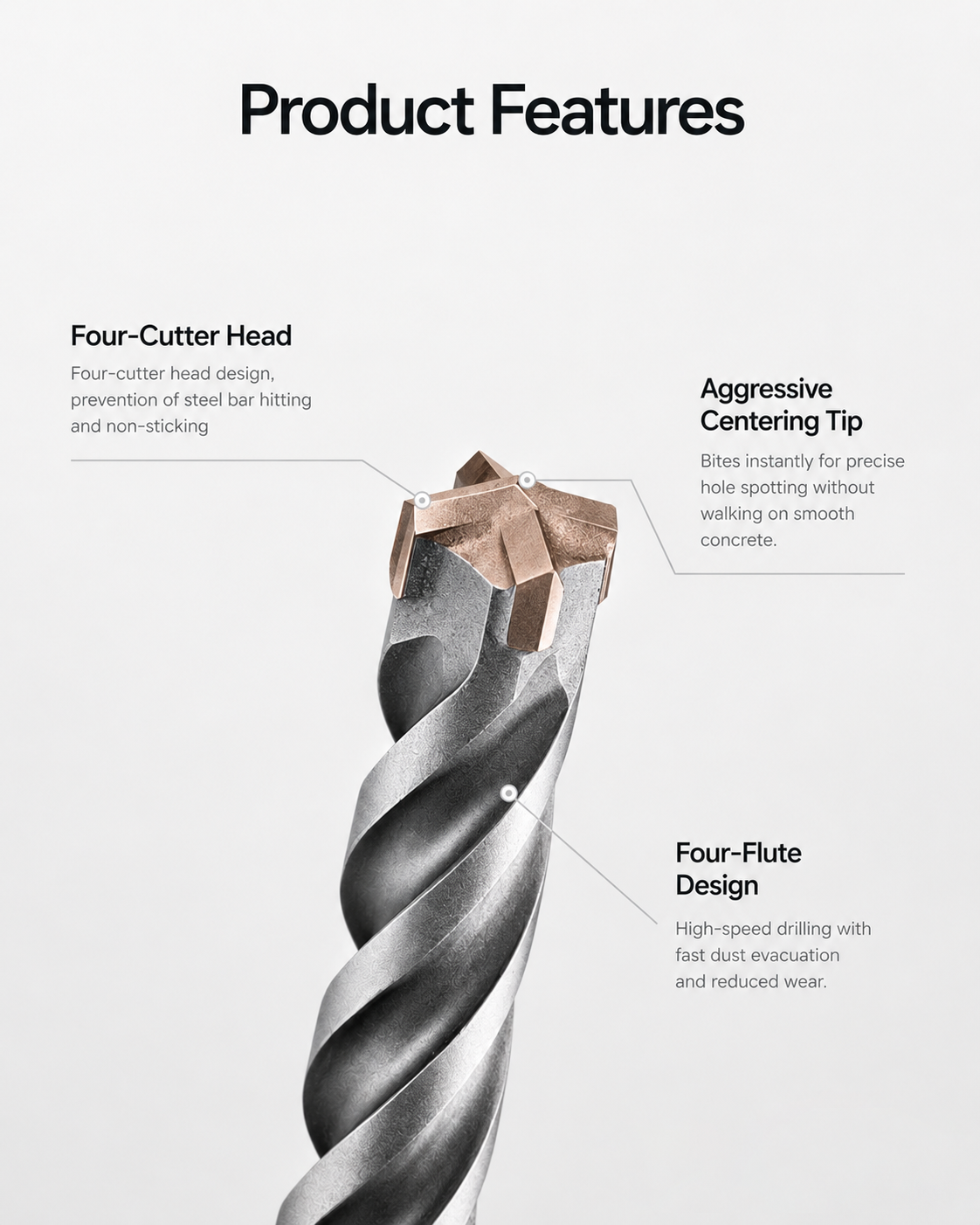
4-cutter cross (ZHMAX-5X) — four-flute through-body. Four cutting edges load the head symmetrically, and the flute is sized to match: wide, short grooves that clear a higher chip volume per revolution without needing a zoned profile — the extra edges, not the flute, are doing the work of handling rebar contact.
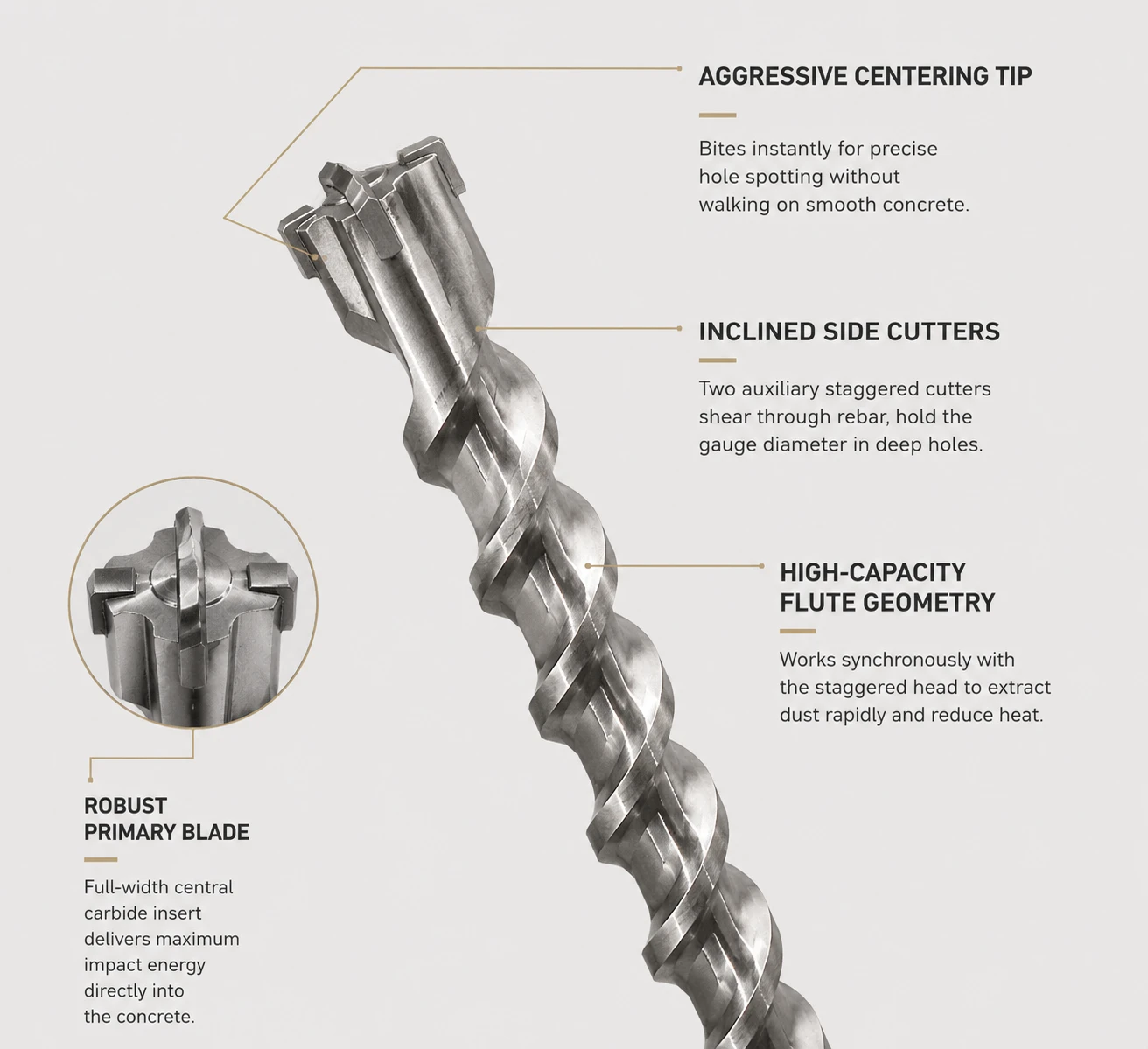
ZHMAX-7 — multi-insert head, controlled-volume helix. This is the one place we do use a deliberately shaped, non-constant flute path — and it's a genuine multi-insert construction, not a 4-cutter with a new name: a full-width primary carbide blade flanked by two inclined side inserts, staged rather than symmetric. The open head pockets feed crushed material into a controlled-volume, vibration-optimised helix built for hard or abrasive aggregate and deep holes, where a plain constant twin-flute would be under-sized for the debris load. This is the zoned-flute trade-off from the table above, taken deliberately: the extra transition is engineered — controlled groove volume through the transition, not a styled undulation — because the duty cycle actually needs it.

ZHMAX-8 — flute run-out through one mass. A full carbide head is a single continuous body, not carbide brazed onto a separate steel head. That changes the flute question entirely: there's no head-to-flute transition line to engineer around, because the head is the start of the flute. The design question here is core section and land width through one uninterrupted piece, not zone management.
Four heads, four flute logics — because a flute that's right for a 2-cutter at 1000 RPM in brick is not right for a multi-insert head chewing hard aggregate at 700 RPM, and stretching one "3D helix" or one "tri-zone" story across both would be exactly the naming-over-substance problem this article is about. If a name doesn't change when the head, the material and the RPM change, the name isn't describing engineering — it's describing a marketing platform.
Specifying Flute Geometry in an RFQ
Don't write "3D helix" or "tri-zone flute" into a spec and expect it to mean anything to a factory. Write the parameters the name is supposed to represent:
SDS [Plus/Max] drill bit, [head type]. Flute: constant twin-lead helix or variable zoned helix (specify zone count if zoned), pitch/lead, land width, minimum core section through any zone transition, connecting radius at transitions, runout tolerance. Confirm with a dust-evacuation test in the target material and a core-section check at the tightest transition point.
If you're benchmarking a specific catalogue product, name it as a benchmark, not an instruction to copy: "benchmark allowed: Heller Twinmax 3D Helix class or Diager Tri-Zone Helix class" tells a factory what performance bar to hit without asking them to reproduce a patented profile line-for-line.
We'll tell you honestly which of our four flute answers fits your target head and material before we quote it — including when the honest answer is that a plain constant twin-flute will outperform a fancier-sounding zoned one for your actual job.


