

A heavy breaker needs a chisel that keeps penetrating while its edge and connection withstand repeated impact. The Hilti TE-HX FM 40 combines a self-sharpening flat working end with a TE-H connection for a defined heavy-demolition platform. For contractors and distributors, the useful questions are how the edge wears, how the shank fits and how consistently the complete tool performs through a job.
We examine the published specification and the supplied product photographs, then translate those features into practical selection points for a premium demolition-chisel program.
TE-HX FM 40 specifications at a glance
| Specification | TE-HX FM 40 |
|---|---|
| Hilti item number | 2254774 |
| Overall length | 400 mm |
| Cutting-edge width | 38 mm |
| Connection end | TE-H (Hilti HEX 28) |
| Published machine fit | Third-generation TE 3000; H28 demolition tools with clamp |
| Working-end type | Self-sharpening flat chisel |
| Published applications | Concrete, brick and block demolition; concrete channeling |
400 mm is the length; 38 mm is the edge width; HEX 28 identifies the connection. These are three separate dimensions. Imperial listings around 15.7 in long and 1.5 in wide are rounded conversions. Hilti FM 40 dimensions and item number · Hilti connection and application reference
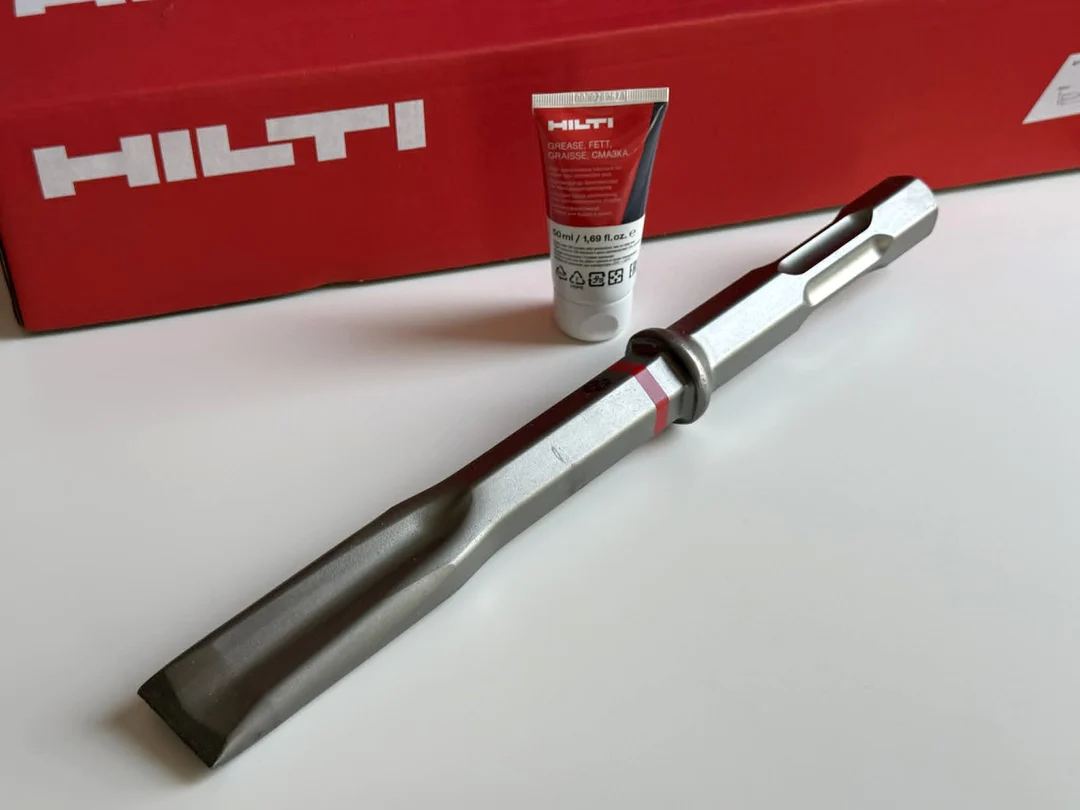
Start with the concrete, the task and the breaker
Hard aggregate increases wear demand; reinforcement can interrupt the intended fracture path. Local channeling and bulk concrete removal also require different control. Select the machine platform and impact duty before choosing blade width and reach.
A flat edge helps define a removal line and break strips of material. A point concentrates the initial contact differently; a wide scaling blade addresses a different removal task. For reinforced concrete, follow the removal plan and use a suitable method for exposed steel. Chisel geometry is selected around those conditions.
What the long recess and raised sides actually show
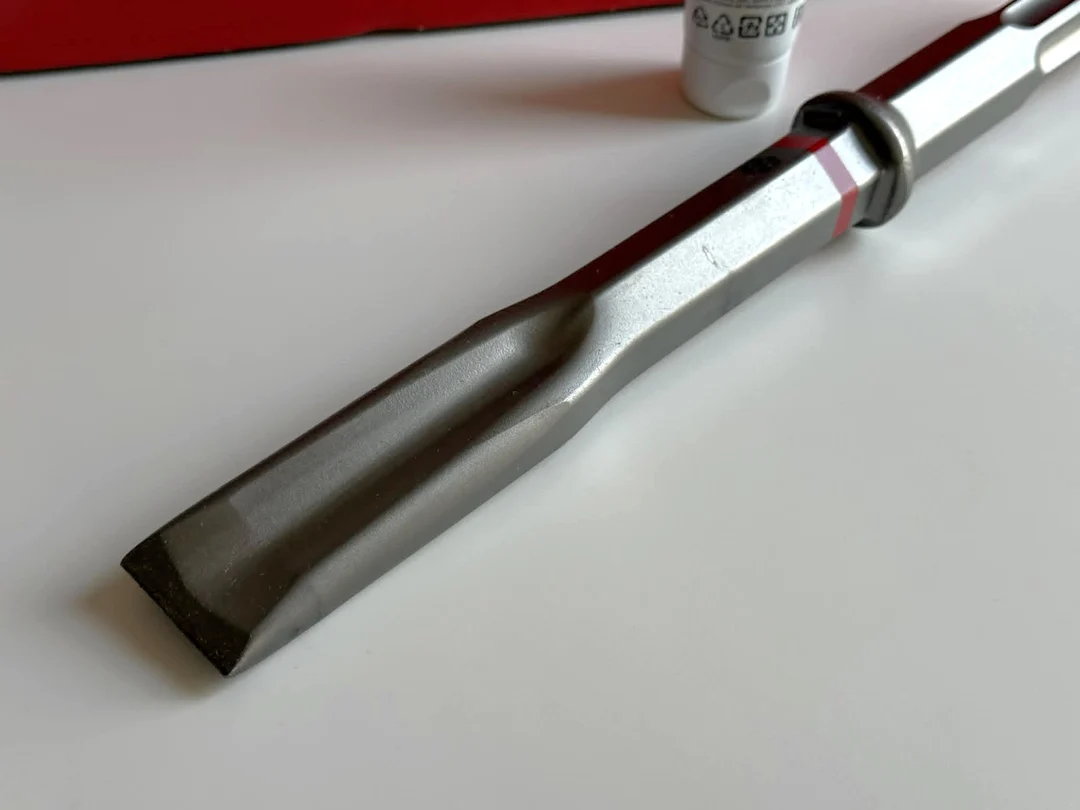
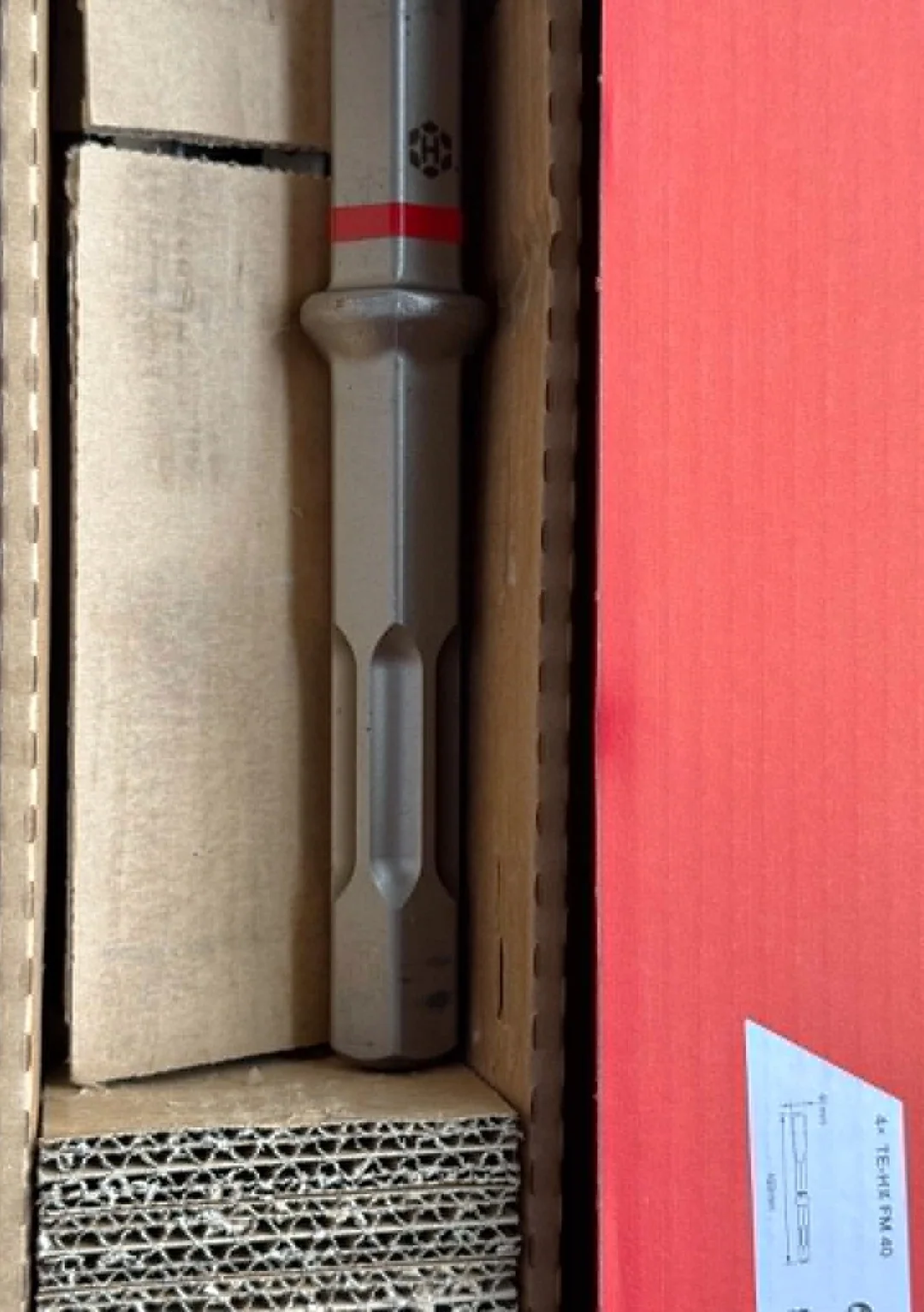
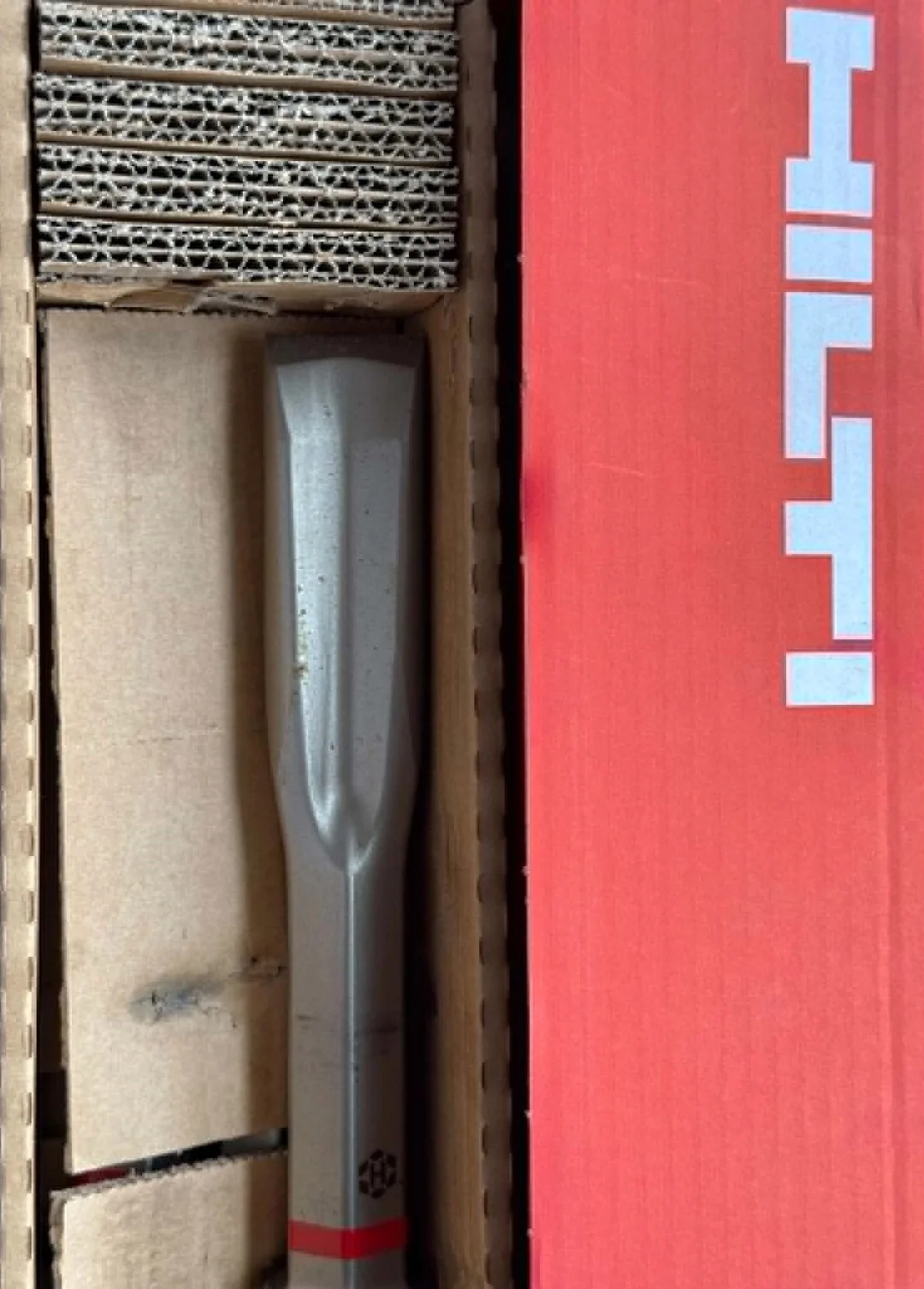
The supplied close-up shows an elongated recessed face bounded by raised side sections, leading into a broad, approximately straight flat edge. The head transitions gradually into the body. This is a shaped working section rather than a uniform smooth wedge.
Mechanically, the raised and recessed regions change the contact pattern as the head penetrates and wears. A self-sharpening design aims to retain a useful working profile as material is consumed. Its value is sustained engagement with less interruption for edge maintenance. The recess alone does not establish an impact-energy gain or a guaranteed reduction in jamming.
Assess the edge, side sections, reverse face and transition together. A new-tool photo describes the starting shape; a controlled wear comparison shows how well that shape remains useful.
Inductive hardening: wear resistance with impact toughness
Hilti identifies inductive hardening as a feature of this flat-chisel family, linking it to resistance against mushrooming, wear and bending. Induction heating and the subsequent hardening cycle address the steel; they are separate from the visible working-end geometry. Hilti TE-HX FM features
For an OEM specification, define the required response at the edge, body, collar transition and impact end. Hardness must support wear resistance without sacrificing the toughness needed for repeated blows. Steel grade, heat-treatment locations and acceptance limits belong in the approved specification. Surface color and stamped markings do not reveal those requirements.
HEX 28 compatibility depends on the complete retaining geometry
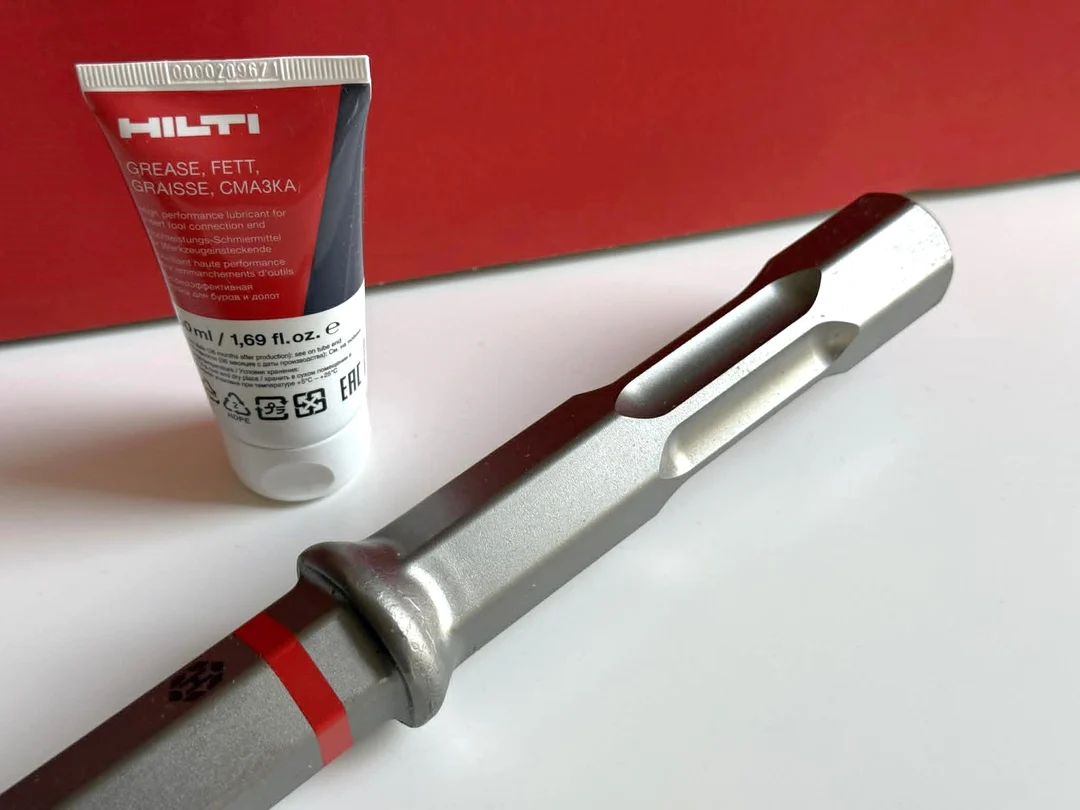
Hilti lists the connection as TE-H (Hilti HEX 28) and identifies third-generation TE 3000 or H28 demolition tools with clamp. Keep that generation and retainer requirement attached to the compatibility statement. Hilti machine compatibility
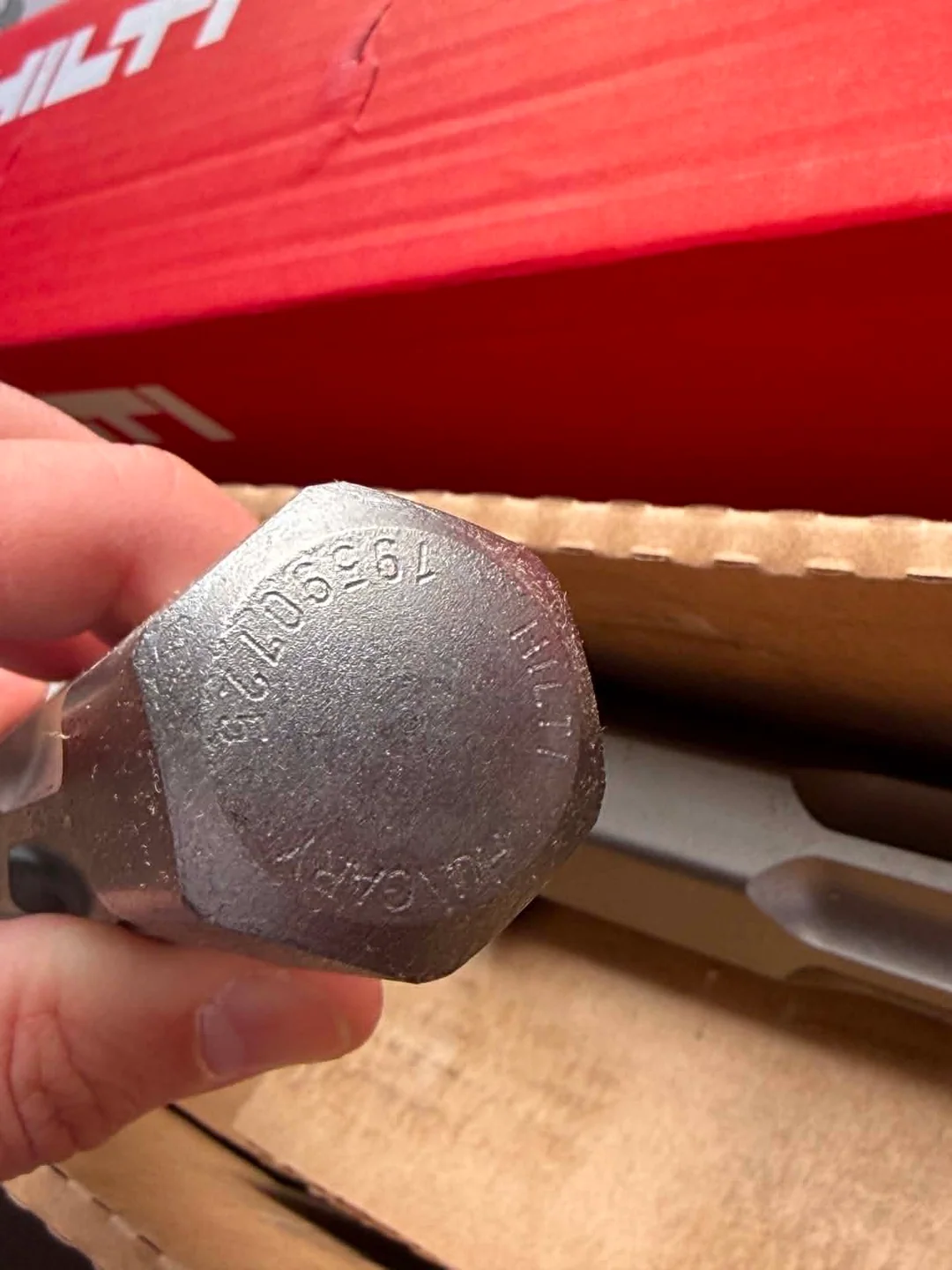
The photos show a hexagonal insertion end with longitudinal recesses and a projecting collar. An OEM drawing must capture the across-flats dimension, insertion length, collar position and dimensions, recess geometry and impact-end details. A nominal hex size alone does not establish a complete fit.
TE-H / HEX 28 and SDS-Max are different interfaces. Their retaining arrangements are not directly interchangeable. For a tool marked only “TE 3000” or “28 mm hex,” confirm the exact model, generation and holder before ordering.
Specify a premium OEM alternative around the failure mode
At Zhonghuan Tools, our premium chisel program combines 42CrMo chromium-molybdenum steel, application-matched heat treatment and defined working-end geometry. We start with the machine and job, then develop the dimensions, marking and packaging needed for repeatable factory supply.
If the existing tool rounds off quickly, review the wear profile and edge treatment. If it bends or fractures, review the body section, transitions, impact duty and toughness. If it becomes difficult to insert or release, review the interface, retaining features, wear and maintenance. Each symptom leads to a different specification decision.
For a HEX 28 project, we review the full connection drawing and approve sample fit before confirming supply compatibility. Our 42CrMo specification describes our own premium program; Hilti’s public product page does not establish that Hilti uses the same steel grade.
Compare completed work and interruption time
Use the same breaker, substrate, working method and defined removal task. Record material removed, productive operating time, time spent freeing or changing the tool, edge condition and shank wear. Keep concrete mix, aggregate and reinforcement conditions comparable.
Cost per completed task = (chisel cost allocated to the task + labor and machine cost for total task time) ÷ accepted completed tasks. Include release, changeover and maintenance time. This gives a distributor or contractor a practical basis for selecting a premium tool beyond its new-tool appearance.
Frequently asked questions
Is Hilti TE-HX FM 40 an SDS-Max chisel?
It uses TE-H (Hilti HEX 28), a different connection from SDS-Max. Match the complete shank and retaining system to the machine.
What size is TE-HX FM 40, item 2254774?
The published metric dimensions are 400 mm overall length and 38 mm cutting-edge width. HEX 28 refers to the connection end, not the blade width.
Does it fit every Hilti TE 3000?
Hilti specifies third-generation TE 3000 and H28 demolition tools with clamp. Confirm the exact tool generation and holder before ordering.
Does self-sharpening mean the edge never wears?
The steel is still consumed. The profile is designed to remain useful as it wears, reducing the need for repeated edge restoration during normal service.
Can the photos identify the steel or exact hardness?
The photos show geometry, surface appearance and markings. Steel grade, heat-treatment requirements and hardness measurement positions must come from the product specification.
Build a premium flat-chisel range with our factory
Send the breaker model, target material, chisel size and quantity. Add a reference photo or sample if available. We will review machine fit and the working profile, then propose a premium specification, sample plan and OEM packaging for your range.


