

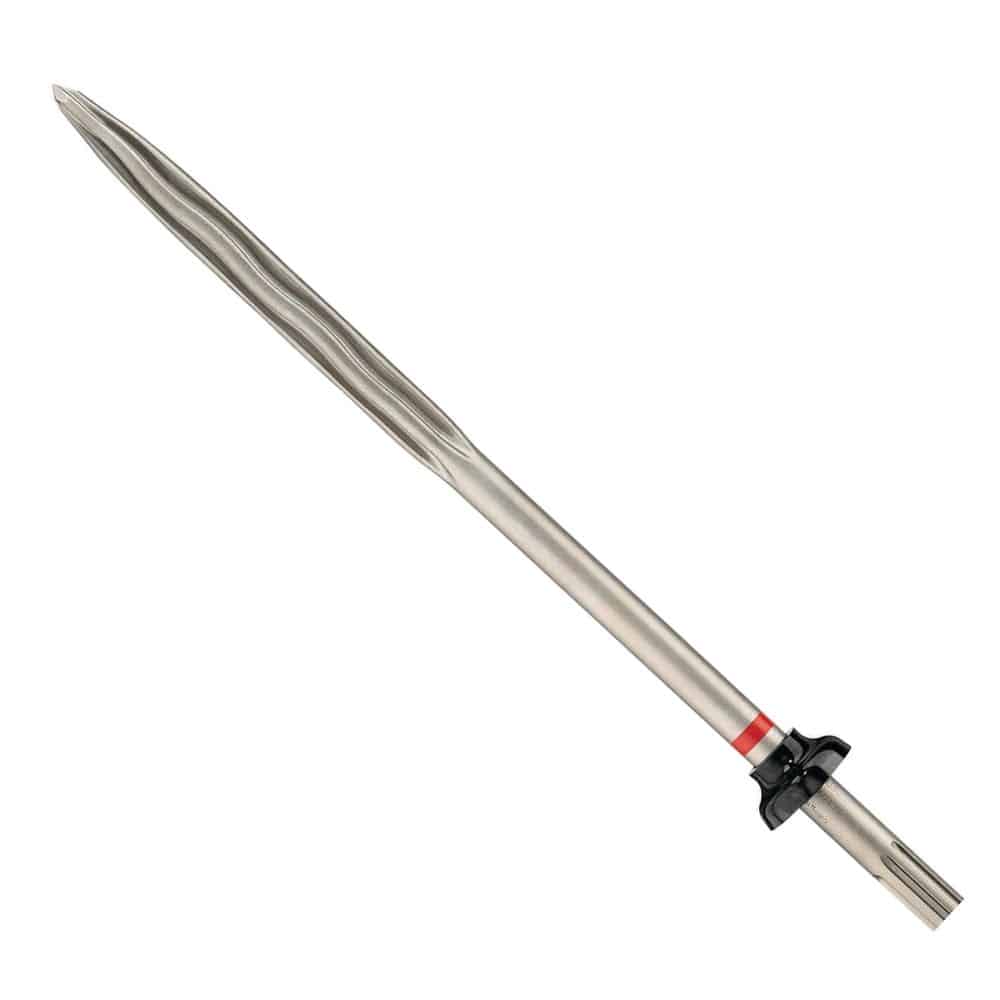
A pointed chisel has to do more than start a hole in concrete. Once its working end enters the material, side contact, trapped fragments and tip wear influence how long the operator can keep breaking without interruption. The Hilti TE-YX SM addresses that task with a self-sharpening point, wave-shaped working section and SDS-Max connection.
We examine this professional demolition reference through its published specifications and the supplied photographs: what the profile is designed to improve, how to choose a length and what makes a premium OEM alternative repeatable.
TE-YX SM models, lengths and machine connection
Hilti identifies the family as an Ultimate-class pointed chisel with a TE-Y (SDS-Max) connection. Its Saudi page currently lists 280, 360 and 500 mm options. The reference table uses Hilti’s 2024 Hong Kong catalogue, which also documents the 700 mm variant. Confirm regional availability and pack size with the exact item number. Hilti TE-YX SM product page · Hilti 2024 accessory catalogue, p. 38
| Reference model | Overall length | Single-item number | Connection |
|---|---|---|---|
| TE-YX SM 28 | 280 mm | 2241982 | TE-Y (SDS-Max) |
| TE-YX SM 36 | 360 mm | 2241983 | TE-Y (SDS-Max) |
| TE-YX SM 50 | 500 mm | 2241984 | TE-Y (SDS-Max) |
| TE-YX SM 70 | 700 mm | 2241985 | TE-Y (SDS-Max) |
The 11-inch retail description for item 2241982 is a rounded reference to the 280 mm model. Length is independent of the machine interface. A pointed chisel has no flat blade width to carry over from the TE-YX FM specification.
Start with the substrate, fracture task and hammer
Concrete strength, aggregate and reinforcement affect the fracture path and wear demand. Brick, block and mortar behave differently again. Establish the material and the intended opening or removal task, then choose the SDS-Max machine and impact duty before the chisel geometry.
A point concentrates initial contact to start cracking and local breakout. Hilti lists concrete and masonry demolition and starting new openings within a slab among the applications. That use still follows the project’s removal plan. Where reinforcement becomes exposed, use the appropriate method for the steel.
Operate in a supported chiselling mode with rotation stopped. TE-YX SM is a demolition chisel; the shared TE-YX name does not make it a rotary-hammer drill bit.
What the wave profile changes after the point enters
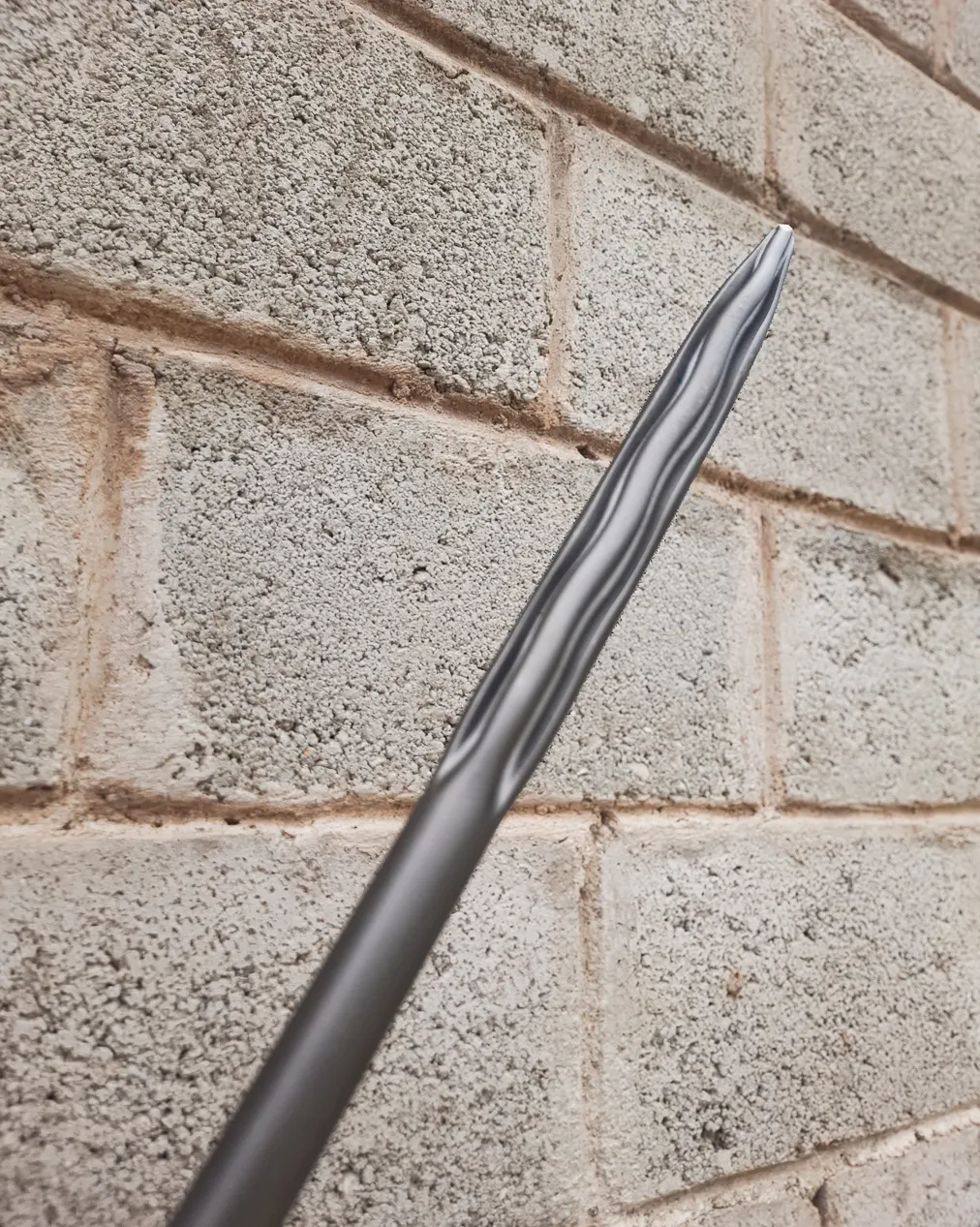
The supplied close-up shows raised longitudinal sections separated by recessed valleys. Their outlines vary along the working zone and converge toward the point. This shaped section continues behind the initial contact tip.
Hilti connects its wave design with reduced side contact, better removal of broken material and less jamming. Mechanically, the alternating raised and relieved areas change where the tool bears against the surrounding concrete and leave clearance around parts of the working end. Hilti wave-design features
The practical result to measure is time spent freeing and repositioning the tool alongside material removed. These external reliefs help material release; they are not an active vacuum-extraction passage. The photographs do not establish an exact cross-section, universal rib count or fixed percentage gain.
Self-sharpening and the 5 cm penetration recommendation
Self-sharpening describes a profile intended to remain useful as steel wears away. It does not mean the point retains its original dimensions indefinitely. The working tip and the shaped section behind it must be evaluated together.
Hilti includes a recommended minimum penetration of 5 cm / approximately 2 in in its self-sharpening description. Retain that use condition when discussing this reference. It is not a depth stop, a maximum permitted penetration or a formula for choosing overall length. Hilti self-sharpening use recommendation
For shallow surface work, select the appropriate flat, scaling or surface-preparation accessory. For breaking into the body of concrete, assess the point’s penetration and worn shape through a representative task.
Inductive hardening supports a durable working section
Hilti specifies inductive hardening and links it with resistance to mushrooming, wear and bending. The profile controls contact and clearance; steel and heat treatment determine how the section withstands repeated impact. Hilti material-treatment features
For an OEM specification, balance wear resistance at the point with toughness through the body, transitions and shank. Excessive brittleness can promote chipping or fracture; an overly soft section can flatten or deform. Agree the material, treatment requirements and hardness measurement locations around those functions.
A surface finish or photograph cannot set that specification. The acceptance plan should include the working end and connection after use, as well as dimensions on a new sample.
SDS-Max fit and the black dust cap are separate features
The TE-Y connection is SDS-Max. Match the exact machine model and holder, then check the insertion end, retaining features and release. SDS-Plus and TE-H / HEX 28 are different interfaces and are not directly interchangeable with it.
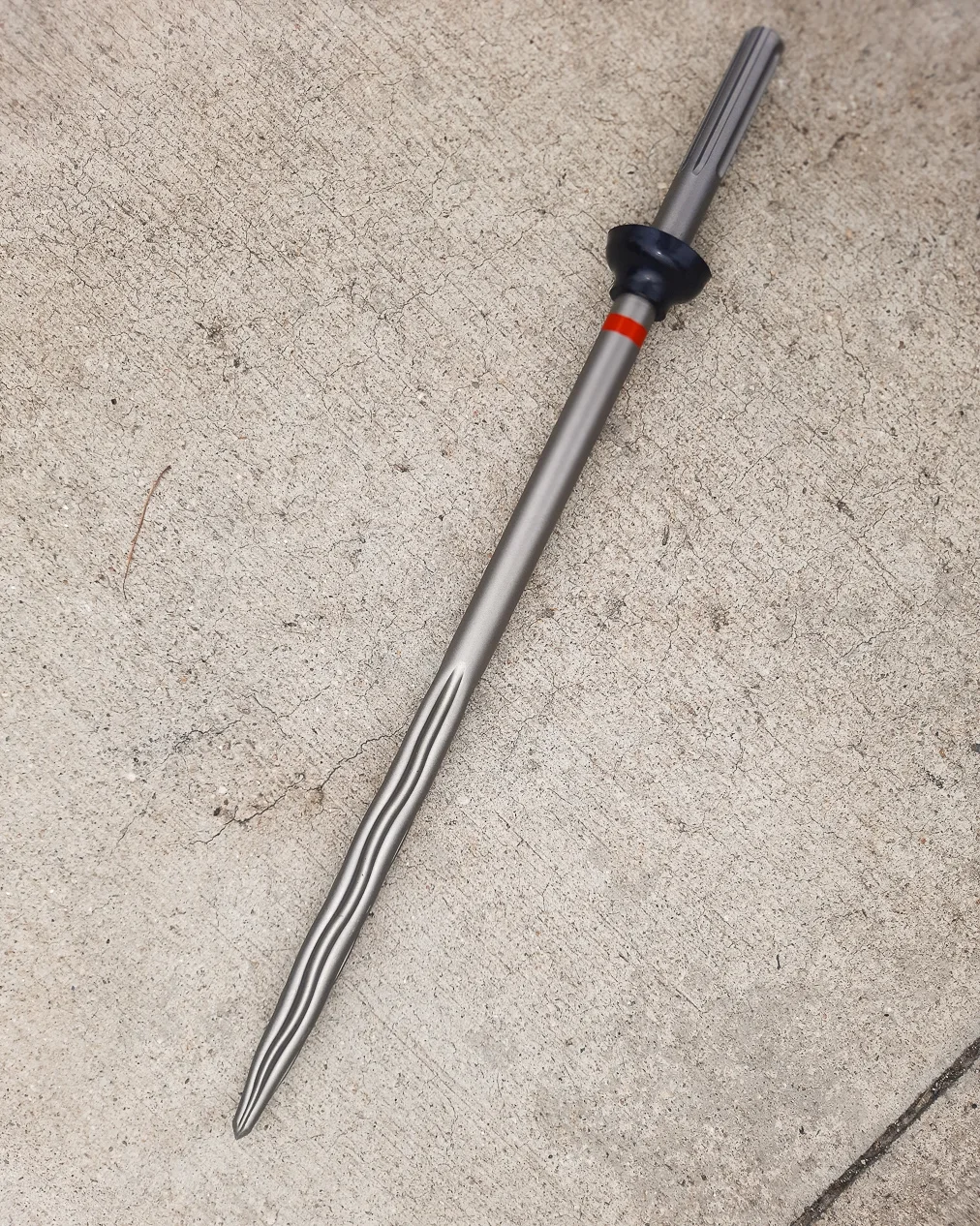
The black component near the holder end is the dust cap identified in Hilti’s feature list. It helps protect the holder entrance and is separate from the SDS-Max locking geometry. For an OEM sample, check cap retention and clearance without obstructing normal tool movement.
Keep cleaning and lubrication aligned with the machine instructions. The cap, shank fit and working-end profile address different parts of the demolition cycle.
Choose length for access and control
Use the shortest length that provides suitable access and working posture. A 280 or 360 mm reference may suit local breaking where reach is limited by the task; a 500 or 700 mm tool provides additional reach for a reviewed application. Longer tools do not increase the hammer’s rated impact energy.
State overall length explicitly in the order and review useful exposed reach separately. A catalogue length does not by itself define safe working clearance, insertion length or the depth of an opening. Confirm the selected length on the actual machine and task.
Pointed, flat and bushing tools do different jobs
A mixed retail listing may offer pointed chisels, flat chisels and a bushing head under one title. Select the actual accessory rather than treating the options as one geometry.
| Accessory | Primary working action | Typical selection focus |
|---|---|---|
| TE-YX SM pointed chisel | Localized penetration and fracture initiation | Starting openings and breaking within concrete or masonry |
| TE-YX FM flat chisel | Flat-edge engagement and controlled stripping | Channeling, edge control and removing strips of material |
| Bushing tool | Repeated impacts across a multi-point surface head | Roughening and suitable surface-preparation work |
Develop a premium wave-profile pointed chisel with our factory
At Zhonghuan Tools, our premium demolition-chisel program combines 42CrMo chromium-molybdenum steel, application-matched heat treatment and defined working-end geometry. We specify the complete point, wave section, body transition, shank and cap around the target machine and job.
A fast-rounding point calls for a review of the wear profile and working-end treatment. Repeated trapping calls for a review of the working section, material clearance and operation. Bending or fracture requires attention to the body section, transitions, toughness and impact duty.
We use TE-YX SM as an application benchmark. Our 42CrMo specification describes our own premium program, rather than identifying Hilti’s steel. The production deliverable is an approved sample and a repeatable drawing, material and process specification, with OEM marking and packaging.
Compare samples on the same hammer and substrate. Record removal progress, productive time, release time, point wear and shank condition. Include changing and freeing time in the cost per accepted completed task so the purchase decision reflects work delivered.
Frequently asked questions
Is Hilti TE-YX SM an SDS-Max pointed chisel?
Yes. Hilti identifies its connection as TE-Y (SDS-Max) and its working end as a self-sharpening point. Use a compatible machine in chiselling mode with rotation stopped.
What length is item 2241982?
TE-YX SM 28, item 2241982, has a published overall length of 280 mm. The common 11-inch retail description is a rounded imperial reference.
What does the 5 cm recommendation mean?
Hilti recommends at least 5 cm penetration in the self-sharpening description. It is a use condition for the cited design, not a fixed depth setting or overall-length formula.
Does the wave profile provide active dust extraction?
No. The external reliefs provide space for broken material to release. Active extraction requires the appropriate separate machine and dust-management equipment.
Is TE-YX SM interchangeable with TE-YX FM?
They share the SDS-Max interface but use different working ends. Choose the point for localized fracture initiation and the flat profile for the appropriate controlled-removal task.
Request a premium SDS-Max pointed-chisel program
Send the machine model, target material, required length and quantity. Add a reference photo or sample if available. We will review machine fit and the working profile, then propose a premium specification, comparative sample plan and OEM packaging.


