

A pointed chisel must keep breaking material after its fresh tip has worn and the working end has entered the concrete. That is where a wave-profile self-sharpening design earns its place: effective penetration, room for broken material to release and less time spent maintaining or freeing the tool.
The useful feature is the complete working system. The point starts the fracture, the profiled body engages the surrounding material, heat treatment supports the steel under repeated loading, and a dust cap helps protect the connection. We assess these features together when specifying a professional demolition chisel.
Four features, four different jobs
| Feature | Mechanical purpose | Buyer benefit to evaluate |
|---|---|---|
| Self-sharpening point | Retain a useful contact profile as material wears away | Penetration after use and time between permitted maintenance |
| Wave ribs and relief valleys | Arrange side contacts while leaving space around the working zone | Release time, trapped-tool interruptions and breaking progress |
| Steel and selective heat treatment | Combine local resistance to wear and deformation with a supporting section | Point wear, bending, cracking and connection-end condition |
| Dust cap | Help limit debris reaching the holder entrance | Holder cleanliness, cap condition and maintenance interruptions |
These features address different losses in a demolition cycle. A good point is less valuable if the body repeatedly wedges into the concrete; a durable working end still needs a correctly matched shank.
Five pointed-chisel configurations to keep separate
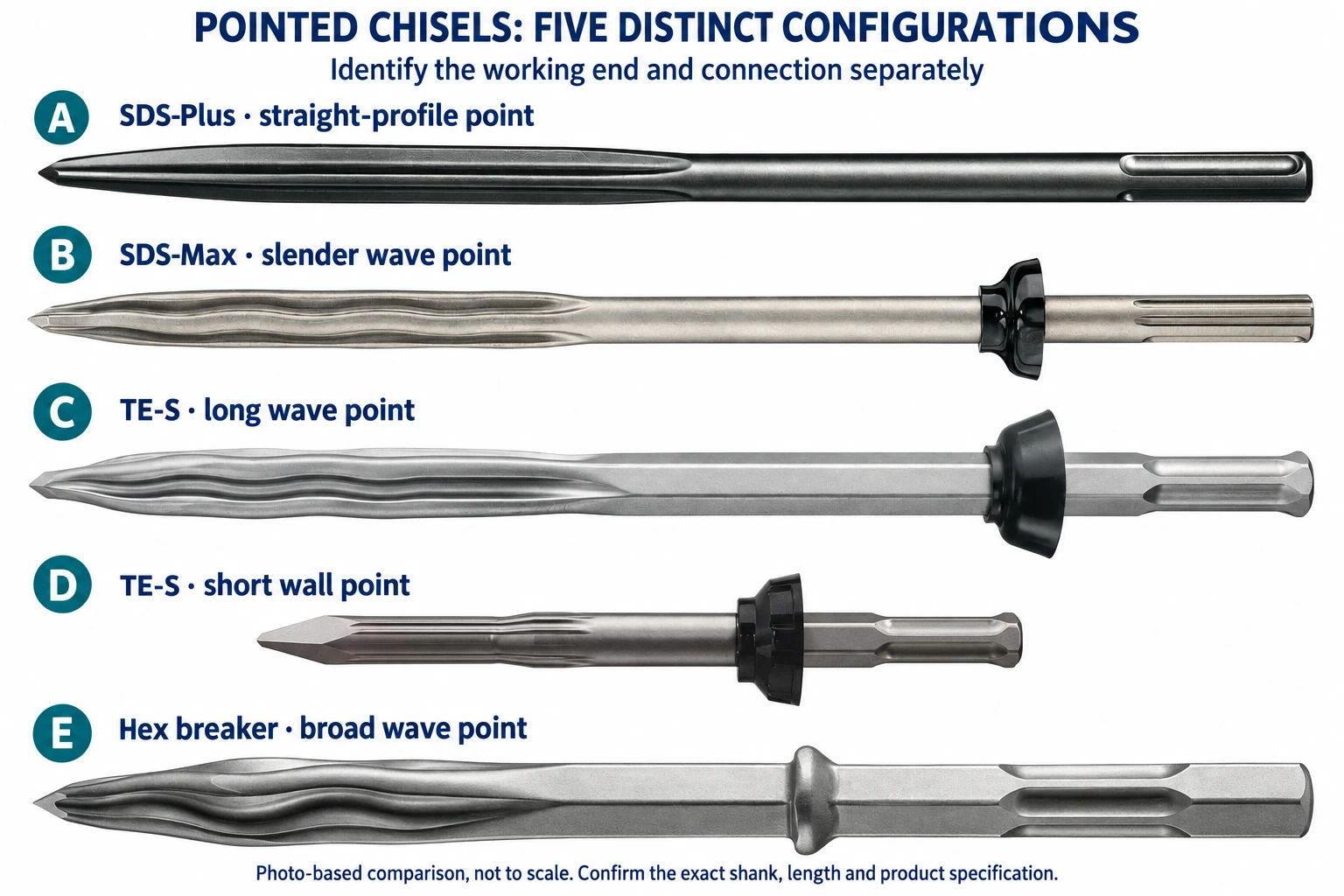
The comparison groups the visible designs by connection and working-end form. It is a selection map, not a claim that every photograph is a different model or that the illustrations share a physical scale.
| Reference | Connection | Visible working form | Main distinction |
|---|---|---|---|
| A | SDS-Plus | Slender point with predominantly straight longitudinal relief | Self-sharpening can be specified without a pronounced wave profile |
| B | SDS-Max | Slender wave working zone, round body and separate dust cap | Wave geometry with an SDS-Max connection |
| C | TE-S | Long wave working zone, polygon body and separate dust cap | A different connection from SDS-Max despite similar functions |
| D | TE-S | Compact wall-point layout with straighter front relief and dust cap | The same connection family can carry a different working length and head form |
| E | Hex breaker interface | Broad wave ribs, substantial polygon body and metal shoulder | Confirm the exact hex and retaining dimensions; the steel shoulder is not a dust cap |
A and B show why self-sharpening and wave profile are different classifications. B and C show why similar working ends do not establish machine compatibility. C and D show why even the same interface does not define the whole tool.
Different camera angles can make one broad-wave profile look slimmer or longer. A shorter illustrated tool may also have been enlarged more. Match the product number, actual length and complete rear connection before counting separate models. A package photograph can contain both pointed and flat chisels.
How the point and polygon section break material
The point concentrates the initial contact over a small area. An impact loads the concrete locally and can initiate fractures. As the tool advances, its flanks and raised portions engage the material around the entry point, helping open the developing break where the concrete has room to move.
A polygon section has several faces or lobes rather than a completely round outline. Its geometry changes where contact occurs and how much steel remains to support the working end. A wave profile adds changes along the length of those features. A tool can therefore be both polygon-shaped in section and wave-shaped along its working zone.
The centreline remains straight. The waves are features of the working surface; they do not make the chisel rotate like a screw. Use the machine's supported chiselling mode with rotation stopped.
How wave ribs and relief valleys can reduce sticking
A chisel can become trapped when surrounding material closes against it, fragments pack around the body, or the chosen depth and angle create a strong wedging condition. Release may then consume more time than the next impact cycle.
The wave design interrupts a continuous side-contact surface. Raised areas engage the material while adjacent valleys leave local relief. That gives loosened fragments space to move and can reduce the amount of the working zone held tightly between broken surfaces. The intended benefit is easier release as the break develops.
This is a contact-and-clearance explanation, not a rule that friction falls in direct proportion to visible surface area. The actual contact forces, fragment shape, working angle and surrounding fracture all matter. Deep valleys also remove supporting steel, so the full section and transitions need to be considered together.
Grooves provide a route for debris to disengage. They are not a vacuum passage: active dust collection requires the appropriate extraction equipment. A solid wave-profile chisel is also different from a hollow dust-extraction drill bit.
What self-sharpening means as the tip wears
Self-sharpening geometry is shaped so that wear can expose a useful working profile behind the original tip. The goal is sustained breaking ability through the intended wear zone, rather than preservation of a needle-sharp point for the entire service life.
A point that becomes heavily rounded presents a broader initial contact. A correctly developed profile can limit that loss of useful geometry as it recedes. Material is still consumed, and the section eventually reaches its service limit.
Mushrooming is permanent deformation, not evidence that the tool is sharpening itself. Judge the remaining point, cracks and service limits using the particular tool's instructions. Do not apply a conventional grinding shape or rehardening recipe to a profiled chisel without the specified maintenance procedure.
Working depth changes which features engage
At very shallow contact, mostly the tip meets the material. As penetration increases, more of the wave-profile working zone can participate in contact, fracture and debris clearance. That is why a fresh point tested only on the surface does not describe its behaviour during a complete break.
Required engagement depth is model-specific. Use the selected tool's instructions and the work plan; a depth recommendation for one design is not a universal setting for every wave chisel. The objective is controlled material removal, not driving the tool deeper solely to reach a number.
A nearby free edge, the direction in which material can escape, aggregate and existing reinforcement all affect the operation. Follow the project requirements for reinforcement and embedded services. A pointed demolition chisel is not a substitute for a specified reinforcement-cutting method.
Induction hardening supports the working surface
Induction hardening uses an electromagnetic field to heat a selected steel region, followed by controlled quenching. With the appropriate steel and process, it can develop a hardened surface while retaining a supporting core. Geometry, starting material condition, heating pattern and subsequent treatment govern the finished result.
For a demolition chisel, the engineering objectives include resistance to wear and permanent deformation without making the tool excessively susceptible to cracking. The working point, body transitions and connection end perform different jobs; the same headline hardness value does not describe all of them.
Case depth and hardness distribution should follow the finished-tool specification. Surface colour does not reveal that distribution, and induction hardening alone does not identify the steel grade. Induction-hardening process reference
What the dust cap protects
The dust cap sits near the machine end and helps limit debris reaching the holder entrance. It supports a cleaner connection environment, where the shank must slide, receive impacts and remain retained as intended.
The cap is separate from the load-carrying steel body and retaining geometry. Its protective function does not change the shank specification. Check its condition and position along with the holder's seals and the prescribed lubrication.
A cap around the shank does not collect the airborne dust produced at the concrete face. Use the dust-control equipment specified for the job and machine.
Where a wave-profile point fits in a tool range
| Task | Starting tool direction | What to confirm |
|---|---|---|
| Local concrete breaking | Pointed chisel, including a suitable self-sharpening wave design | Access, machine duty, release and point wear |
| Controlled edges and narrow channels | Flat or channel chisel | Working width, removal direction and edge control |
| Tile, mortar or floor layers | Application-matched tile chisel, spade or scraper | Entry angle, adhesion and the base to preserve |
| Repeated trapping during breaking | Review the point profile and working method together | Fracture direction, clearance, depth and machine match |
Choose the connection independently of the head shape. SDS-Plus, SDS-Max and hex or other breaker connections have different insertion and retaining geometry. A similar-looking polygon body or nominal hex size does not establish compatibility. Confirm the complete shank and the exact machine model.
Compare complete work, including interruptions
Use the same machine, comparable material and a defined removal task for a useful sample comparison. Keep the tool dimensions and working method in the record. Compare:
- Material removed in the same working period, or time to complete the same task.
- Time spent freeing a trapped chisel and repositioning it.
- Before-and-after tip condition and remaining profile.
- Bending, cracks and connection-end deformation.
- Dust-cap condition and holder contamination.
Report the test conditions with any result. A wave profile is most valuable when it improves the completed task, including downtime, rather than simply producing an impressive-looking new tip.
At Zhonghuan Tools, our premium chisel program uses 42CrMo steel with geometry and treatment requirements matched to the intended duty. When requesting a wave-profile tool, provide the reference shape, machine model, material to remove, dimensions and quantities. Our engineering team handles the detailed section and process match. The exact alloy and treatment of a reference product remain separate from our supplied specification.
For a focused SDS-Max assortment, our current two-piece set pairs a 400 mm twisted pointed chisel with a 25 × 400 mm self-sharpening flat chisel. A twisted point and a wave-profile point are separately specified geometries. View the 400 mm point-and-flat set or discuss a chisel supply program.
Frequently asked questions
Is a wave-profile chisel the same as a twisted point?
No. Wave describes an undulating working profile; twisted describes a change in orientation along the point. Some geometries combine features, so compare the actual tool section and shape.
Does self-sharpening mean no wear or unlimited life?
No. Steel still wears away. The design aims to retain a useful point through its intended wear zone, subject to the tool's service and maintenance limits.
Do the grooves or dust cap provide dust extraction?
Relief valleys help fragments disengage, and the cap helps protect the holder entrance. Active collection at the work face requires suitable extraction equipment.
Can a wave-profile point replace every flat or tile chisel?
No. A point suits concentrated breaking. Controlled channels, tile lifting and wide surface removal need their own edge geometry and machine match.


