

A Multi-Insert Four-Cutter for Professional Concrete Drilling
KEIL W2 TURBOKEIL Xform is a multi-insert four-cutter SDS-Max drill bit for demanding concrete, reinforced concrete, masonry and stone applications. Its compact X-type head combines a full-width primary carbide blade with two separate side inserts. Behind the head, W2 flutes carry the broken material out of the hole.
For installers drilling larger fastening or installation holes, head stability and dust removal need to work together. Select the diameter and depth for the job, then match the rotary hammer’s drilling capacity and impact energy. The resulting load on the head, steel body and connection is more useful for selection than cutter count alone.
Three Carbide Pieces, Four Working Edges
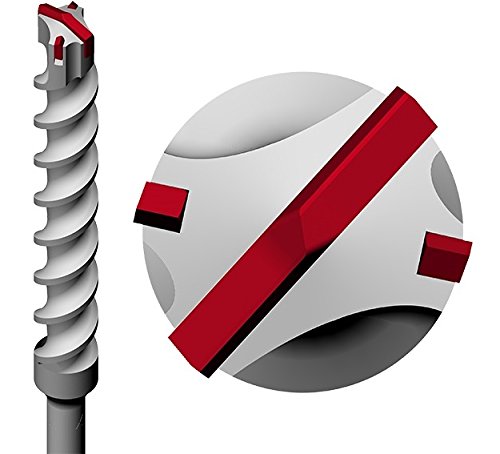
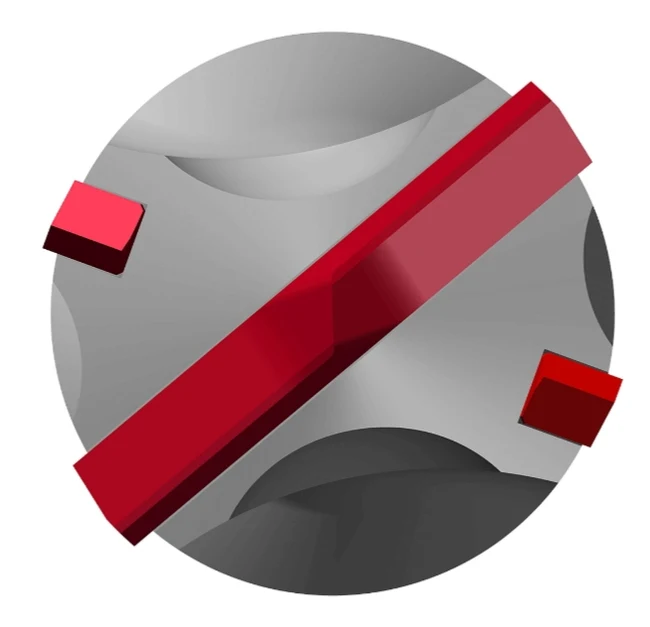
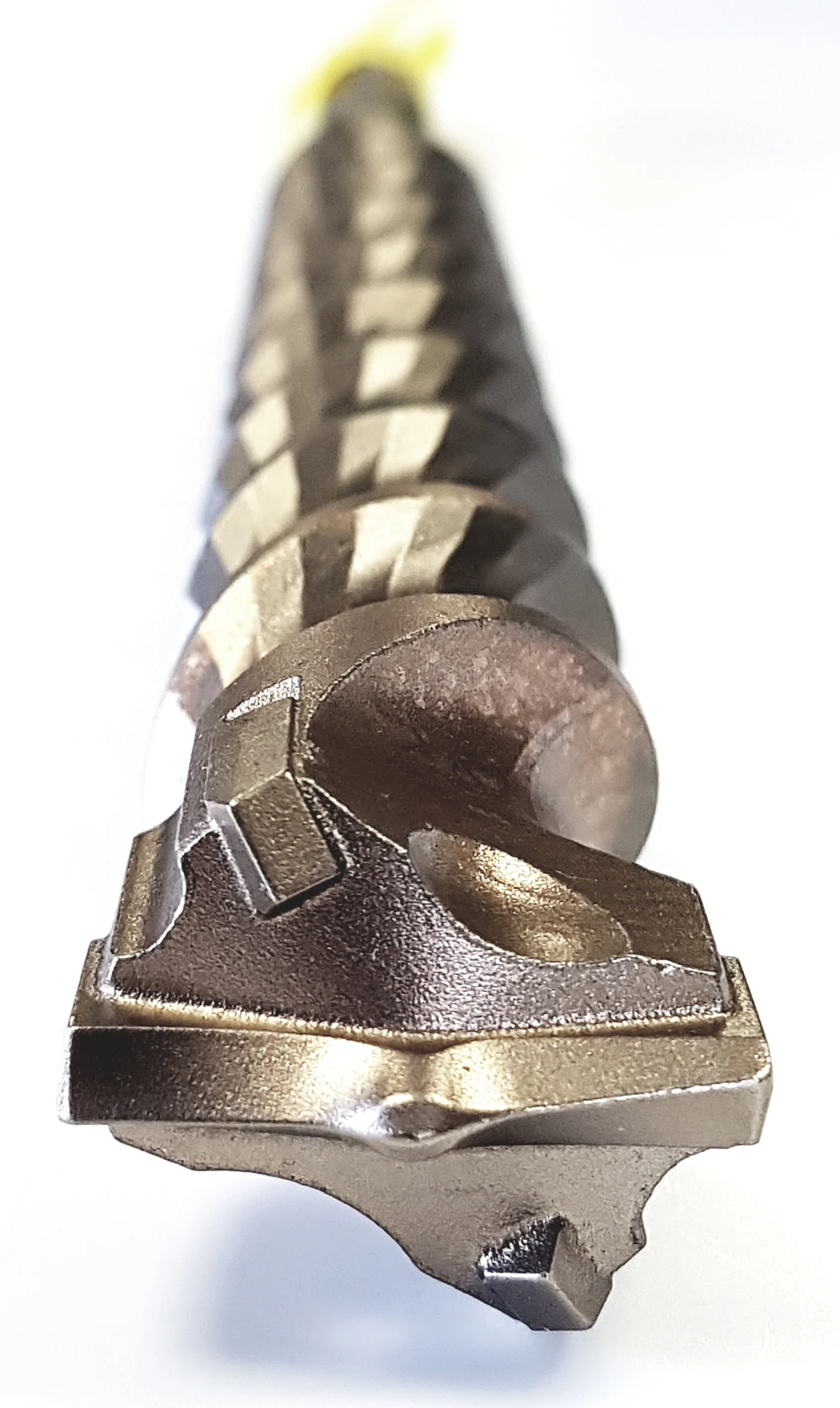
The coloured end view makes the construction easy to read: a long carbide blade crosses the steel head, with a separate carbide insert at each side. The primary blade forms two main working edges, and the side inserts add two further edges. Three carbide components therefore produce the four-cutter layout.
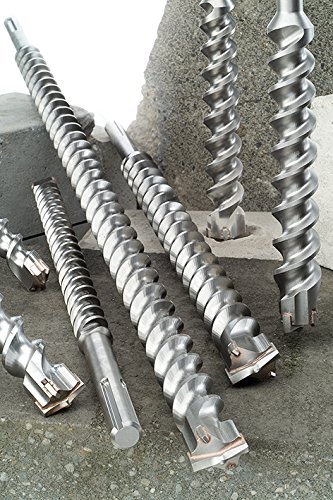
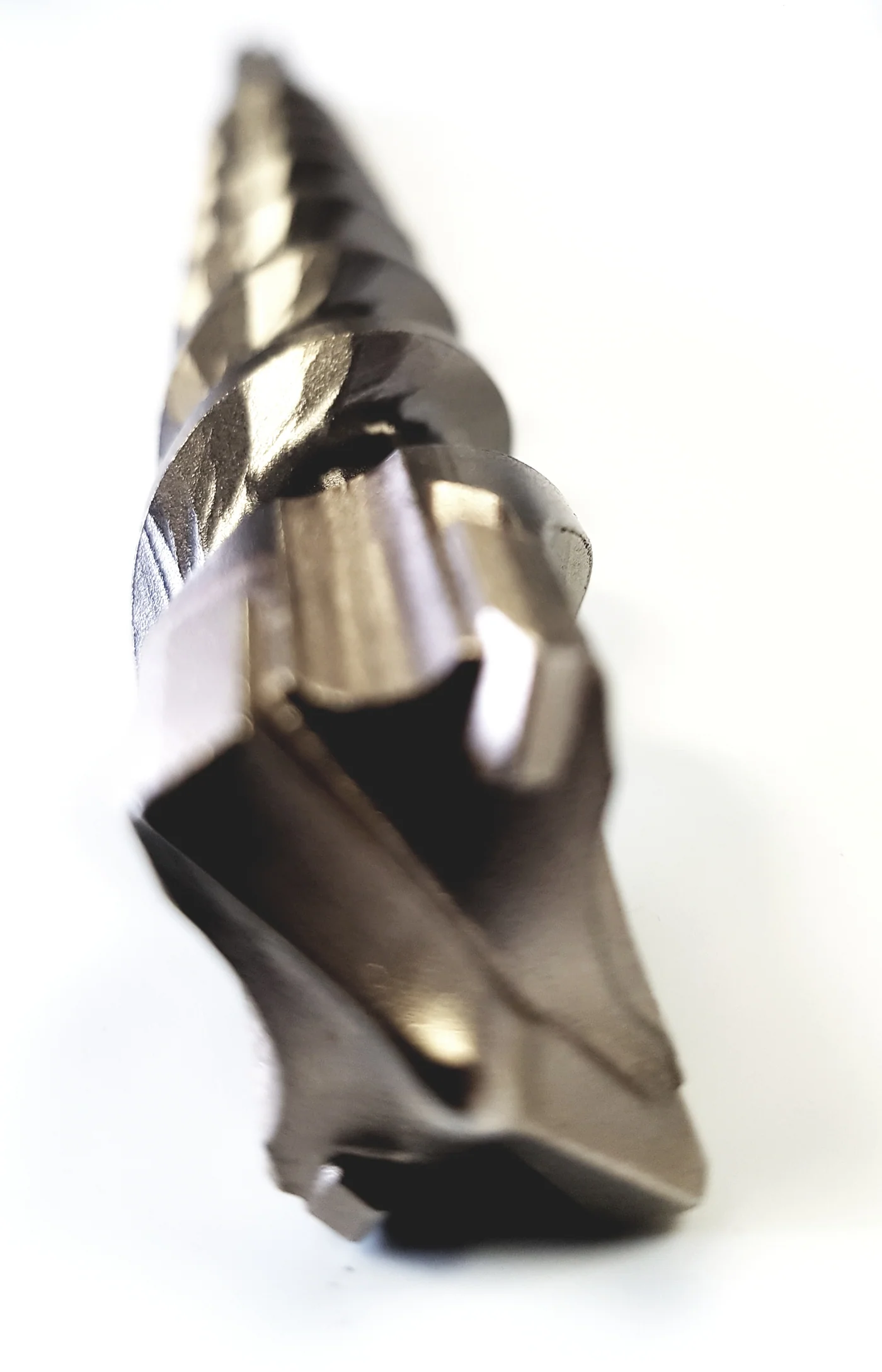
The detailed photos show the primary blade, side-insert seats and steel between the carbide pieces. This supported arrangement gives each component a defined place in the compact head. KEIL describes the design around accurate guidance, reduced hole-wall friction and resistance during reinforcement contact (KEIL).
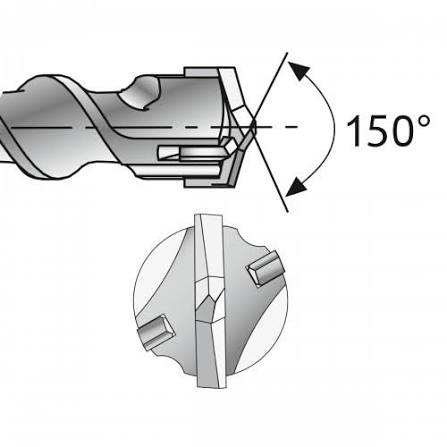
The supplied drawing marks a 150° tip angle. Read that angle alongside the primary-blade profile, the positioning of the side inserts and the clearance behind the edges. These features determine how the head engages the material and passes fragments into the flutes.
How the W2 Double Flute Clears the Hole
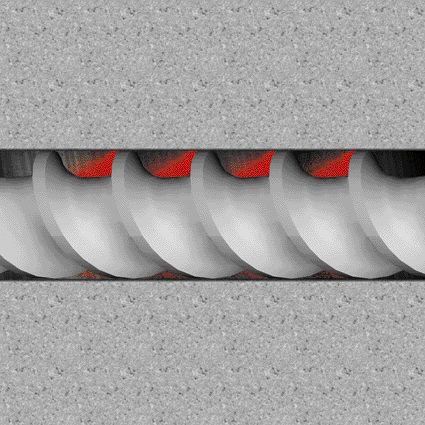
KEIL describes W2 as a double conveying flute with asymmetrical, shovel-shaped entry grooves and large dust chambers. Short entrances behind the head help material reach the conveying channels; the open channel volume gives the fragmented concrete room to move towards the hole mouth (KEIL).
This makes the head-to-flute transition a useful inspection point. For deep-hole work, compare continuous drilling progress, evacuation and resistance to blockage on the same concrete and hammer. The flute transports debris out of the hole, while the selected extraction accessory collects dust at the work surface.
Head Construction Changes with Diameter
KEIL’s 270 product group covers more than one carbide-head construction. The Xform product page lists Ø22–50 mm and one main cutter with two side cutters. The 2025 catalogue, pages 27–28, places this multi-insert design from Ø22 mm and assigns the smaller diameters through Ø20 mm to TURBOHEAD Xpro (KEIL 2025).
The same catalogue explicitly lists Ø15 mm as a two-cutter exception. A retailer may show the whole 8–50 mm range on one page, so select the construction by diameter and article. The table below separates the head families; it does not mean every length is available in every diameter.
| Head family | Diameter grouping | Carbide construction |
|---|---|---|
| W2 TURBOHEAD Xpro | Ø8–20 mm* | Full-carbide Xpro head |
| W2 TURBOKEIL Xform | From Ø22 mm; product page Ø22–50 mm | Primary carbide blade + two side inserts |
* The 2025 catalogue lists Ø15 mm as a two-cutter exception.
Compare the one-piece Xpro head and MS5 SDS-Plus flute in our separate KEIL guide.
SDS-Max Sizes, Article Numbers and Machine Selection
The following article examples come from KEIL’s 2025 catalogue. L2 is working length; L1 is overall length. For example, 270 320 570 identifies Ø32 mm with 450 mm working length and 570 mm overall length. Keep all three dimensions in an order.
| KEIL article | Diameter (mm) | Working length L2 (mm) | Overall length L1 (mm) |
|---|---|---|---|
| 270 220 320 | 22 | 200 | 320 |
| 270 250 520 | 25 | 400 | 520 |
| 270 320 570 | 32 | 450 | 570 |
| 270 320 920 | 32 | 800 | 920 |
| 270 401 320 | 40 | 1200 | 1320 |
| 270 500 570 | 50 | 450 | 570 |
The connection is SDS-Max, which KEIL also identifies for the corresponding HILTI TE-Y drive. Use a rotary hammer with rotation and hammer action and a suitable diameter range. An SDS-Plus holder is a different machine connection.
For working lengths of 400 mm and above, KEIL specifies pre-drilling at least 150 mm with a shorter bit of the same diameter. At working lengths of 800 mm and above, the specified pilot depth is at least 400 mm. These catalogue instructions support controlled starting of longer bits; follow the approved drilling plan around structural reinforcement (KEIL 2025).
Steel Body and Brazed Carbide Connections
KEIL lists chrome-nickel-molybdenum steel, shot peening, heat treatment and high-temperature brazing at approximately 1,120°C on the Xform product page. In this construction, the steel supports three separate carbide components and transfers the rotary hammer’s load through the complete bit (KEIL).
For sample comparison, examine carbide seating, joint consistency, head gauge, body straightness and shank fit alongside drilling progress. The page’s PGM marking relates to controlled hole geometry for fastening; anchor selection, hole cleaning and installation still form part of the fastening system.
Build an OEM SDS-Max Range with Zhonghuan
We develop SDS-Max drill bits for distributors, importers and private-label brands. A three-piece X-type four-cutter programme can be specified around the primary blade, side inserts, carbide grade, steel body, brazed joints and required working lengths.
Send the concrete or stone application, reinforcement conditions, rotary-hammer model, diameter × working length × overall length, quantities and packaging requirements. We will propose a configuration and sample plan for your market, with the finished head and complete bit assessed against the approved specification.
Frequently Asked Questions
Why is this a four-cutter if the head contains three carbide pieces?
The primary carbide blade forms two working edges. The two separate side inserts add one edge each, giving four edges from three components.
Is the entire 8–50 mm range made with the same head?
KEIL’s catalogue places Xpro through Ø20 mm and the primary-plus-two-side-cutter Xform construction from Ø22 mm. It separately identifies Ø15 mm as two-cutter.
Is W2 the same flute as the MS5 on the SDS-Plus Xpro?
They are separate named flute systems. This SDS-Max Xform uses the W2 double conveying flute; the earlier SDS-Plus article covers MS5.
Can this SDS-Max bit be fitted directly into an SDS-Plus hammer?
Choose a bit with the machine’s specified holder. SDS-Max and SDS-Plus are different connections; the Xform range discussed here is SDS-Max.


