
Quick Answer: Two Tools for Two Different Jobs
If you searched “TCT chisel vs forged chisel”, the short answer is: they are not competing products. They are two fundamentally different tools optimized for different cutting mechanisms and different substrates. A TCT-tipped chisel rakes and shears with discrete carbide teeth — best for mortar joints, tile, adhesive, and surface scaling. A forged steel chisel impact-fractures with a monolithic steel edge — best for concrete demolition, channel cutting, and structural breaking.
The longer answer matters for procurement and field selection: choosing the wrong tool wastes both the bit and the rig time. Carbide teeth shatter under sustained structural impact (regardless of carbide grade). Forged steel edges dull in seconds against silica-rich mortar. The decision rule is substrate + duty cycle, not personal preference.
This article walks through the construction, the cutting mechanism, the engineering specs, and the substrate decision matrix so the choice becomes deterministic.
The Construction Difference
The two chisel types are built differently from the steel up:
| Construction Element | Forged Steel Chisel | TCT-Tipped Chisel |
|---|---|---|
| Cutting edge | Hardened steel itself, one piece | Discrete tungsten carbide teeth brazed onto steel face |
| Body material | 40Cr or 42CrMo4 forged, heat-treated 50–55 HRC throughout | 40Cr or 42CrMo4 body, heat-treated 45–50 HRC (carbide teeth handle the cutting hardness) |
| Manufacturing process | Hot forging + grinding + heat treatment + induction-hardened tip | Body machining + carbide tooth procurement + controlled-atmosphere mesh-belt or nitrogen-shielded high-frequency induction brazing + final grinding |
| Edge geometry | Single continuous edge (point, flat, gouge, spade) | Discrete multi-tooth face (4 / 6 / 8 teeth across 25–50 mm width) |
| Sharpening behavior | Self-sharpens via impact deformation (point chisels especially) | Carbide does not deform — wears or fractures; bit is discarded at end of life |
| Cost per piece (commodity tier) | Lower — single material, single process | Higher — composite construction, brazing process control adds cost |
The construction difference drives every downstream property. A forged chisel is its cutting edge — when the steel deforms or wears, the geometry changes but the tool continues to function (sometimes better — point chisels notoriously self-sharpen on concrete). A TCT-tipped chisel carries its cutting edges — the carbide teeth do the cutting work, the steel body is the structural delivery mechanism for impact energy from the SDS shank to the workpiece.
Cutting Mechanism: Raking Shear vs Impact Fracture
The deeper physics is in how each chisel removes material:
Forged steel — impact fracture mechanism
A forged chisel works by transmitting impact energy through a concentrated steel edge into the workpiece. The impact creates a stress wave that exceeds the substrate's fracture toughness, and material breaks along the crack propagation path. The chisel itself absorbs reaction force by plastic deformation — the steel yields slightly with each blow, which is why forged point chisels in particular tend to mushroom (and self-sharpen) over their service life.
This mechanism is well-suited to brittle, isotropic substrates with definable fracture toughness: concrete, hardened mortar in bulk demolition, brick when crushing rather than preserving, stone, rock. The bit transmits impact, the substrate fractures, material removal proceeds.
TCT-tipped — raking shear mechanism
A TCT-tipped chisel works differently. The discrete carbide teeth do not transmit a single concentrated impact — they create multiple smaller shearing actions across the chisel face. The operator typically holds the bit at a slight angle (5–15° from the surface plane) and the rotary hammer's impact pulses drive the teeth into the substrate at that angle, shearing material off in a raking action.
The gaps between teeth are not cosmetic — they are functional. As each tooth shears a chip, the chip needs somewhere to go. The inter-tooth gap provides the clearance for chips to evacuate ahead of the next impact cycle. Without this clearance, the bit would pack out (chips jamming under the teeth) and lose effectiveness within seconds.
This mechanism is well-suited to substrates that are:
- Softer than the body of the workpiece you want to preserve — mortar between bricks (preserve the bricks), thinset under tile (preserve the substrate), adhesive on a floor.
- Highly abrasive but not structurally fracture-resistant — silica-rich mortar, ceramic adhesive, paint residue, surface concrete spatter.
- Layered or laminated — tile-on-thinset-on-substrate, where you want to remove the upper layer without damaging the lower.
When TCT-Tipped Chisels Win
The applications where TCT-tipped chisels are clearly the right tool:
- Mortar raking / repointing — removing damaged mortar from brick joints without scuffing the brick face. The dominant TCT chisel application; 25–32 mm width 4-tooth design is the volume product. Professional masons use TCT chisels for sustained brick-repointing work.
- Tile and adhesive removal — stripping floor or wall tile and the underlying thinset / adhesive layer. 40 mm 6-tooth or 50 mm 8-tooth face works well; the wider face speeds removal and the discrete teeth shear the adhesive without gouging the substrate.
- Surface scaling — cleaning concrete spatter off walls and floors, removing surface coatings, stripping old plaster or render before re-application.
- Cavity inspection and brick removal — when a single brick needs to come out of a wall for inspection or repair, a TCT chisel can rake the mortar joints all the way around without damaging adjacent bricks.
- Channel cutting in light masonry — narrow channels for electrical conduit in brick or AAC where preserving the surrounding material matters.
When Forged Steel Chisels Win
The applications where forged steel is clearly the right tool — and where TCT would actively fail:
- Concrete demolition — breaking up slabs, walls, foundations, structural concrete. Sustained heavy impact at high frequency. TCT teeth would shatter within minutes; the carbide-to-steel brazed joint would fail under the lateral fracture forces. Forged point chisels are the standard tool here.
- Heavy channel cutting in reinforced concrete — when the channel needs to go through hardened reinforced concrete (not just brick or render), the impact loading exceeds TCT tooth capability.
- Brick crushing demolition — when you're tearing down a wall and want to break the bricks rather than preserve them, a forged flat chisel works faster and cheaper.
- Asphalt and bituminous surface breaking — the sticky-ductile behavior of asphalt clogs TCT tooth gaps; forged steel edges shear through without packing out.
- Heavy structural removal — column shaving, slab edge breaking, structural repair where the chisel is hammered against rebar or hardened steel inclusions. TCT teeth do not survive rebar contact.
- Cost-sensitive high-volume work — when you're going to consume 30+ chisels on a single demolition contract, forged steel's lower per-piece cost matters even if life is shorter.
Substrate Decision Matrix
| Substrate / Application | Right Tool | Why |
|---|---|---|
| Mortar joints (brick repointing) | TCT 4-tooth 25–32 mm | Preserve brick face, abrasive-resistant carbide |
| Tile + thinset removal | TCT 6-tooth 40 mm or 8-tooth 50 mm | Wide face speeds removal, preserves substrate |
| Surface scaling / concrete spatter | TCT 6-tooth or 8-tooth | Surface work, not structural fracture |
| Adhesive / coating removal | TCT 8-tooth 50 mm+ | Shear action ideal for layered removal |
| Concrete demolition (slab breaking) | Forged point chisel | Impact fracture, sustained heavy load |
| Channel cutting in reinforced concrete | Forged flat chisel | May contact rebar, TCT would shatter |
| Brick crushing demolition | Forged flat chisel | Cost-effective at high volume |
| Asphalt / bituminous breaking | Forged spade or flat | Sticky-ductile material clogs TCT gaps |
| Stone / hard aggregate | Forged point chisel | Brittle fracture substrate, impact mechanism |
Tooth Count and Geometry Physics
TCT chisel tooth count is matched to face width and target substrate. The relationship is governed by two physical constraints — impact load per tooth, and chip clearance.
Impact load per tooth
An SDS-Plus rotary hammer in chisel mode delivers roughly 2–4 joules of impact energy per blow. If that energy concentrates on a single forged steel edge, the steel deforms slightly but transmits the load. If the same energy concentrates on a single carbide tooth, the tooth fractures — carbide is hard but brittle. Distributing the load across multiple teeth keeps the per-tooth impact below the carbide's fracture threshold.
The rough scaling: a single tooth on a TCT chisel face would see roughly 100% of the impact energy and fail in the first few cycles. 4 teeth see ~25% each — well within carbide's load capacity for YG8C / YG11C grades. 6 teeth see ~17% each, 8 teeth see ~12% each. More teeth = lower per-tooth load = longer service life under heavy duty.
Chip clearance
The trade-off against adding more teeth is chip clearance. Each cutting cycle generates material chips that need somewhere to go — between the teeth, ahead of the next impact pulse. If teeth are packed too densely, chips bridge across multiple teeth, the bit packs out, and cutting effectiveness collapses.
Practical tooth pitch (center-to-center spacing) for TCT chisels is roughly 6–8 mm. This gives enough clearance for mortar chips and adhesive debris to evacuate while keeping per-tooth load manageable. The face width then determines tooth count:
- 4 teeth × 6–8 mm pitch ≈ 24–32 mm face width — mortar raking standard
- 6 teeth × 6–8 mm pitch ≈ 36–48 mm face width — surface scaling / tile removal
- 8 teeth × 6–8 mm pitch ≈ 48–64 mm face width — heavy adhesive / coating removal
Why TCT Chisels Share DNA with TCT Core Bits
The engineering of premium TCT chisels parallels TCT core bits at every material and process layer:
- Same carbide grade family — YG8C or YG11C cobalt-rich impact-grade tungsten carbide, optimized for SDS rotary hammer impact loading. Same selection logic, same suppliers, same material certificates.
- Same controlled joining discipline — continuous controlled-atmosphere mesh-belt furnace brazing for volume production, or nitrogen-shielded high-frequency induction brazing for a selected standard professional program. Both require a locked filler, joint gap, atmosphere, thermal window and inspection plan.
- Same body steel — 40Cr or 42CrMo4 hardened with documented mill certificate. Same metallurgy, slightly different geometry (chisel is a solid bar with a flat face, core bit is a hollow tube with a circular rim).
- Same QC documentation — material certificates, brazing process documentation, dimensional inspection per production lot.
This is why a factory that can produce premium TCT core bits can also produce premium TCT-tipped chisels: the engineering knowledge transfers directly. The geometry changes (chisel face vs core bit rim, fewer teeth in a row vs many teeth around a circumference) but the underlying material science and process control are identical.
For procurement teams: a supplier audit that verifies TCT core bit brazing capability also verifies TCT chisel brazing capability. The two categories often share production lines at the brazing furnace stage.
Cost Per Cut: Procurement Economics
The procurement framework that matters is not unit cost per chisel but cost per linear meter of material removed. The numbers swing depending on substrate:
- Mortar raking — a premium TCT 4-tooth chisel ($15–30) can rake 200–400 meters of brick mortar before tooth wear retires it. A forged flat chisel ($5–10) used in the same application would dull within 20–40 meters and need replacement. TCT cost per meter: 25× lower than forged in this application.
- Concrete demolition — a forged point chisel ($8–15) can break out 5–10 cubic meters of concrete before mushrooming retires it. A TCT chisel attempted in this application would fail within 30 minutes of sustained impact. TCT cost per cubic meter: not measurable, the bit fails first.
- Tile removal — a premium TCT 6-tooth 40 mm chisel ($20–40) strips 30–50 m² of tile before retirement. A forged flat chisel in the same application strips 5–10 m² but gouges the substrate. TCT is the only viable choice if substrate preservation matters.
The economics drive the selection rule: match the chisel type to the substrate, not to the unit price. A $30 TCT chisel that completes a $5,000 brick repointing job in one bit is cheaper than $50 of forged chisels that damage the brickwork.
Inside our production
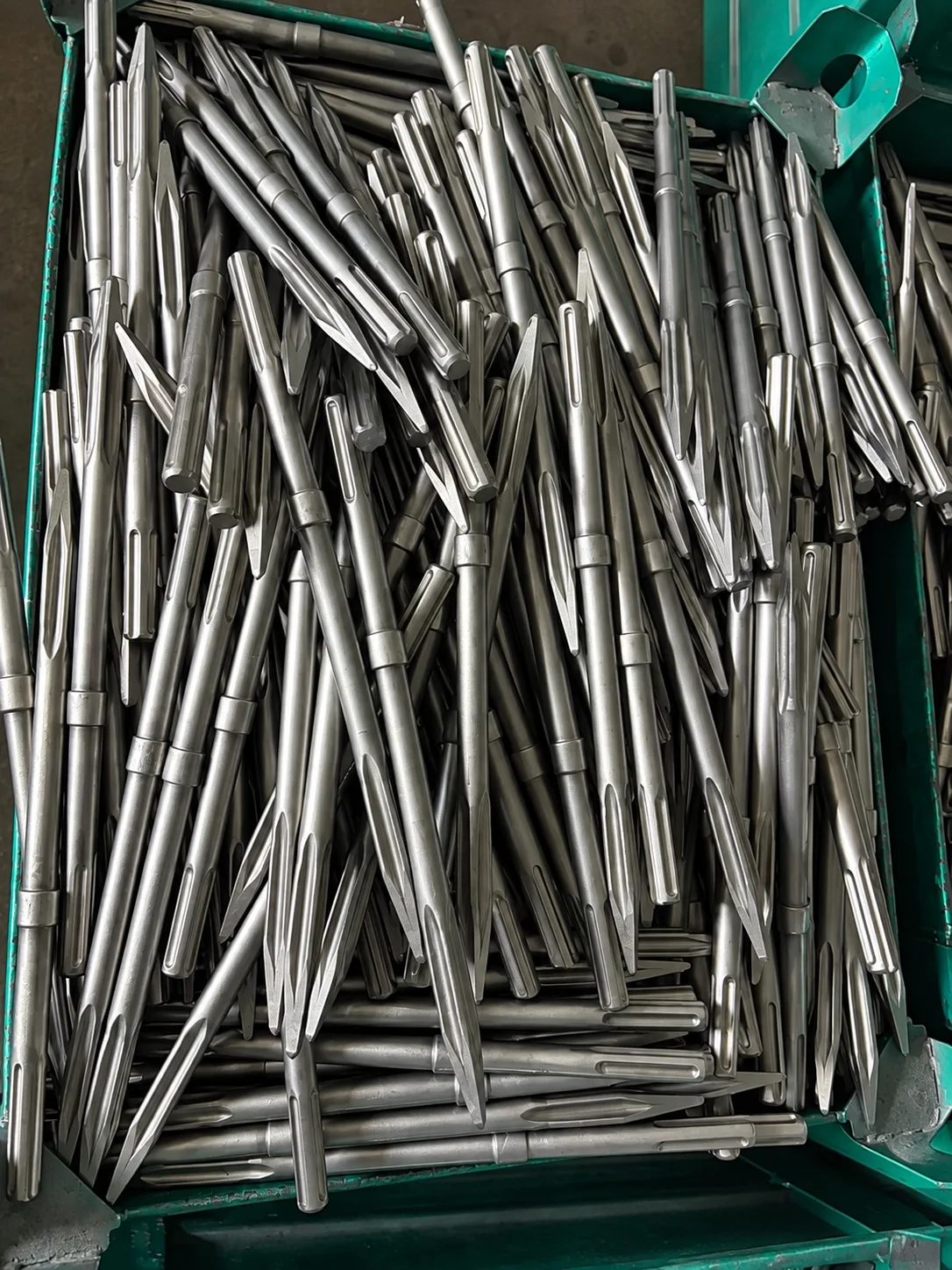
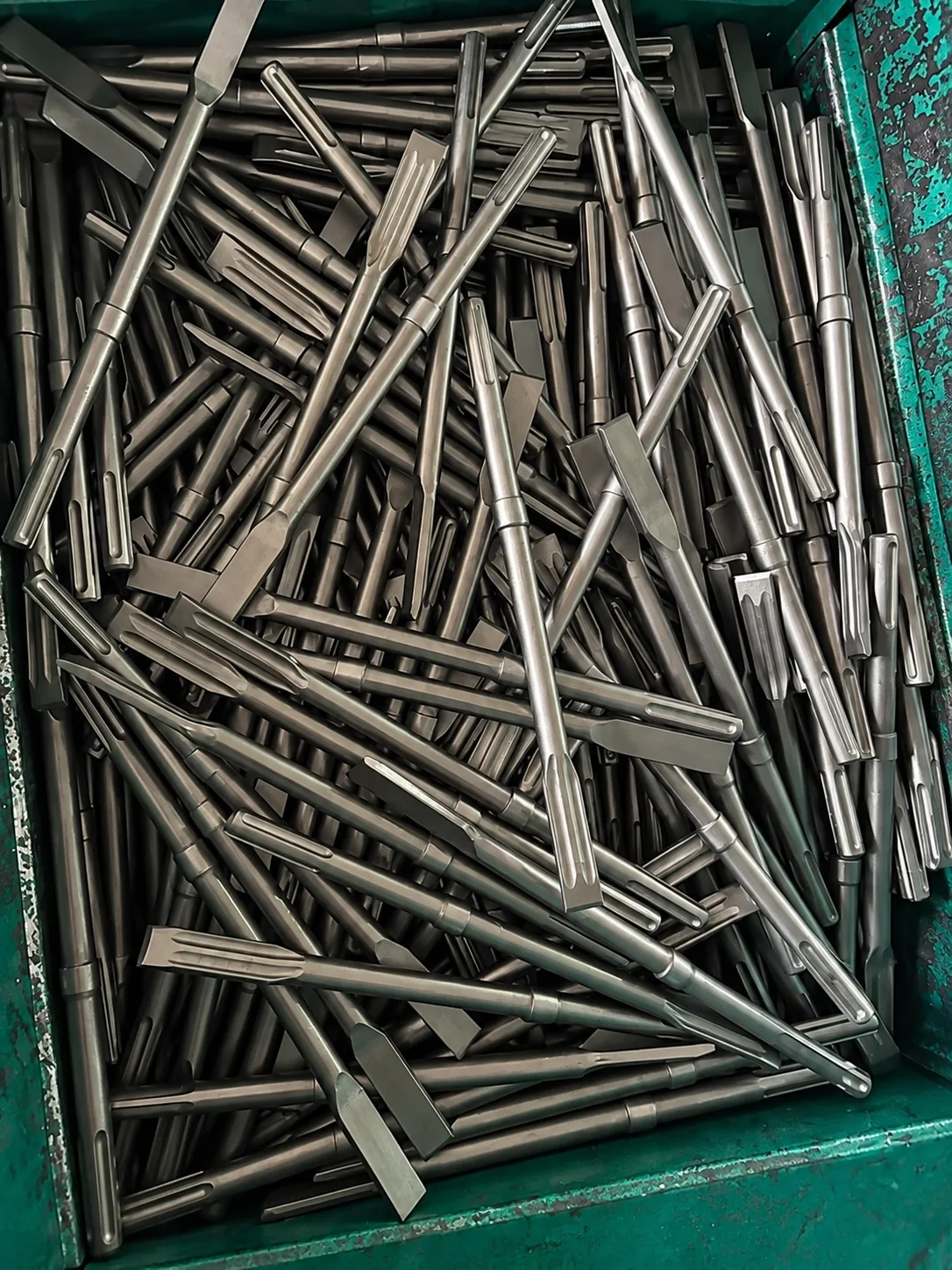
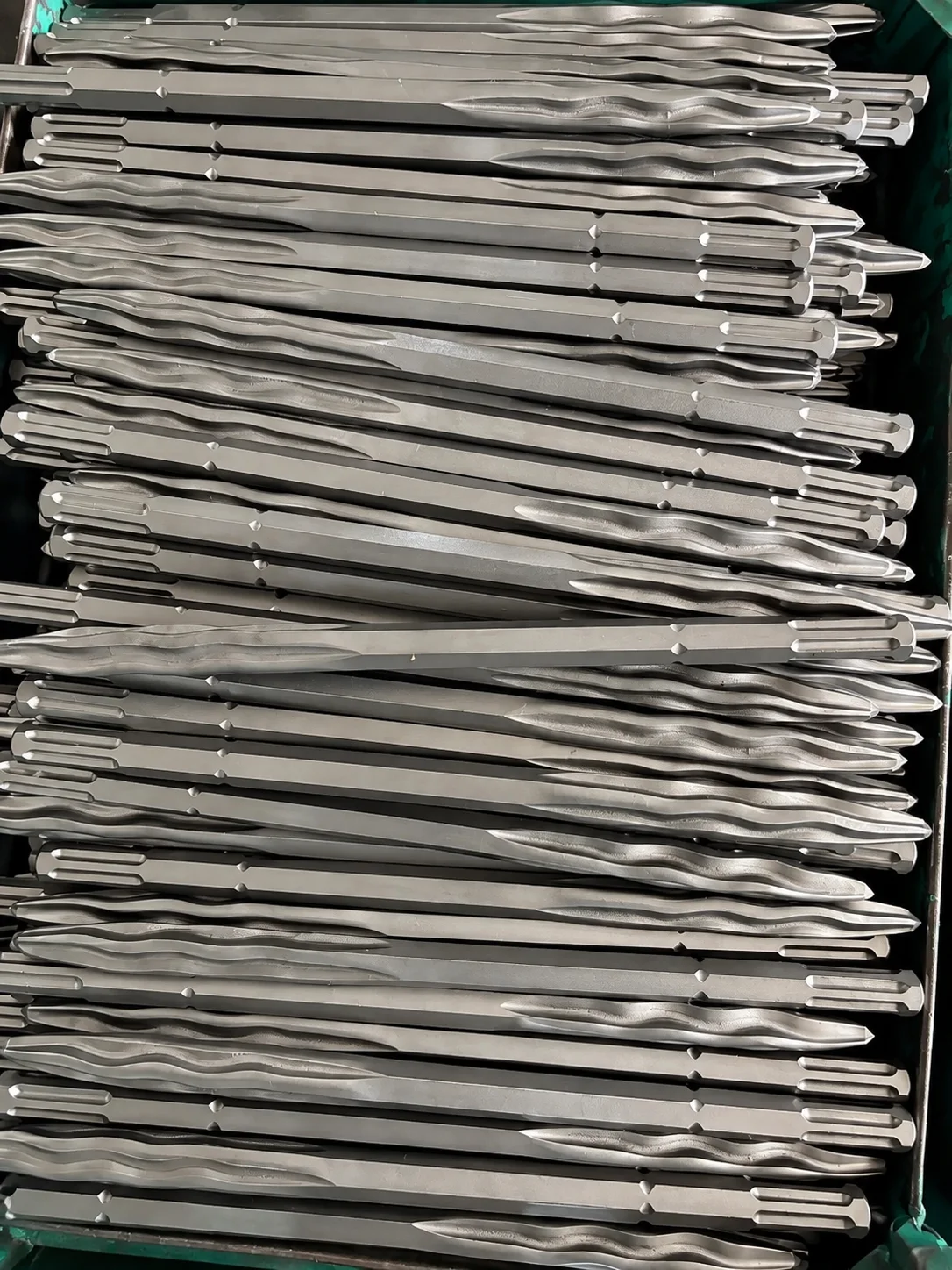
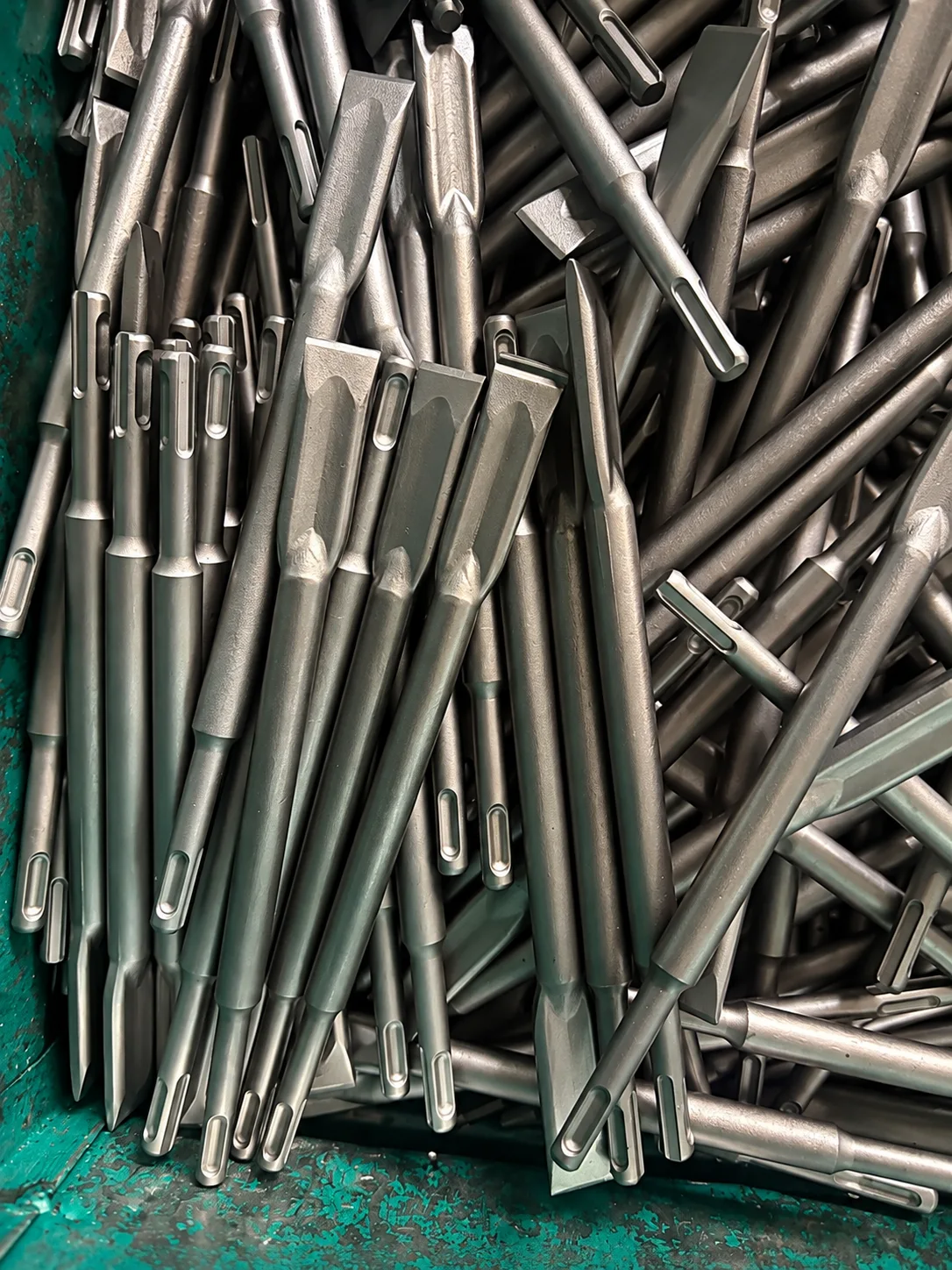
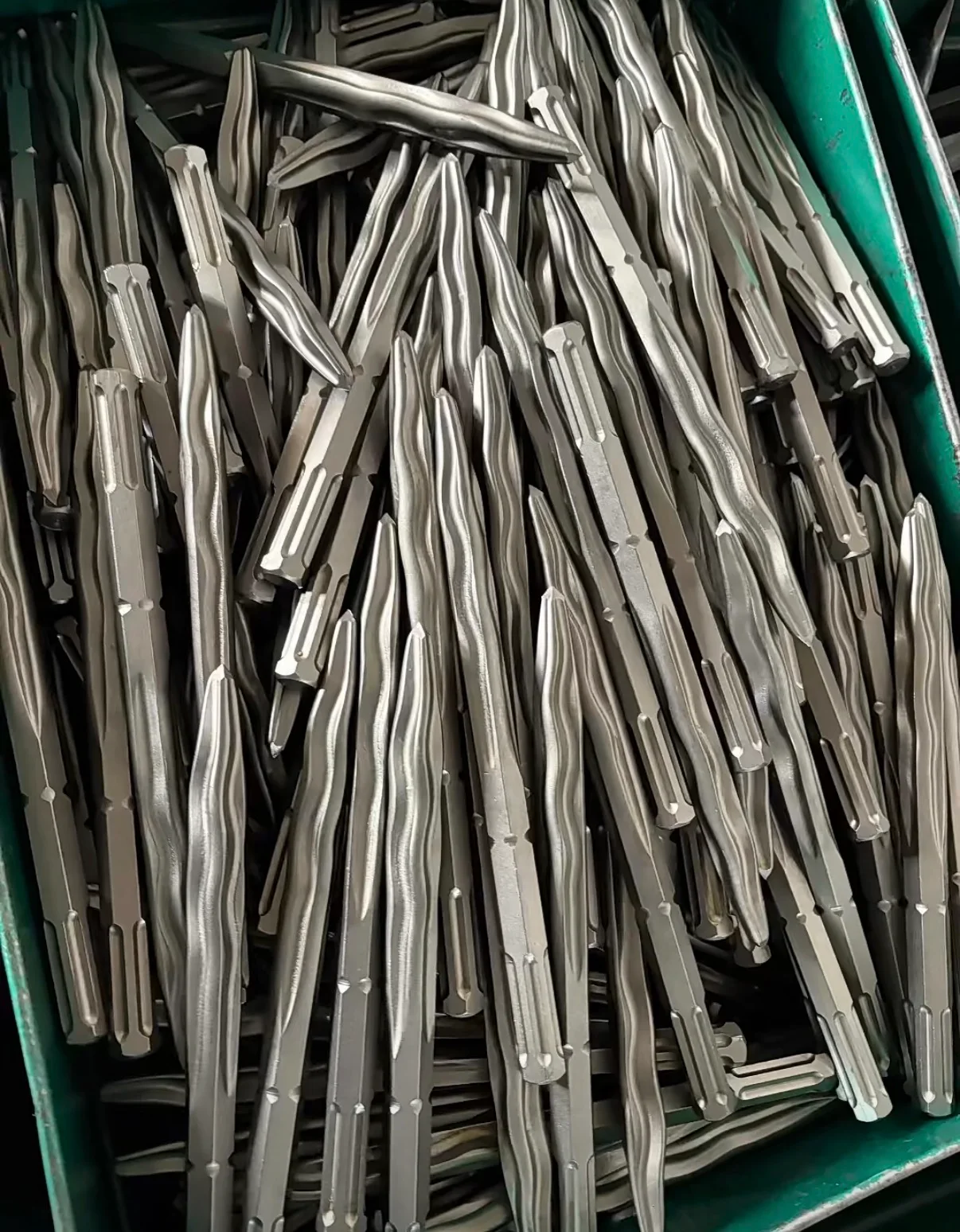
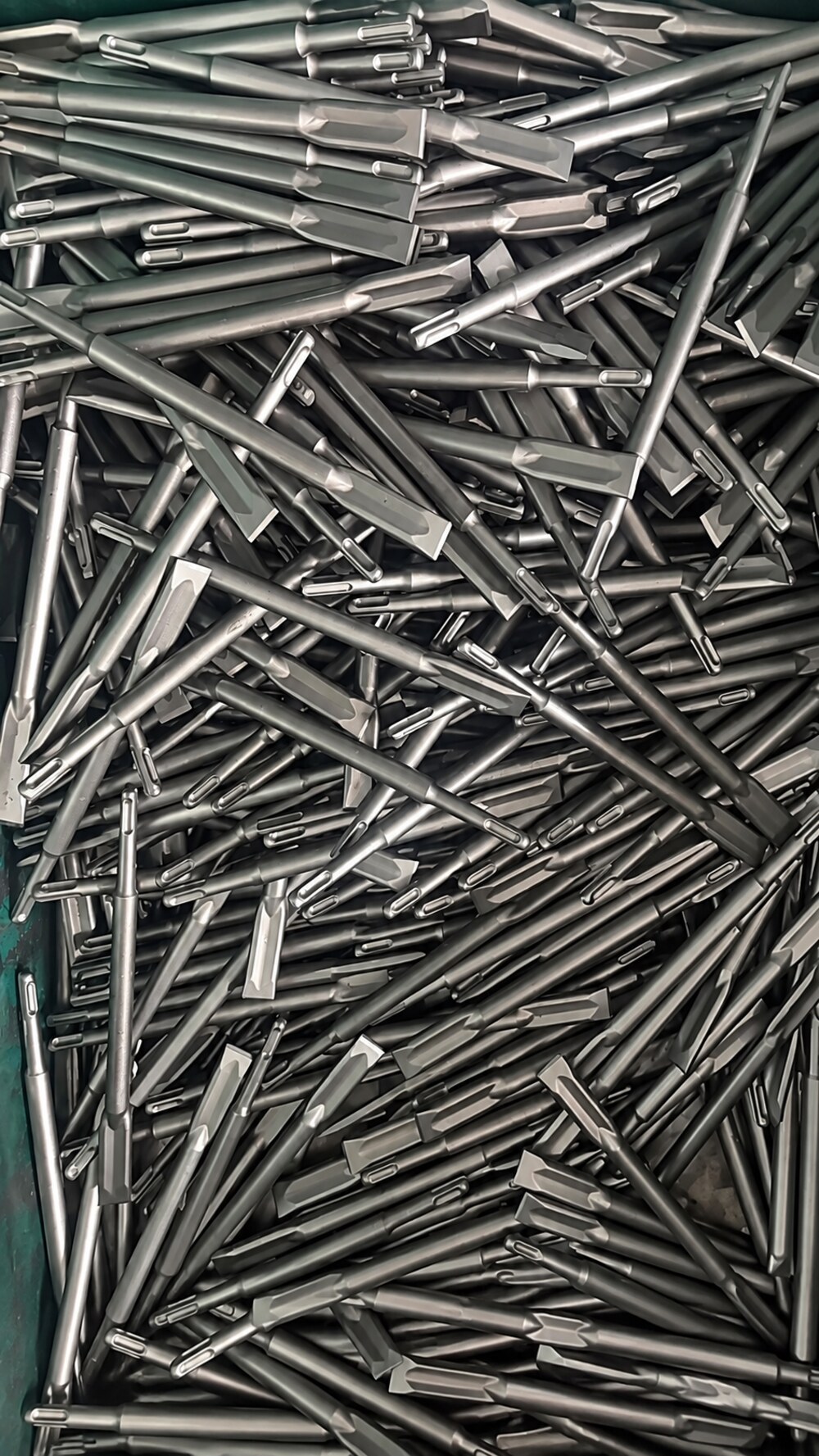
Zhonghuan pointed and flat chisel production gallery
Our production photos show chisel working ends, body profiles and shank details. For an OEM range, send us the working-end type, shank, dimensions and quantity so we can prepare a specification and sample proposal.