

Diager Ultimax 646 is a professional SDS-Max reference for hard and reinforced concrete. The illustrated ten-edge version combines a substantial carbide head, cutting edges with distinct jobs, lateral guidance and space for debris to leave the cutting zone.
The useful reading of “646” is 6 front cutters + 4 side cutters + 6 lateral stabilisers. The first two groups make ten cutting edges; the last group guides the head. This article explains that construction and shows where the Ref. 166 size table uses other cutter counts.
Drilling Hard Concrete and Reinforcement
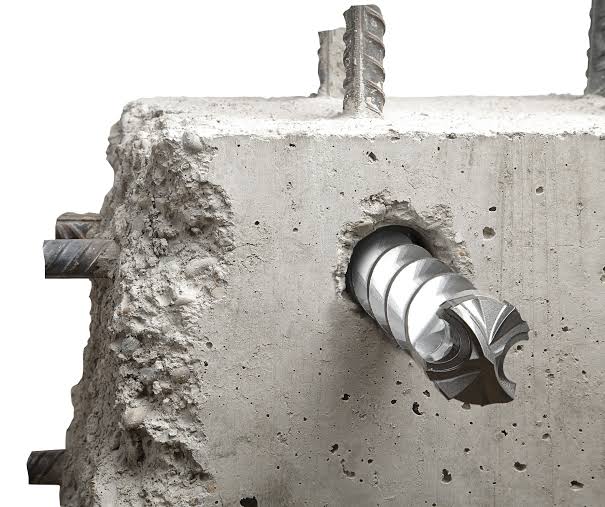
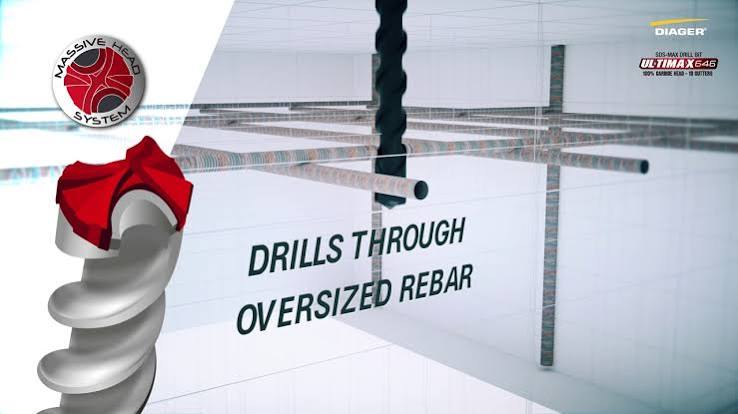
Concrete and reinforcing steel load a rotary-hammer bit differently. The concrete phase calls for impact-driven fracture and effective removal of crushed material. At a rebar encounter, only part of the head may contact steel while the rest remains in concrete. Contact becomes uneven, the cutting load changes and the head can be pushed sideways.
That combination exposes weak edges, poor guidance and inadequate clearance. A premium reinforced-concrete bit needs to keep cutting while controlling the head’s path and clearing the bore. This is the problem the Ultimax 646 architecture addresses.
The Monobloc Carbide Head and Its Connection
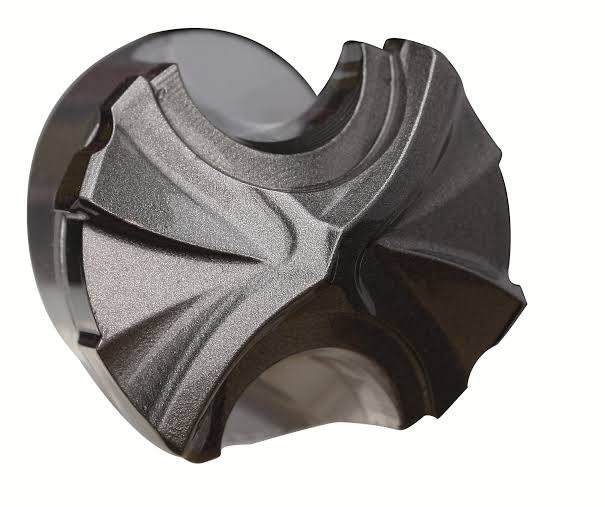
Diager describes the illustrated working head as a compact monobloc, 100% carbide component. The flute body and SDS-Max shank remain steel. The one-piece head supports the front and peripheral cutting geometry within the same carbide component.
The 2017 launch leaflet highlights 50% more carbide weight. The engineering value is material around the working edges for support and wear allowance. Head construction and the connection to steel remain separate specifications: Diager’s 2019 catalogue explicitly lists copper brazing solder for its published Ultimax 646 design.
6 Front Cutters, 4 Side Cutters and 6 Stabilisers
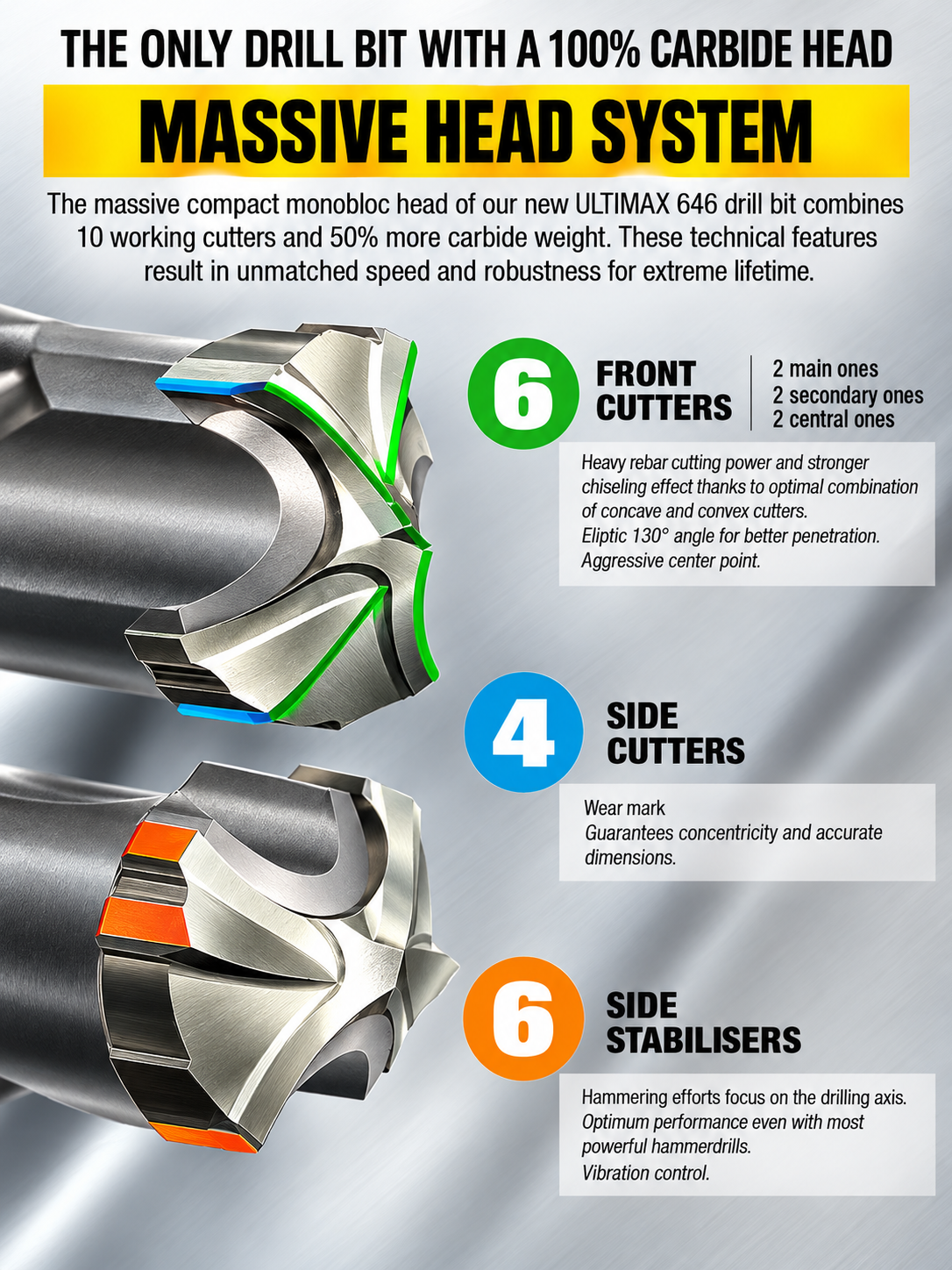
The original colour-coded diagram separates three functions within the ten-edge head:
| Head feature | Count | Job |
|---|---|---|
| Front cutters | 6 = 2 main + 2 secondary + 2 central | Forward penetration and the combined concrete-breaking / rebar-cutting action |
| Side cutters | 4 | Peripheral cutting, hole gauge and wear indication |
| Lateral stabilisers | 6 | Axial guidance and vibration control |
Diager pairs the concave/convex front geometry with a centring point and an elliptical 130° tip angle. The front works ahead of the bit, the side edges work around the bore, and the stabilisers support guidance. Cutter count and stabiliser count describe different parts of that design.
Two Large Clearance Channels and the Flute
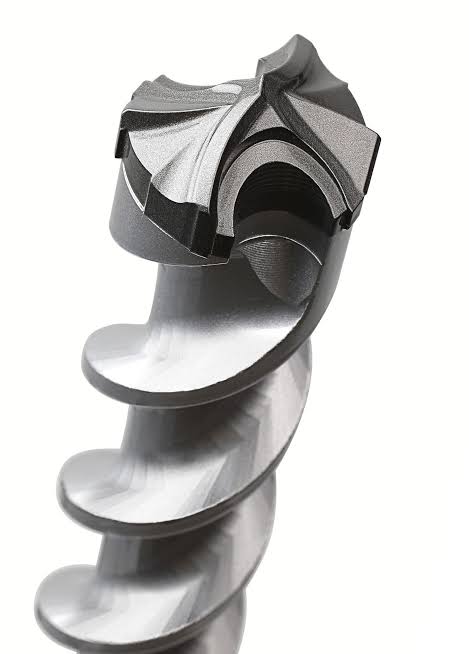
A productive head also needs an exit route for crushed concrete. Diager’s French specification identifies two large evacuation channels, and Diager’s side view shows how the head opens into the spiral.
Debris retained under the head consumes energy through rubbing and repeated crushing. As depth increases, the flute system must transport material over a longer distance. Open clearance behind the cutting edges helps the cutting zone hand material to the flutes; the body then has to carry it out of the bore.
This is why cutter count and flute count answer different questions. For deep holes, compare penetration stability and withdrawal behaviour as well as the first few centimetres of drilling.

Ref. 166 Dimensions and Diameter-Specific Head Variants
The 2026 catalogue, pages 30–31, lists Ref. 166 across Ø12–52 mm and selected overall lengths of 340–1500 mm. Its footnotes matter: Ø12 and Ø15 are marked as three-cutters; the marked Ø40, Ø42, Ø45 and Ø52 references are six-cutters. The other listed references use the ten-cutter designation.
| Item code | D (mm) | Working length (mm) | Overall length (mm) | Cutters |
|---|---|---|---|---|
| 166D12L0340 | 12 | 200 | 340 | 3 |
| 166D14L0340 | 14 | 200 | 340 | 10 |
| 166D15L0540 | 15 | 400 | 540 | 3 |
| 166D16L0690 | 16 | 550 | 690 | 10 |
| 166D20L0920 | 20 | 780 | 920 | 10 |
| 166D24L0540 | 24 | 400 | 540 | 10 |
| 166D28L1500 | 28 | 1360 | 1500 | 10 |
| 166D32L0690 | 32 | 550 | 690 | 10 |
| 166D38L0540 | 38 | 400 | 540 | 10 |
| 166D40L0540 | 40 | 400 | 540 | 6 |
| 166D45L0920 | 45 | 780 | 920 | 6 |
| 166D52L0540 | 52 | 400 | 540 | 6 |
These are representative catalogue combinations. Keep the actual head and part number together when ordering. The table identifies cutter count; confirm the selected head construction from its drawing or sample.
The Test Conditions Behind Diager’s Launch Figures
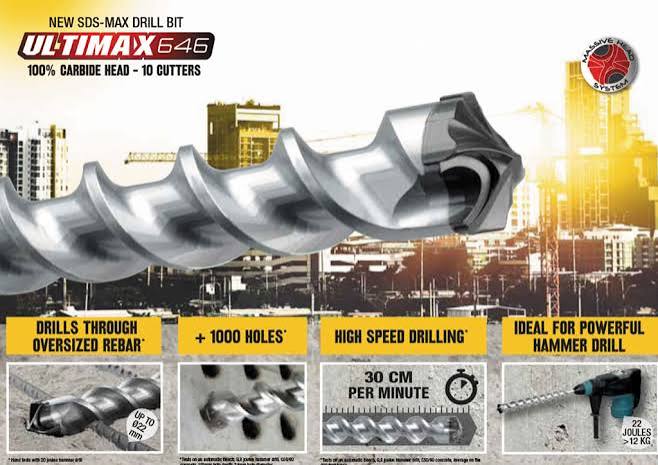
The original launch poster gives numerical results with specific test setups. Read the result and its test conditions together:
| Published launch figure | Stated test setup |
|---|---|
| Rebar up to Ø22 mm | Hand tests with a 20 J hammer drill |
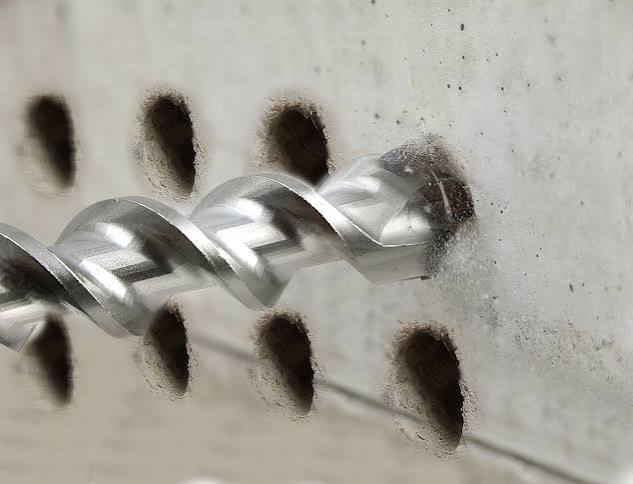
| 1,000+ holes | Automatic bench; 8.8 J hammer; C50/60 concrete; Ø24 mm holes, 150 mm deep |
| 30 cm per minute | Automatic bench; 8.8 J hammer; C50/60 concrete; average over the first 300 holes |
For a purchasing comparison, use the same hammer, concrete, rebar layout, hole diameter and depth. Record completed-hole time, edge condition and worn hole diameter. Select the actual SDS-Max hammer against its permitted drilling capacity and the required bit size.
Ultimax 646 vs Ultimax 168
Ultimax 646 uses Ref. 166 / 166D. Ultimax 168 is a separate six-edge family. In our Ultimax 168 analysis, three carbide plates form six cutting edges. Its component count and architecture differ from the pictured one-piece ten-edge 646 head.
| Reference | Construction / edge count | Selection focus |
|---|---|---|
| Pictured Ultimax 646 ten-edge version | Monobloc carbide head; 6 front + 4 side cutters | Hard/reinforced concrete, hole gauge and debris clearance |
| Ultimax 168 / our ZHMAX-168 programme | Three carbide plates; six cutting edges | Application-matched six-edge construction and its joining details |
| Other Ref. 166 catalogue variants | Three- or six-cutter entries identified by catalogue footnotes | Exact SKU, actual head and dimensions |
Our SDS-Max OEM Selection Route
At Zhonghuan, we manufacture SDS-Max drill bits and select the head around the drilling task: concrete and aggregate, rebar exposure, hammer platform and hole dimensions. We coordinate the carbide geometry, support, joining and flute transition against the approved drawing and sample.
Proposed configuration A: our ZHMAX-168 three-plate, six-edge programme for the selected concrete or rock application. Proposed configuration B: our ZHMAX-8 full-carbide-head programme within the confirmed supply matrix. Our engineering team confirms the available diameter/length combinations and sampling plan for the job.
Send the benchmark reference, diameter, working length, overall length, hammer model, substrate and quantity per size. We can confirm the configuration, marking, packaging and quotation. See our full-carbide-head manufacturing page and ZHMAX-168 manufacturing overview.
Frequently Asked Questions
What does the 646 head designation describe?
The illustrated head has six front cutters, four side cutters and six lateral stabilisers. The front and side cutters form ten cutting edges; the stabilisers guide the head.
Is every 166D reference a ten-cutter?
Diager’s 2026 catalogue marks Ø12 and Ø15 as three-cutters and the starred Ø40, Ø42, Ø45 and Ø52 references as six-cutters. Order against the specific reference and head.
How is it different from Ultimax 168?
The pictured ten-edge 646 uses a one-piece carbide working head on a steel body. Ultimax 168 uses three carbide plates forming six cutting edges. The 646 family’s diameter-specific variants still need their own SKU check.
How were the launch performance figures tested?
The leaflet associates 1,000+ holes with an 8.8 J automatic bench test in C50/60 concrete using Ø24 × 150 mm holes. Its Ø22 mm rebar statement uses 20 J hand tests; the 30 cm/min figure is averaged over the first 300 holes on an 8.8 J bench setup.
What should an OEM enquiry include?
Benchmark reference, actual head construction, diameter, working and overall lengths, hammer model, material/rebar conditions and quantity per size. We then confirm the proposed configuration and sample-drilling acceptance.
Official Sources
- Diager — Ultimax 646 Ref. 166 product specification
- Diager 2026 catalogue — pages 30–31, dimensions and cutter-count footnotes
- Diager 2017 launch leaflet — head diagram and performance test conditions
- Diager 2019 English catalogue — published copper-brazing description
References checked on 26 October 2026. Original product graphics are retained; dimensions and cutter counts follow the selected catalogue reference.


