

What Is a Bushing Bit
A bushing bit — also called a bush hammer bit, bushing hammer bit, bushing tool, or bush hammer steel — is a rotary-hammer accessory with a flat striking face populated by multiple hardened pins or teeth in a grid pattern. Unlike a chisel, which works through a sharp edge, a bushing bit works through repeated blunt-impact strikes that fracture the surface of concrete or stone in a controlled, uniform pattern.
The accessory exists in two SDS shank sizes — SDS-Plus (10mm shank) for compact rotary hammers, and SDS-Max (18mm shank, also labeled TE-Y by Hilti) for heavy demolition-class hammers and breakers — and in two material tiers: tungsten carbide pins for wear-critical professional work, and hardened alloy steel teeth for general-purpose, price-sensitive channels.
Bushing bits are not high-volume retail items. They are a specialty accessory bought by surface-prep contractors, shotcrete crews, bridge and tunnel sub-contractors, decorative concrete finishers, and architectural restoration teams. The category is small in unit volume but unusually price-stratified — carbide-pin SKUs from Hilti retail at multiples of hardened-steel Bosch, Diablo, and Milwaukee equivalents, even though the engineering difference is narrower than the price gap suggests.
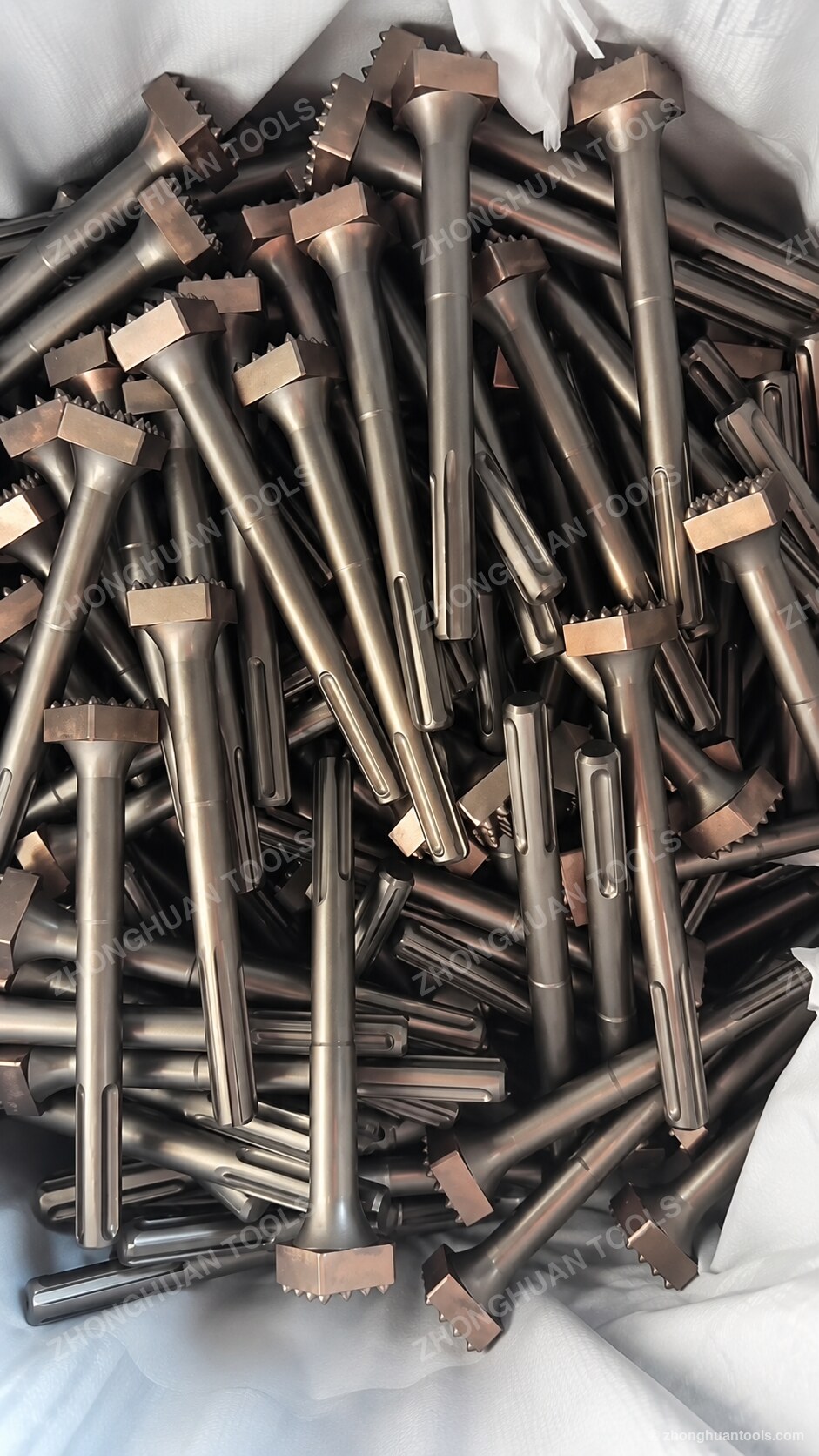
Our SDS-Max Bushing Bits: Bulk Production Photos
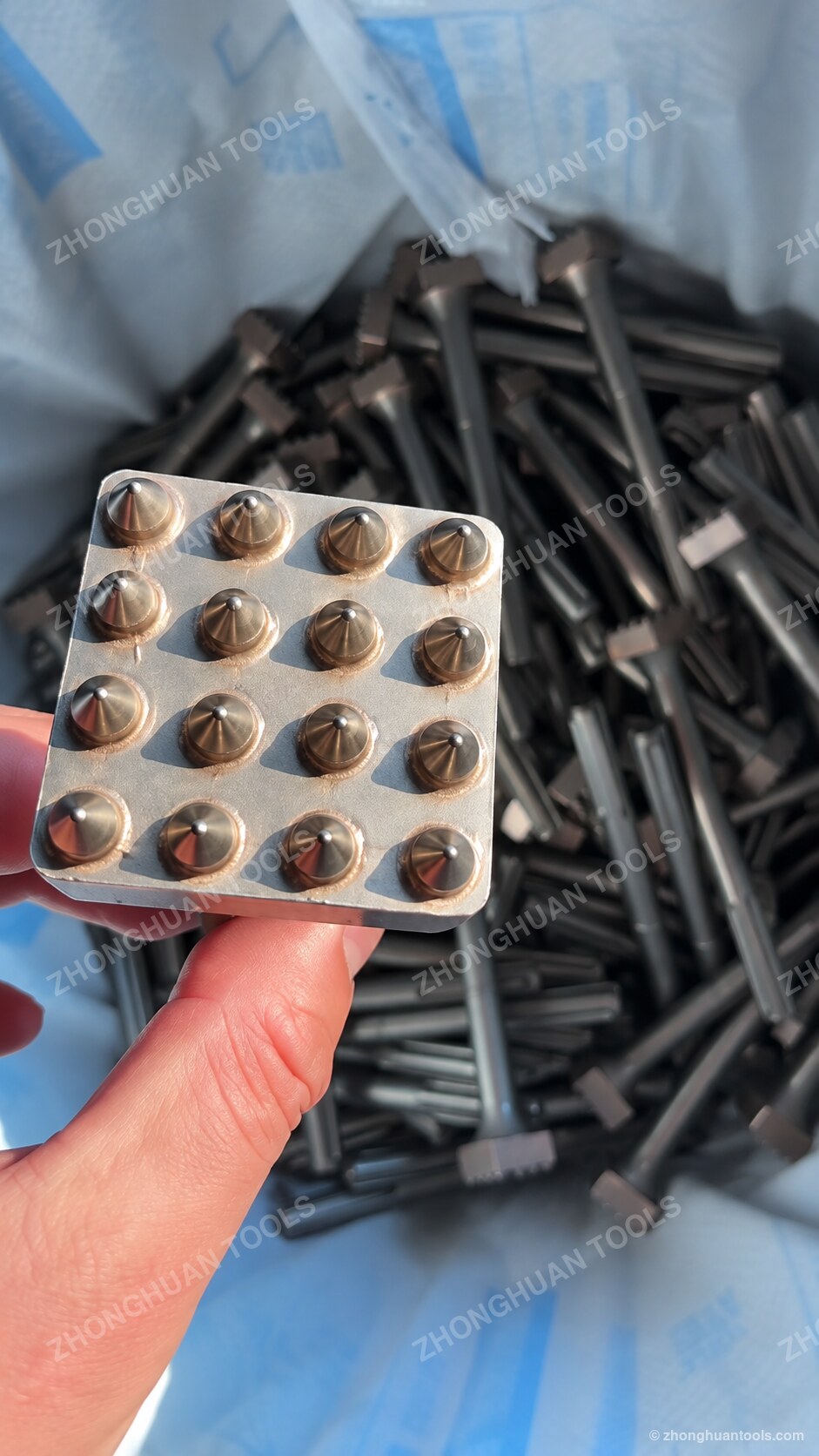
Our production-batch photos show finished bushing tools, head details and SDS-Max shanks. Use these views alongside the confirmed drawing and order specification when reviewing your OEM programme.
The Four Jobs Bushing Bits Do
Despite the variety of tool brands and patterns, every bushing bit is doing one or more of these four jobs:
1. Surface roughening for coating bonding. Smooth concrete is a poor substrate for paint, epoxy, polyurethane, waterproofing membrane, tile adhesive, plaster, or render. Mechanically roughening the surface with a bushing tool creates the texture profile (CSP-3 to CSP-6 in the ICRI scale) that coatings require for adhesion. This is the highest-volume use of bushing tools.
2. Shotcrete substrate preparation. In tunnel linings, slope stabilization, swimming pool construction, and rock-bolt collar areas, fresh shotcrete must bond to a pre-existing concrete or rock substrate. A bushing bit roughens the substrate immediately before the shotcrete pass to ensure adhesion. This is where the carbide-pin tier (Hilti TE-Y BT class) is most often specified — sustained tunnel work consumes accessories quickly.
3. Anti-slip texturing. Walkways, ramps, pool decks, parking-garage slopes, loading docks, and stair treads need controlled surface texture for pedestrian safety. A bushing bit produces a more durable anti-slip pattern than acid etching, sandblasting, or applied non-slip coatings, because the texture is integral to the concrete itself rather than a removable layer.
4. Excess-concrete removal and exterior finish. Architectural concrete sometimes requires a textured "rough hewn" appearance — bushing tools produce this finish quickly and uniformly. They are also used to knock down minor surface irregularities, formwork marks, and shallow excess concrete on a finished pour.
Choose the Construction for the Job
Choose by striking-face material and head construction, then confirm dimensions and machine fit.
| Construction | Selection focus | Confirm before ordering |
|---|---|---|
| Carbide-pin head | Wear-intensive concrete or stone surface preparation | Pin layout, head size and pin retention |
| Hardened-steel teeth | General concrete roughening and texturing | Tooth geometry, heat treatment and wear criteria |
| Replaceable-head system | Programmes requiring head replacement | Head-to-shank connection and spare-head compatibility |
Carbide Pins vs Hardened Steel Teeth
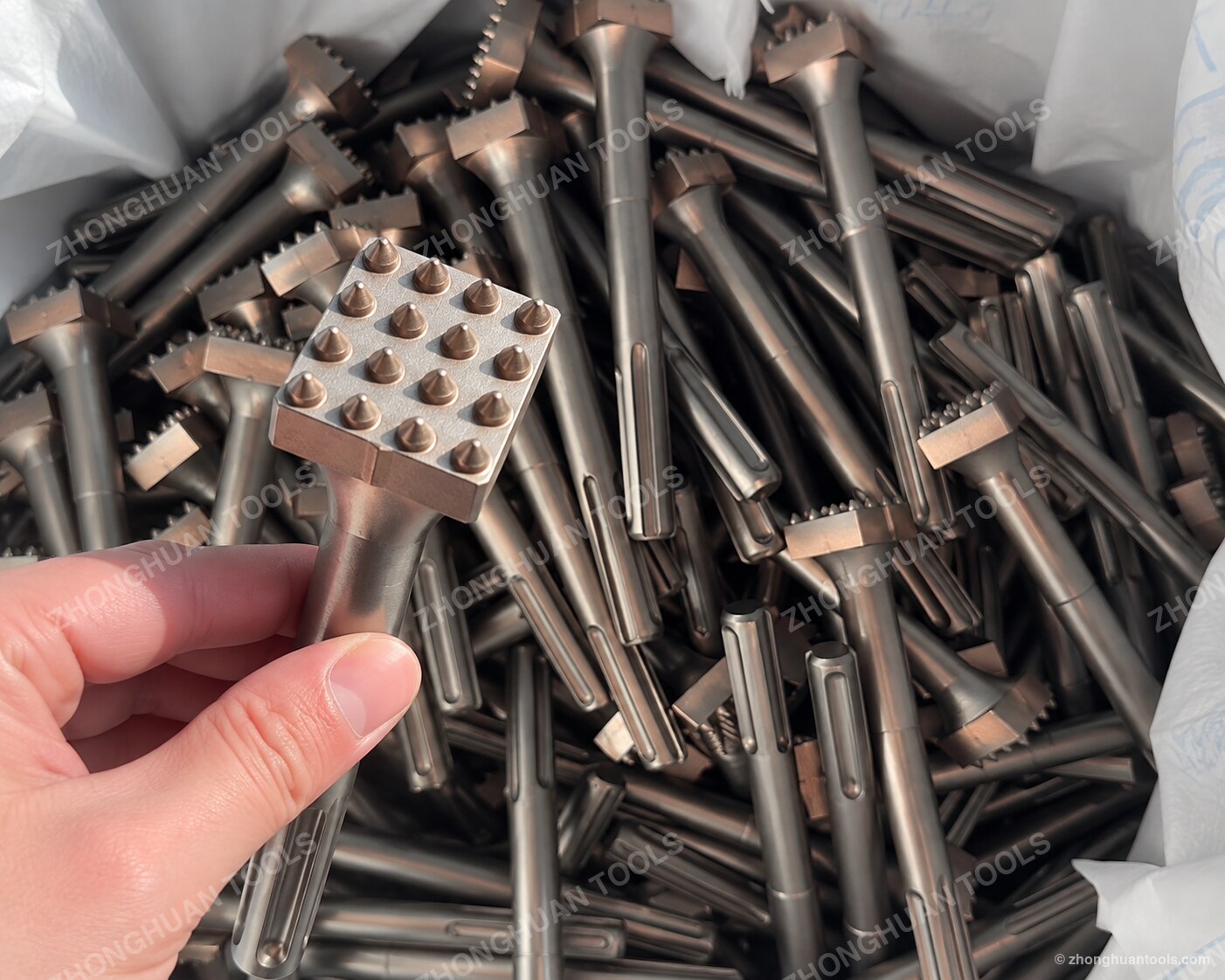
The single biggest engineering decision in this category is the strike-face material. Tungsten carbide pins and hardened alloy steel teeth produce visually similar surface textures on a fresh bit, but their service-life curves diverge sharply.
Tungsten carbide pins. Pressed and sintered tungsten carbide cylinders, brazed or mechanically pinned into precision sockets in the steel head. Carbide is several times harder than the hardest tool steel, so the pins maintain their shape and texture pattern through far more impact cycles before rounding off. Carbide-pin SDS-Max bushing tools — Hilti TE-Y BT, Hilti TE-Y/S BH heads, and our carbide-pin variant — use this construction. The cost premium is real (carbide is more expensive than steel and requires precision sintering), but on sustained-use accounts (tunnel shotcrete, bridge deck programs, repetitive industrial floor prep) the longer life pays back the upfront cost.
Hardened alloy steel teeth. Forged or machined teeth in a single piece with the head, then heat-treated to a high hardness (typically HRC 55–60). Lower upfront cost, lighter weight, and easier to manufacture at retail price points. The trade-off is faster wear: hardened steel teeth round off measurably after extended use, and the texture pattern degrades with the teeth. Bosch HS1909, Diablo SDS-Max, and Milwaukee 48-62-4063 use this construction (Milwaukee adds a carbide tip but is not full-pin carbide). Most distributor private-label programs default to this tier because it hits the price points retail and contractor channels expect.
The right answer for distributor ranges is usually both. A two-tier private-label program — carbide-pin SKU as the professional line, hardened-steel SKU as the value line — gives the distributor a complete shelf and lets the contractor self-select based on job intensity. We supply both at OEM volumes from the same factory, with consistent branding and packaging across the two tiers.
Pin and Tooth Pattern Selection Guide
The number and arrangement of pins or teeth on the head determines the texture profile and the rate of material removal. Industry conventions:
| Pattern | Texture profile | Best for |
|---|---|---|
| 4×4 (16 pins) | Coarse, ~2–4mm depth | Aggressive shotcrete prep, structural keying, heavy coating bonding |
| 16-tooth (Bosch HS1909) | Coarse, ~1.5–3mm depth | General concrete roughening, anti-slip ramps, floor prep |
| 25-tooth (Bosch HS1909-12) | Medium, ~1–2mm depth | Larger-area work where uniform finer texture is needed |
| 9-point / 16-point | Coarse, point-pattern | Tunnel shotcrete substrate, rock-bolt collar prep |
| 30-tooth / 45-tooth | Fine, ~0.5–1.5mm depth | Decorative architectural finish, exposed-aggregate, stone aging |
Rule of thumb: Fewer larger pins/teeth produce deeper, more aggressive textures and remove material faster — choose for structural and shotcrete work. More smaller pins/teeth produce finer, more uniform textures with slower material removal — choose for decorative, architectural, and aesthetic finishing.
Pre-Assembled vs Interchangeable Head Systems
The physical construction of the bushing tool falls into two categories.
Pre-assembled, one-piece (fixed shank + head). The standard construction. Hilti TE-Y BT 4×4, Bosch HS1909 / HS1909-12, Diablo SDS-Max, and Milwaukee 48-62-4063 are all one-piece tools — the textured head is permanently joined to the SDS-Max shank as a single unit. This is also our standard offering. Advantages: stiffer load path with no joint to loosen, simpler retail SKU structure, lower price point, easier QC on the head-to-body weld. Most distributor channels source one-piece bushing tools because they fit retail and contractor purchasing patterns.
Interchangeable head (separate textured heads + reusable shank). The less common variant, exemplified by Hilti's TE-Y/S BH product family — separate bushing tool heads that thread onto a reusable TE-S or TE-Y shank, allowing one shank to drive multiple head patterns and sizes. Advantages: lower per-job cost when contractors need multiple patterns, less weight to carry, and the shank can outlast many heads. Trade-offs: a threaded joint at the head-to-shank interface adds complexity and a potential failure point, the per-bit price is higher (separate purchase of head and shank), and packaging and SKU structure is more complex.
Our default is the one-piece construction because it matches the dominant market preference and the dominant distributor channel structure. The interchangeable head system is technically straightforward for our factory to produce — the engineering challenge is not significant — but the MOQ economics, packaging design, and channel positioning need to be discussed up front. If your account sells primarily to professional contractors who would value multiple head patterns on one shank, we can quote both systems.
Induction Hardening and Anti-Mushrooming
Bushing tools work in a punishing environment. A demolition-class breaker delivers thousands of impacts per minute, and the bushing tool absorbs every one of those strikes through its body. Two failure modes dominate the category:
Mushrooming. Repeated axial impact deforms the strike-end of the steel body outward into a mushroom shape. A mushroomed bit becomes stuck in the chuck of the breaker, transfers less energy efficiently, and is hazardous to remove. This is the failure mode Hilti specifically calls out for the TE-Y BT line — "resistance to mushrooming" — and addresses through induction hardening.
Bending. Long bushing tools (235mm and 320mm SDS-Max lengths) are prone to bending if used at an angle to the surface or under uneven pressure. A bent shaft causes vibration, uneven texture, and eventually breakage at the head-to-shank transition.
Induction hardening is a localized heat-treatment process — high-frequency electromagnetic induction heats the surface layer of the steel to austenitizing temperature, then the part is quenched. The result is a hardened case (typically 2–5mm deep) over a tougher core. The hardened case resists deformation under impact (anti-mushrooming, anti-bending), while the ductile core absorbs shock without fracturing. The technique is the same one Hilti specifies on TE-Y BT, and it has been the standard for SDS-Max chisels and bushing tools across the industry for decades.
All our SDS-Max bushing bits are induction-hardened on the body as standard. Buyers comparing private-label OEM offers should confirm this is included — some lower-cost Chinese suppliers skip induction hardening to save cost, then the bit mushrooms within a fraction of its expected life.
SDS-Plus vs SDS-Max: When to Use Each
Both shank sizes have bushing tools available, and the choice is dictated by the rotary hammer the contractor owns and the scale of the work.
SDS-Plus bushing bits (10mm shank, head Ø30–50mm, 180–250mm length) match compact rotary hammers in the 1.5–3.5 kg class. These are residential and small-commercial tools used for detail work, small repair patches, bathroom and kitchen substrate prep, individual stair treads, and limited anti-slip work. Productivity is 2–5 m²/hour. Most retail-channel bushing tool sales are SDS-Plus.
SDS-Max bushing bits (18mm shank, head Ø50–80mm, 235–350mm length) match heavy rotary hammers and demolition breakers in the 5–12 kg class. These are commercial and industrial tools used for floor coatings prep, parking garage anti-slip work, bridge deck preparation, tunnel shotcrete prep, and large-area architectural finishing. Productivity is 5–15 m²/hour. Most professional-contractor and tunneling-channel sales are SDS-Max.
SDS-Plus and SDS-Max bits are not interchangeable. The shank diameters are different (10mm vs 18mm), and the chuck mechanisms are completely different. A buyer planning a private-label range should expect to stock both sizes — most distributor channels need both.
OEM Sourcing Note for Distributors
For distributors and private-label tool brands evaluating Chinese OEM bushing bit supply:
The hardened-steel tooth tier is widely available from multiple Chinese manufacturers. Differentiating factors are induction hardening of the body (often skipped by lower-cost suppliers, leading to early mushrooming), tooth heat-treatment hardness consistency (HRC 55–60 baseline), and dimensional consistency to industry-standard 1-3/4 in or 40mm head sizes. Verify these before committing to a program.
The carbide-pin tier has a much narrower Chinese supply base. Producing the carbide-pin variant requires three things many factories lack: precision-sintered tungsten carbide pin supply at consistent grade, the tooling and process to braze or mechanically pin the carbide into precision sockets in the head, and the QC infrastructure to verify pin retention under sustained impact. Zhonghuan is one of the manufacturers that supplies the carbide-pin tier at OEM volumes — engineered to match the dimensional and performance benchmarks of Hilti TE-Y BT 4×4 and equivalent international lines.
Interchangeable head systems (Hilti TE-Y/S BH analogues) are available on request. The technical barriers are low; the economic barriers — MOQ, packaging tooling, channel positioning — are the real conversation. If your account would benefit from offering an interchangeable head program alongside a one-piece program, we can quote both together.
Related Procurement Programs
If you are sourcing concrete surface preparation tools at distribution volumes, these programs cover the procurement questions buyers typically ask next.
- Zhonghuan Bushing Bit Product Range — Full SDS-Plus and SDS-Max bushing bit specifications, carbide-pin and hardened-steel tier options, pin and tooth pattern selection, and OEM inquiry.
- SDS Chisels & Demolition Accessories OEM Program — The complete demolition accessory program for distributors: point, flat, wide, scaling, and bushing tools across SDS-Plus and SDS-Max, with private-label packaging.
- Rock Bolt & Ground Support Drilling Solutions — Bushing bits for shotcrete substrate preparation around bolt collars, alongside SDS-Max drill bits and chisels for the full mining and tunneling accessory program.


