

What Is a Bush Hammer Bit?
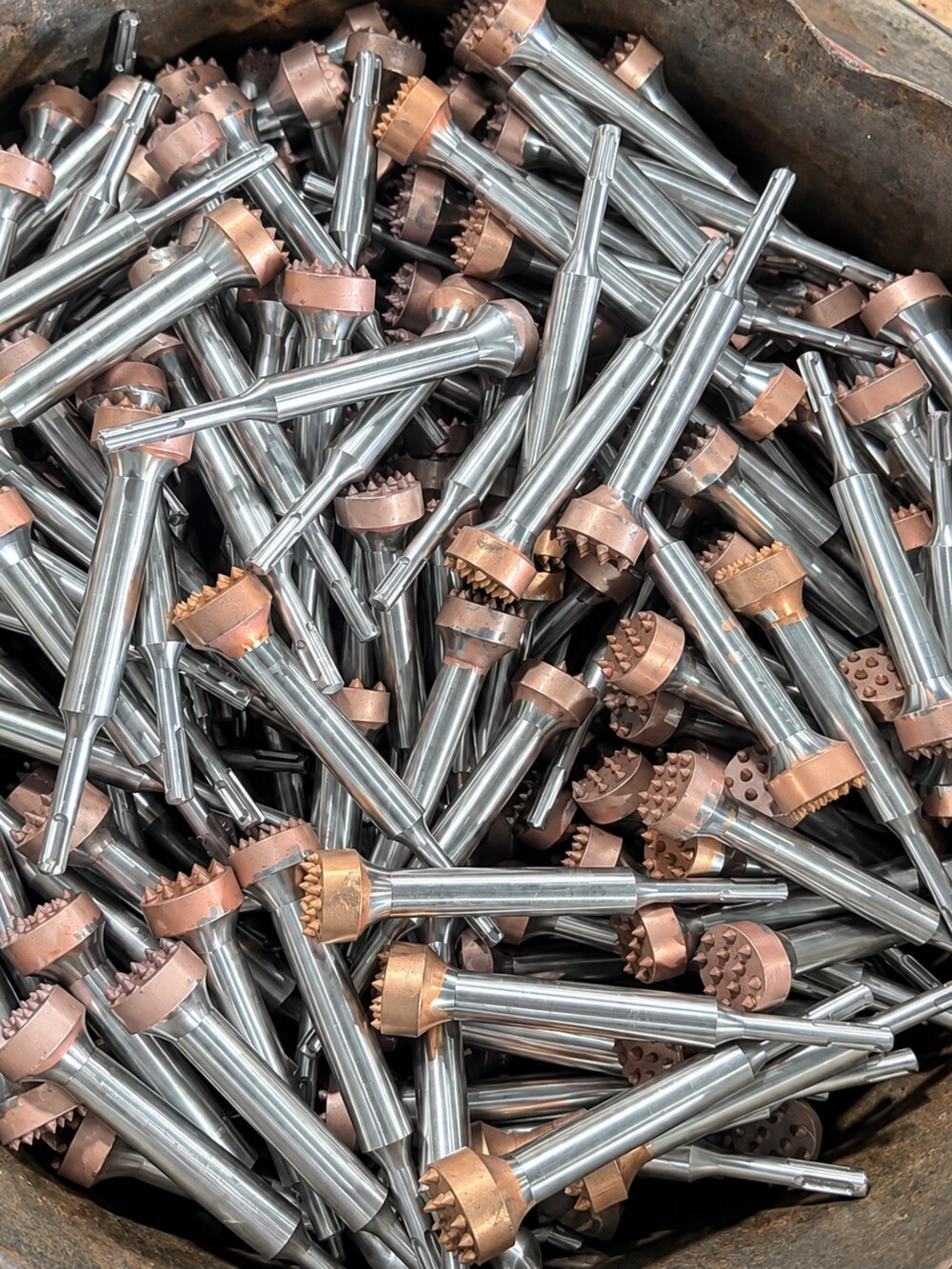
A bush hammer bit is a surface texturing tool fitted with rows of tungsten carbide teeth. It attaches to a standard rotary hammer via an SDS-Plus or SDS-Max shank. When the rotary hammer spins, the carbide teeth repeatedly strike and chip the concrete surface, creating a rough, uniform texture.
Unlike chisels that remove material in lines, bush hammer bits texture an area evenly. The result resembles natural stone — a look prized in architectural concrete, anti-slip walkways, and bonding preparation.
Common use cases:
- Anti-slip treatment on ramps, stairs, and pool decks
- Surface preparation before tiling, overlays, or coatings
- Decorative stone-like texturing on concrete walls and floors
- Removing thin coatings, paint, or laitance from concrete
Carbide-Pin vs Integral Steel-Tooth: Two Constructions, Not Two Quality Tiers
Every number in this guide — 16, 20, 25, 30, 45 — describes a working-face pattern, not a single fixed product. Bush hammer bits are built in two distinct constructions, and the tooth-count logic below applies to both.
- Carbide-pin construction: individual tungsten carbide pins are bonded into precision-machined sockets in the head. Each pin is a separate insert, visually distinct from the body. This construction holds its impact profile longest on hard concrete and abrasive aggregate, and is the standard choice for sustained shotcrete and bridge-deck work.
- Integral steel-tooth construction: teeth are forged or machined directly into a single hardened alloy-steel head, with no separate pin insert. This construction costs less to manufacture and suits general-purpose roughening, leveling and retail-channel programs.
Neither construction is universally better — they are two different answers to the same job. See the Bushing Bit Buying Guide for the full construction comparison, including working-face material, body treatment and head-system options.
How Carbide Pins Are Bonded: Mesh Belt Furnace Brazing
On carbide-pin construction, the joint between each pin and the steel body determines whether the bit survives its rated service life or loses pins early. Three brazing methods are used across the industry, with very different consistency:
- Torch brazing. A technician heats each joint by hand with a gas torch. Quality depends entirely on individual technique, and heat control varies pin to pin, joint to joint, and shift to shift.
- Induction brazing. An induction coil heats one joint, or a small group, rapidly through electromagnetic induction. Fast and repeatable per joint, but still processes pins in batches rather than as a single uniform pass.
- Mesh belt furnace brazing. The assembled head moves through a continuous furnace on a conveyor mesh belt, under a controlled protective atmosphere that prevents oxidation of the braze alloy as it melts. Every pin on every head in the batch sees the same temperature curve, the same atmosphere and the same dwell time.
The controlled atmosphere matters as much as the even heating: an oxidized braze joint is a weak braze joint, even if the temperature was otherwise correct. Furnace brazing under protective atmosphere avoids that failure mode, which is why it produces the most consistent pin retention across a full production batch — important for a distributor who needs every piece in a shipment to perform the same way, not just the sample that was inspected.
Whatever the brazing method, the pin should fail by wearing down, not by coming loose. If a supplier cannot show a destructive test confirming the carbide fractures before the braze joint fails, treat that as a red flag on any carbide-pin order.
Tooth Count: 16 vs 20 vs 25 vs 30 vs 45
The number of carbide teeth determines how aggressive the cut is and how fine the finished texture appears. Choosing the right tooth count is the most important decision when selecting a bush hammer bit.
| Tooth Count | Aggressiveness | Finish Quality | Roughness Depth | Best Application |
|---|---|---|---|---|
| 16 teeth | Very aggressive | Coarse | 3-5mm | Heavy bonding prep, coating removal |
| 20 teeth | Very aggressive | Coarse | 2.5-4mm | Deep structural keying, heavy bonding prep |
| 25 teeth | Aggressive | Medium-coarse | 2-3mm | Anti-slip ramps, general surface prep |
| 30 teeth | Moderate | Medium-fine | 1-2mm | Anti-slip stairs, tiling prep |
| 45 teeth | Light | Fine | 0.5-1mm | Decorative texturing, architectural finish |
Rule of thumb: For bonding preparation, choose fewer teeth (16-25) to maximize surface roughness. For decorative or anti-slip finishes where appearance matters, choose more teeth (30-45).
SDS-Plus vs SDS-Max Bush Hammer Bits
Bush hammer bits come in two shank types to match different rotary hammer classes:
- SDS-Plus: Fits light to mid-duty rotary hammers (2-4 kg class). Ideal for residential work — texturing ramps, stairs, small pool decks, and patching prep. Lower vibration and easier to control for detail work.
- SDS-Max: Fits heavy-duty rotary hammers (5-12 kg class). Required for commercial and industrial projects — parking garage floors, factory walkways, large-area anti-slip treatment. Higher power drives the teeth harder for faster coverage.
| Factor | SDS-Plus | SDS-Max |
|---|---|---|
| Hammer Class | 2-4 kg | 5-12 kg |
| Typical Use | Residential: stairs, ramps, small areas | Commercial: garages, factories, large floors |
| Coverage Speed | Slower — fine control | Faster — high power |
| Vibration | Lower | Higher |
| Best For | Detail work, edges, small patches | Large-area texturing, heavy prep |
For B2B buyers: stock both SDS-Plus and SDS-Max variants. Contractors doing residential anti-slip work need SDS-Plus, while commercial flooring crews demand SDS-Max.
Applications
- Anti-Slip Treatment: Bush hammering creates a rough, grip-friendly surface on concrete ramps, stairs, pool decks, and loading docks. A 25 or 30 tooth bit provides the ideal balance between traction and comfort underfoot. This is the most common application worldwide.
- Bonding Preparation: Before applying tile adhesive, concrete overlays, or waterproof coatings, the surface needs mechanical roughening for proper adhesion. A 16 or 25 tooth bush hammer bit opens the concrete pores and creates a profile that adhesives can grip. This replaces slower methods like acid etching or manual scarifying.
- Decorative Stone-Like Texturing: Architects and designers specify bush hammered finishes to give poured concrete the appearance of natural split stone. A 45 tooth bit produces the fine, even texture needed for exposed architectural surfaces — feature walls, columns, facades, and landscaping elements.
Coverage Rate and Productivity
Coverage rates depend on tool power, tooth count, and material hardness. These figures represent average output for a skilled operator using correct technique:
| Tool Class | Tooth Count | Coverage (m²/hr) | Best For |
|---|---|---|---|
| SDS-Plus (2–3 kg) | 25 teeth | 2–4 m²/hr | Residential stairs, small areas |
| SDS-Plus (3–4 kg) | 30 teeth | 3–6 m²/hr | Ramps, pool decks, tiling prep |
| SDS-Max (5–8 kg) | 25 teeth | 5–9 m²/hr | Commercial floors, parking garages |
| SDS-Max (8–12 kg) | 30 teeth | 8–14 m²/hr | Industrial anti-slip, large-scale prep |
For project planning: a 100 m² floor requires approximately 7–20 working hours depending on the tool class. Factor in setup time, breaks, and edge detailing with smaller hand tools when building your estimate.
Vibration and Operator Safety
Bush hammering produces significant hand-arm vibration (HAV) and silica dust — both serious occupational hazards when unmanaged:
- HAV exposure: SDS-Max bush hammers typically exceed 8 m/s² HAV. Under EU Directive 2002/44/EC, the daily exposure action value is 2.5 m/s². Limit continuous operation to 15–20 minutes per session and rotate operators on long jobs.
- Silica dust: Concrete bush hammering generates respirable crystalline silica (RCS). Use P100/FFP3 respiratory protection and attach a vacuum extractor or wet the surface whenever possible.
- Eye and hearing protection: Flying carbide fragments are a constant hazard. Safety goggles (not glasses) and hearing protection rated to at least 25 dB are mandatory on all bush hammering work.
- Anti-vibration gloves: ISO 10819-compliant vibration-rated gloves reduce transmission but do not eliminate HAV risk. Work time limits are the primary control measure.
For B2B buyers supplying contractors: including HAV data sheets with your product catalog differentiates you from distributors who supply bits without documentation — increasingly important for European buyers under PPE and vibration regulations.
Extending Carbide Tooth Life
Bush hammer carbide teeth are not replaceable on standard bits — when the teeth wear out, the bit is replaced. However, proper technique significantly extends service life:
- Correct down-pressure: Let the tool's own weight do most of the work. Pushing hard forces the teeth to bite deeper than necessary and accelerates wear without increasing coverage speed.
- Overlap pattern: Move the bit in overlapping rows, advancing 60–70% of the bit diameter per pass. Full-width steps miss areas and create ridges; too-small steps waste time with no benefit.
- Check periodically for broken teeth: A cracked or missing carbide tooth causes uneven texturing and puts extra load on adjacent teeth, accelerating cascading failure. Stop if you notice irregular surface marks — inspect the bit face before continuing.
- Store dry: Carbide is hard but brittle. Store bits off concrete floors and away from steel tools that can chip the teeth. A dry, padded drawer or dedicated holder extends both tooth and shank life.
Related Procurement Programs
If you are sourcing this product line for a distributor, importer, or private-label channel, these OEM and wholesale programs cover the procurement questions buyers usually ask next.
- SDS Drill Bits Manufacturer & Wholesale Supply for Distributors — OEM and wholesale SDS drill bit supply for importers, distributors, and tool brands: SDS-Plus, SDS-Max, carbide tips, 2-cutter and 4-cutter heads, packaging…
- Construction Anchor Drilling Assortment Matrix — A distributor matrix for anchor drilling: SDS-Plus, SDS-Max, 4-cutter bits, chisels, drill bit sets, packaging, sample checks, and RFQ planning for concrete fix…


