

The shank is the part held by the machine. It defines the connection, not the cutting material or hole diameter. Our SDS specification separates three questions: does the tool fit the hammer, what are the steel body and carbide head made from, and which construction suits the hole and substrate?
How SDS shanks transmit rotation and impact
An SDS holder drives rotation through matching longitudinal grooves and retains the bit while allowing axial movement for hammering. The striker acts on the shank end. This controlled sliding is intentional; it is different from a loose, damaged or incorrectly latched bit.
SDS-Plus has a nominal 10 mm shank, normally with two open drive grooves and two closed retention grooves. SDS-Max has a nominal 18 mm shank with three open drive grooves and two closed retention grooves. These dimensions describe the connection, not the cutting diameter. Neither system name specifies a carbide grade.
| Connection | Identification | Compatibility check |
|---|---|---|
| SDS-Plus | Nominal 10 mm shank; 2 open + 2 closed grooves | SDS-Plus holder and permitted accessory |
| SDS-Max | Nominal 18 mm shank; 3 open + 2 closed grooves | SDS-Max holder and permitted accessory |
| Demolition hex | Across-flat size plus collar and retention geometry | Exact breaker interface; often hammer-only |
Is shank steel the same as drill-body steel?
For our conventional one-piece steel-body SDS drill bits, the shank and fluted body use the same specified steel grade because they are regions of the same steel blank. Forming and machining produce the flute, transition, drive grooves and retention features; the shank is not normally a separate material insert attached simply to change its shape.
A body specified as 40Cr uses 40Cr in its integral shank; a body specified as 42CrMo uses 42CrMo in its integral shank. Select the grade by product and order specification. This statement concerns the steel body, not the carbide cutting head, and should not be extended automatically to assembled or welded-body designs.
Same steel grade does not mean identical hardness at every position. Heat treatment and any specified local treatment establish the required balance of wear resistance and toughness. The shank must withstand holder contact and repeated impact; the body must transmit load and resist bending and torsion. Confirm hardness requirements separately from the steel designation.
Carbide material and joining are separate specifications
The cutting tip is normally cemented tungsten carbide, distinct from the alloy-steel shank and body. A carbide grade such as YG8C or YG11C is a specification to confirm for the selected model; “carbide head” alone does not tell a buyer the grade, piece count or four-cutter construction.
Joining is another separate question. Our tipped constructions can use controlled-atmosphere mesh belt furnace brazing; the applicable process follows the model specification. Full-head constructions may use a different confirmed joining route. Carbide-to-steel joining does not mean that the shank itself has been welded onto the body.
Match the tool to concrete, reinforcement and the task
Begin with concrete or masonry, hard aggregate and possible reinforcement. Then identify the rotary hammer and the hole diameter and depth. SDS-Plus is common for installation drilling; SDS-Max serves larger rotary hammers and demanding drilling or chiselling tasks. Their working ranges overlap and must be checked against the actual machine.
A rotary-hammer drill bit uses rotation plus percussion for its intended mineral substrate. A chisel uses hammer-only operation where the machine supports it. Demolition hex shanks are a family of interfaces with different across-flat sizes, collars and retaining features, not one interchangeable “SDS hex” standard.
SDS-Plus, SDS-Max and hex compatibility
SDS-Plus and SDS-Max do not directly interchange. A correctly specified SDS-Max-machine to SDS-Plus-accessory adapter can be an option only where the adapter and machine instructions allow the accessory and operating mode. It does not turn the smaller accessory into a heavy-duty SDS-Max bit.
Legacy SDS-Top, spline drives, SDS-Quick and Hilti TE-S are different interfaces. SDS-Quick is not another name for SDS-Plus, and a demolition-only holder is not made suitable for rotary drilling by a similar appearance. Confirm the exact tool model and holder instead of identifying compatibility from brand alone.
Can an SDS bit be used in a regular drill?
A three-jaw chuck does not provide the SDS groove engagement and guided axial movement. Clamping an SDS shank in an ordinary chuck is not the intended arrangement for SDS hammer drilling. Use the holder specified for the accessory.
The reverse arrangement is different: some rotary hammers accept a manufacturer-approved conventional chuck for straight-shank accessories. Follow that machine’s instructions and use rotation-only mode where required. A 1/4-inch hex masonry bit for a drill or impact driver is also a different product from a large hex breaker chisel.
Impact energy comes from the machine
SDS identifies a connection system, not a guaranteed joule rating, motor power or energy-transfer percentage. Rated impact energy, impact rate, permitted accessory range and recommended drilling diameter belong to the machine specification.
Select around the intended diameter and working conditions, not an arbitrary hole-count threshold or fixed SDS-Plus/SDS-Max stock ratio. Large capacity on a data sheet is not necessarily the machine’s most productive drilling range. Anchor hole dimensions and cleaning requirements come from the anchor system, not from an assumed shank-to-anchor-size rule.
Stop drill bits and integral depth stops
A drill with a fixed shoulder that limits penetration is commonly called a Stop Drill Bit, Fixed-Depth Hammer Drill Bit, or Drill Bit with an Integral Depth Stop. Use SDS-Plus or SDS-Max in the name only after confirming the connection. Quick-Stop can be a commercial series name; Stop Drill Bit states the depth-control function directly.
The stop face contacts the reference surface to limit penetration. Specify cutting diameter, required hole depth, the drawing reference used to measure that depth, shoulder geometry and holder. Overall length and flute length alone do not define the stop depth. A fixed shoulder is different from an adjustable stop collar or a depth rod on the machine.
Hilti uses “Stop drill bit” for dedicated anchor-installation tools. That establishes useful industry terminology; it does not make every collared bit compatible with a particular Hilti anchor. A stop drill makes the specified hole; any separate anchor setting or undercutting operation still follows the anchor instructions.
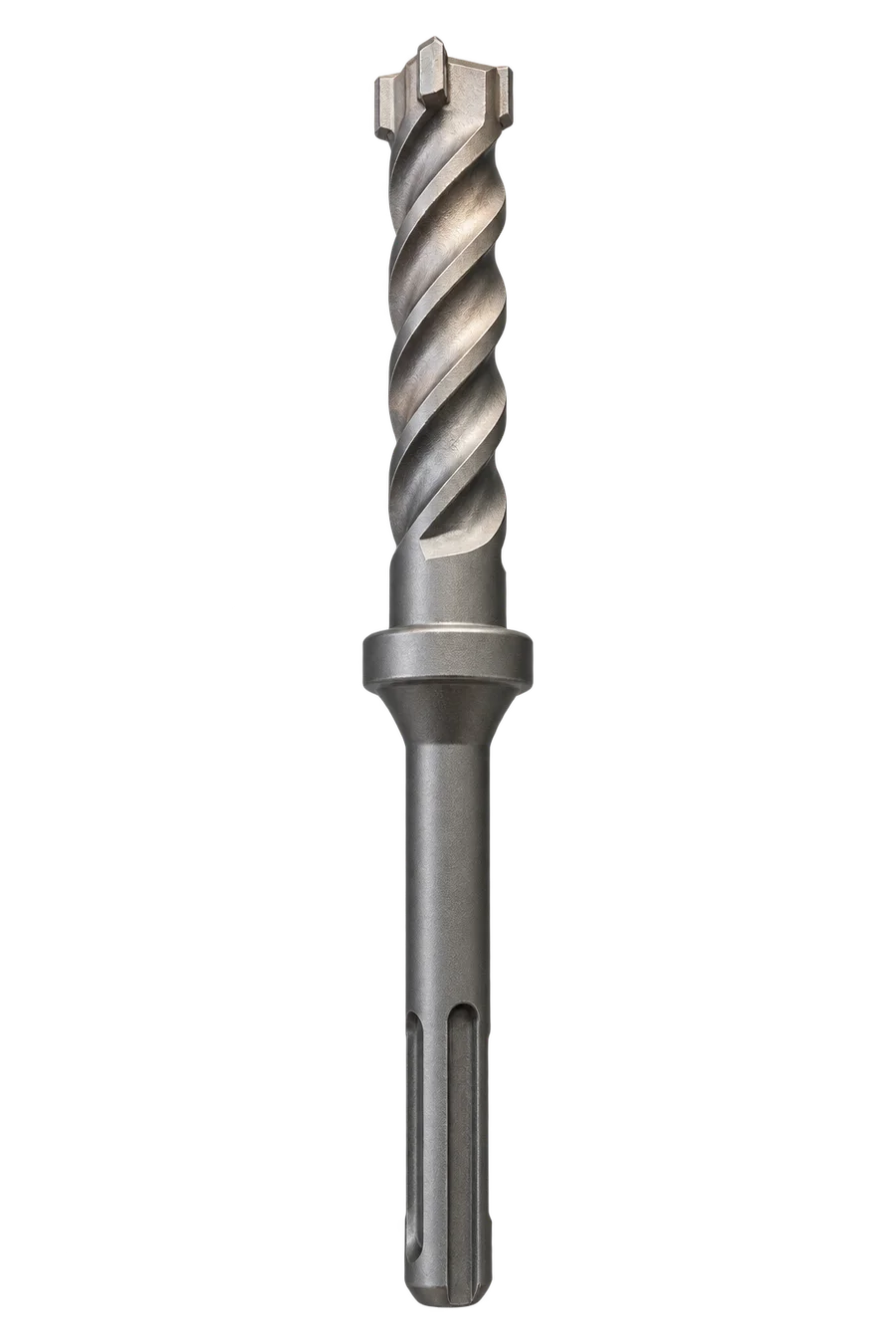
Hilti TE-Y-HDA-B · Stop drill bit
Diameter, length, lubrication and wear
Separate cutting diameter, shank diameter, working length and overall length. A nominal 10 mm SDS-Plus shank can carry different cutting diameters. Choose enough usable length for the required hole while following the machine and accessory limits.
Clean the insertion end and apply the grease specified by the hammer manufacturer, in the specified amount. This is shank lubrication, not a general instruction to oil the cutting tip or fill the flutes. Check the locking action before work.
Some axial travel is normal after locking. Excessive radial play, damaged grooves, burrs, a mushroomed striking end or sticking require inspection of both bit and holder. Stop using damaged parts; do not force an incompatible shank into the chuck or grind it to make it fit.
A practical specification and enquiry checklist
For a useful enquiry, send the product or head photo, hammer model and holder, cutting diameter, working and total lengths, material and reinforcement conditions, and quantities by size. For a stop drill, add the stop-depth drawing or the approved anchor reference.
Ask separately for the body/shank steel grade, carbide grade and head construction, joining method and agreed sample acceptance. Our specification sheets, carbide guide, joining guide and heat-treatment reference cover these topics; the exact production configuration follows the selected model and approved order.
Technical specification sheets · Carbide grade selection · SDS joining methods · Steel heat treatment · Send your drilling requirements
Stop Drill Bit vs Standard SDS-Plus Drill Bit: Depth Control for Anchor Holes

