

CERATIZIT grade code → ISO code → Chinese benchmark direction
CTM17-BC is the CERATIZIT grade code; BC20 is its listed ISO code. YG8C is the closest common Chinese benchmark direction for impact-drilling carbide.
CTF12-BC is the CERATIZIT grade code; BC05 is its listed ISO code. YG6 is the closest common Chinese benchmark direction for lower-cobalt, wear-oriented masonry carbide.
Benchmark direction does not mean automatic equality: the named producer's grain size, hardness, TRS and material certificate still control the final specification.
A masonry drill bit, stone drill bit or SDS drill bit is not made from one uniform material. The body is alloy steel; the cutting zone is a cemented-carbide composite. The useful engineering question is not simply whether the label says tungsten carbide. It is how the WC powder, cobalt binder, grain size, pressing route, sintering cycle and finished tip geometry were specified for the drilling load.
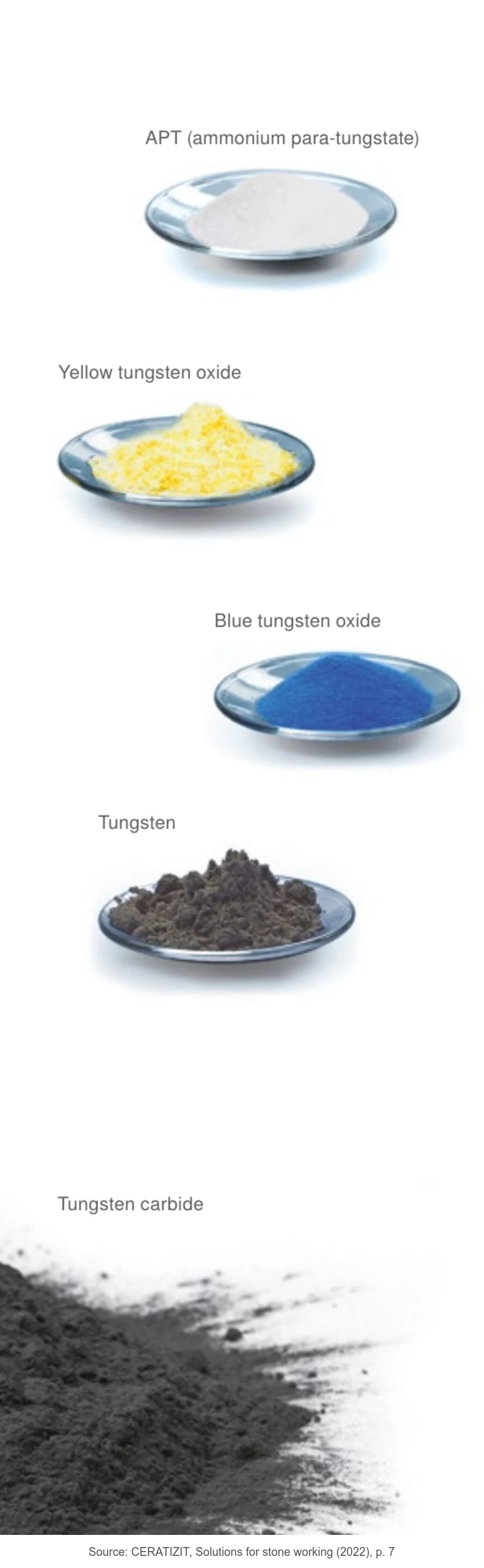
From APT Powder to a Carbide Tip
CERATIZIT describes four broad powder-metallurgy stages: powder preparation, shaping, sintering and finishing. The upstream chain begins with ammonium para-tungstate (APT). APT is calcined into tungsten oxide, reduced in hydrogen to tungsten metal powder, mixed with carbon and carburised under an inert atmosphere to create tungsten carbide (WC). Production parameters at these stages influence the WC grain size that later appears in the sintered masonry or hammer drill tip.
WC powder + cobalt binder + inhibitors and pressing aids are wet-ground into a homogeneous suspension.
Spray drying converts the suspension into free-flowing granules suitable for repeatable forming.
Uniaxial pressing is common for tips; isostatic pressing, extrusion and MIM serve blocks, rods and complex shapes.
Liquid-phase sintering at about 1300-1500°C, sometimes up to 100 bar, densifies the green blank; volume can shrink by up to 50%.
After sintering, the blank still needs finishing. Grinding creates the centre point, cutting edge, rake, relief and protecting chamfer. Only then does the drill-bit factory join the carbide tip to the steel body by brazing or, for some full carbide head products, a controlled welding process.
WC Hard Phase and Co Binder: the Real Hardness-Toughness Trade
Cemented carbide is a two-phase composite. The hard phase is tungsten carbide (WC), which supplies hardness and abrasive wear resistance. The comparatively soft cobalt (Co) binder fills the spaces between WC grains and supplies toughness. Increasing hardness is useful against abrasive concrete and stone, but excessive hardness with insufficient toughness makes an impact-loaded carbide tip more sensitive to chipping.
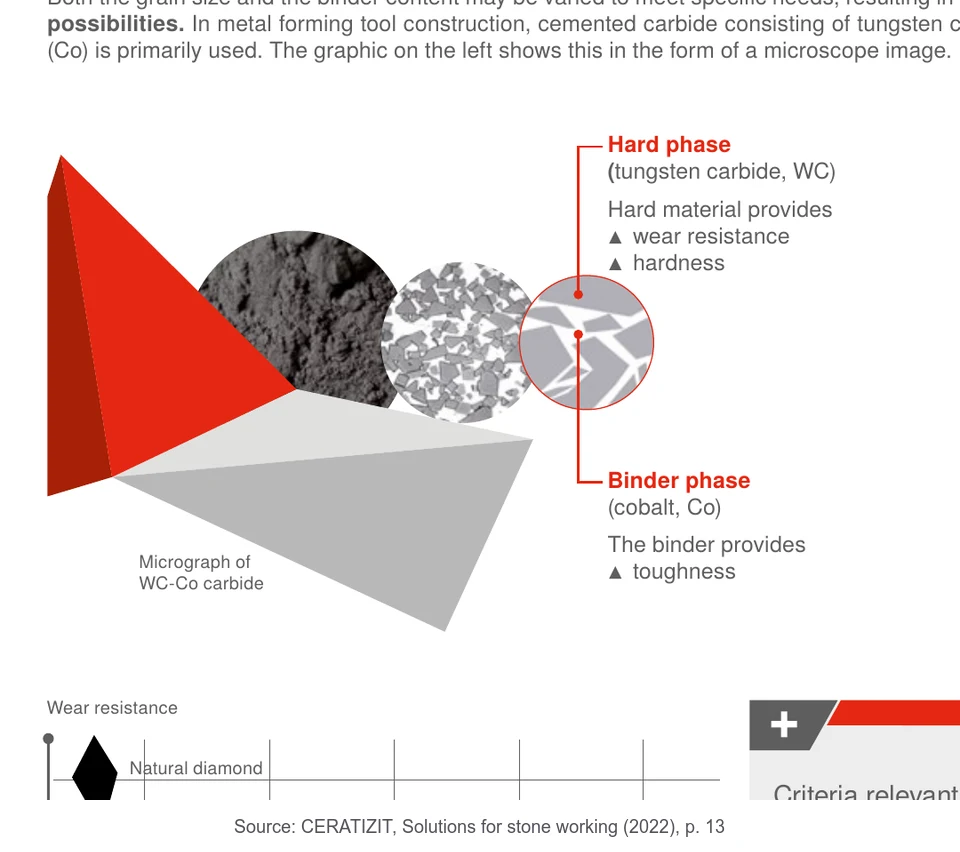
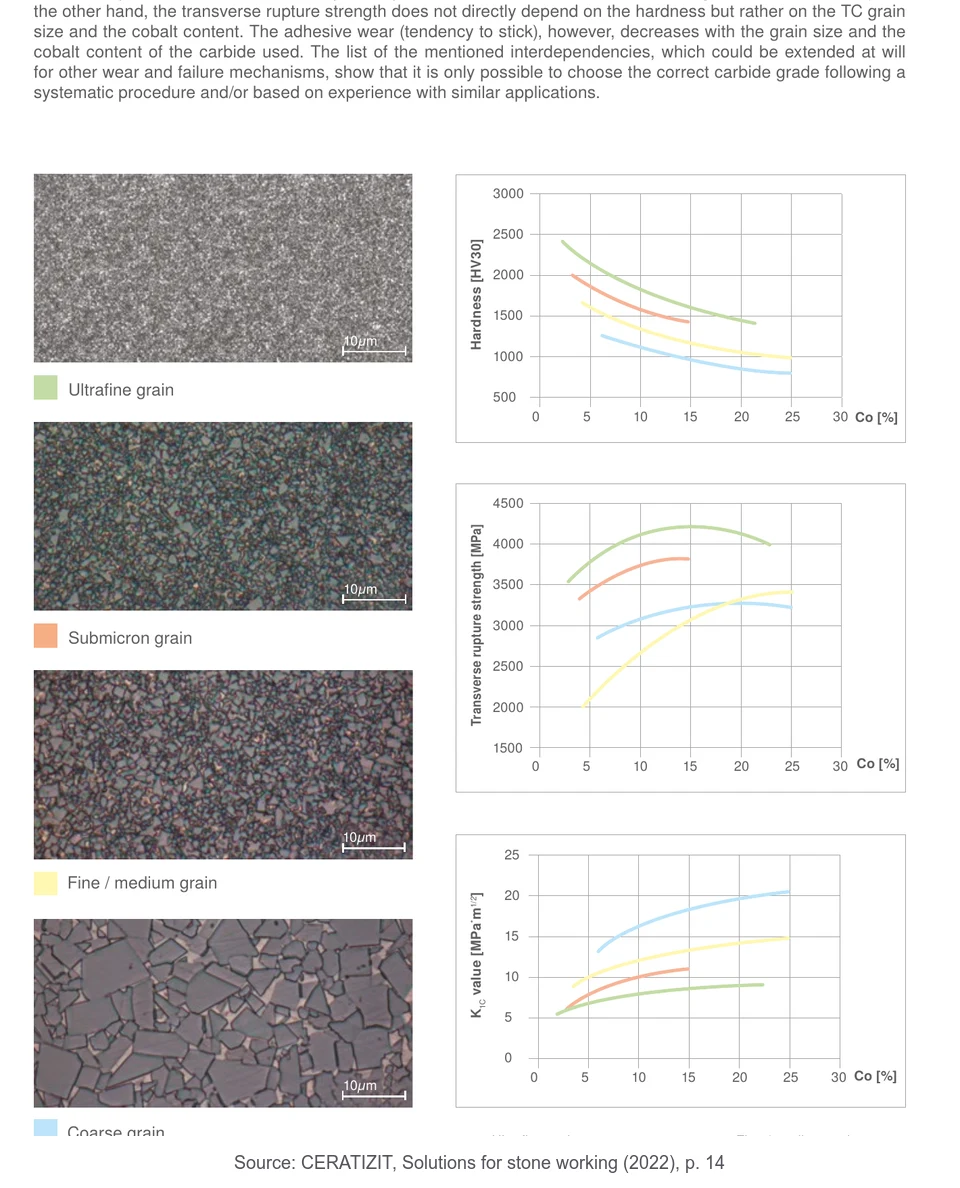
Grain size creates the second control axis. CERATIZIT classifies average WC grain size from nano below 0.2 µm through ultrafine, submicron, fine, medium, coarse and extra-coarse above 6 µm. In general, finer and lower-cobalt structures push hardness and wear resistance; coarser grains and more cobalt push fracture toughness. TRS follows the combined composition and microstructure rather than hardness alone.
CERATIZIT Grade Code, ISO Code and Published Properties
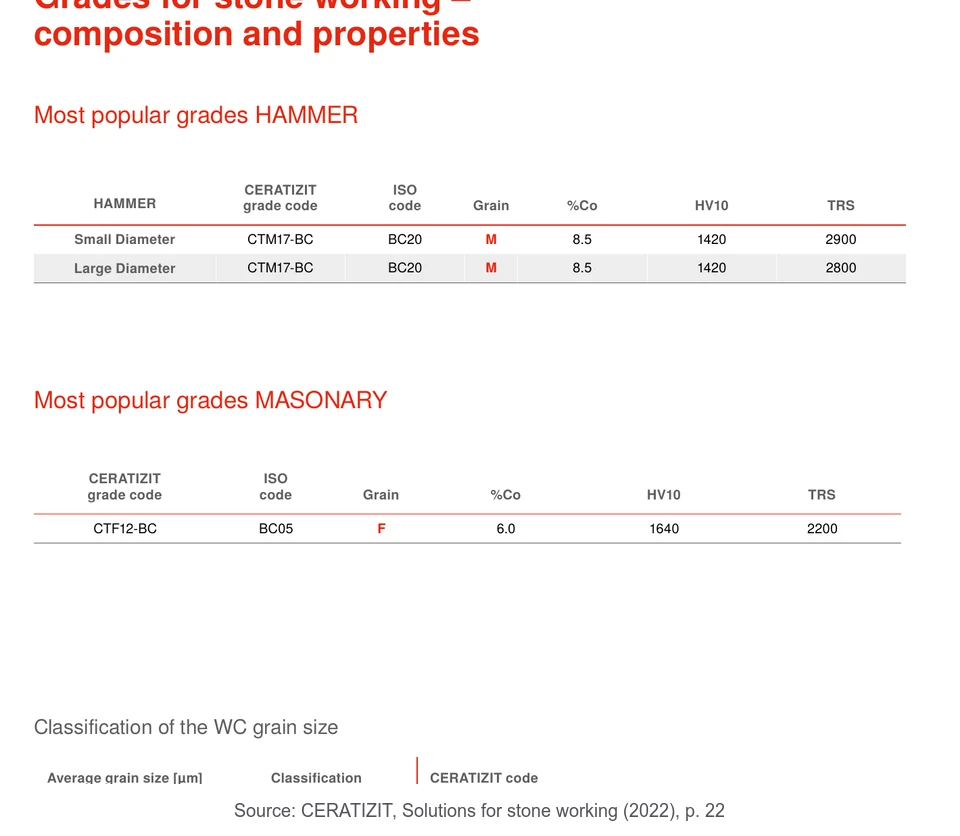
| Catalogue role | CERATIZIT grade code | ISO code | Grain | Co | HV10 | TRS |
|---|---|---|---|---|---|---|
| Hammer tip, small diameter | CTM17-BC | BC20 | M, 1.3-<2.5 µm | 8.5% | 1420 | 2900 MPa |
| Hammer tip, large diameter | CTM17-BC | BC20 | M, 1.3-<2.5 µm | 8.5% | 1420 | 2800 MPa |
| Masonry tip | CTF12-BC | BC05 | F, 0.8-<1.3 µm | 6.0% | 1640 | 2200 MPa |
The table explains why BC20 is not a synonym for YG8C. CTM17-BC is the supplier's grade code; BC20 is the ISO code shown for it. A buyer should quote the complete supplier grade when that material is required. Quoting only BC20 can leave composition, allowable sizes and commercial availability ambiguous.
Chinese YG6, YG8, YG8C and YG11C: Useful Labels, Not Universal Recipes
| Grade family | Typical direction | Best-fit drill-bit duty | Important limitation |
|---|---|---|---|
| YG6 | ~6% Co, grain producer-dependent | Wear-oriented masonry and stone drilling | Closest domestic benchmark direction to CTF12-BC / BC05; not an automatic equivalent |
| YG8 | About 8% Co; grain suffix not defined | General carbide-tipped masonry drill bit and stone drill bit where abrasion matters more than heavy impact | Two mills can sell YG8 with different grain, HRA, TRS, purity and porosity |
| YG8C | About 8% Co; coarse-grain direction | Balanced SDS Plus drill bit, two-cutter, four-cutter and general concrete hammer drilling | Not automatically equivalent to CTM17-BC / BC20 |
| YG11C | About 11% Co; coarse-grain, toughness-first direction | Larger SDS Max drill bit heads, long bits, hard aggregate and higher shock/rebar risk | Higher cobalt can reduce hardness and abrasive wear resistance; this PDF does not publish a direct one-to-one CERATIZIT counterpart |
Zhonghuan specifies carbide by application and order requirement. The quoted grade, geometry, diameter range and supporting mill documentation should be confirmed together at sample approval. We do not present a Chinese label as a guaranteed copy of a CERATIZIT grade.
Application Map: Masonry Drill Bit, Stone Drill Bit, SDS Plus and SDS Max
Masonry & stone drill bits
Brick, block, sandstone and rotary/percussion masonry drilling usually reward a sharper, harder tip. CTF12-BC / BC05 shows the fine-grain, low-cobalt benchmark direction; YG6 is the closest common domestic benchmark direction, subject to the named producer's certificate.
SDS Plus & SDS Max drill bits
Rotary-hammer blows, hard aggregate and rebar contact need more crack resistance. CTM17-BC / BC20 is CERATIZIT's published hammer-tip benchmark; YG8C and YG11C are Chinese sourcing directions selected by impact level and head support.
Why Carbide Geometry Still Matters After the Grade Is Chosen
Powder metallurgy determines what the carbide can withstand. Geometry determines how the load reaches it. Zhonghuan's standard 11384-class 2-cutter roof tip uses a symmetrical 130° point, an 8° plan rake and diameter-dependent α values: 20° from Ø4-12 mm and 30° from Ø13-52 mm. This is the geometry we can connect to an actual product program.
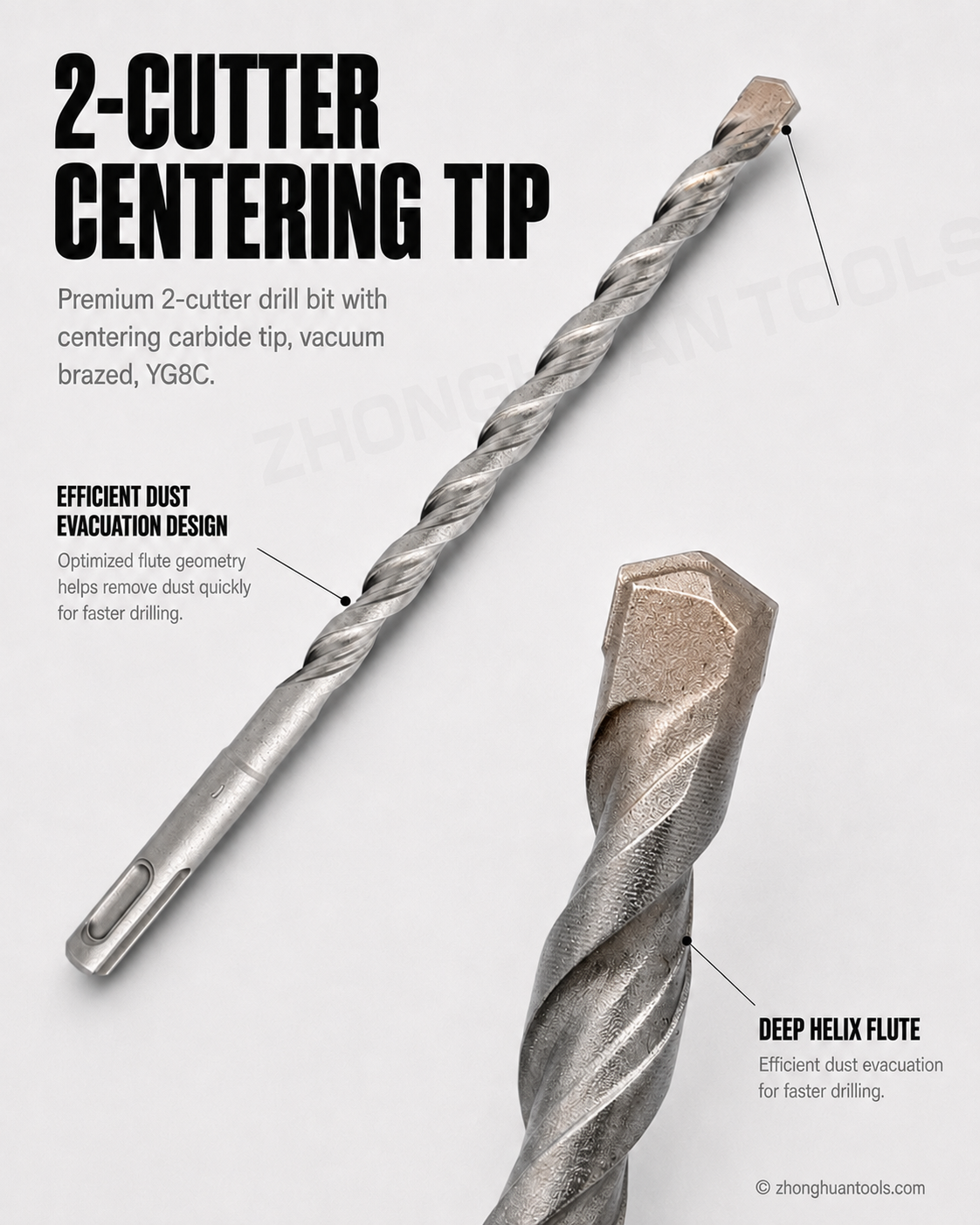
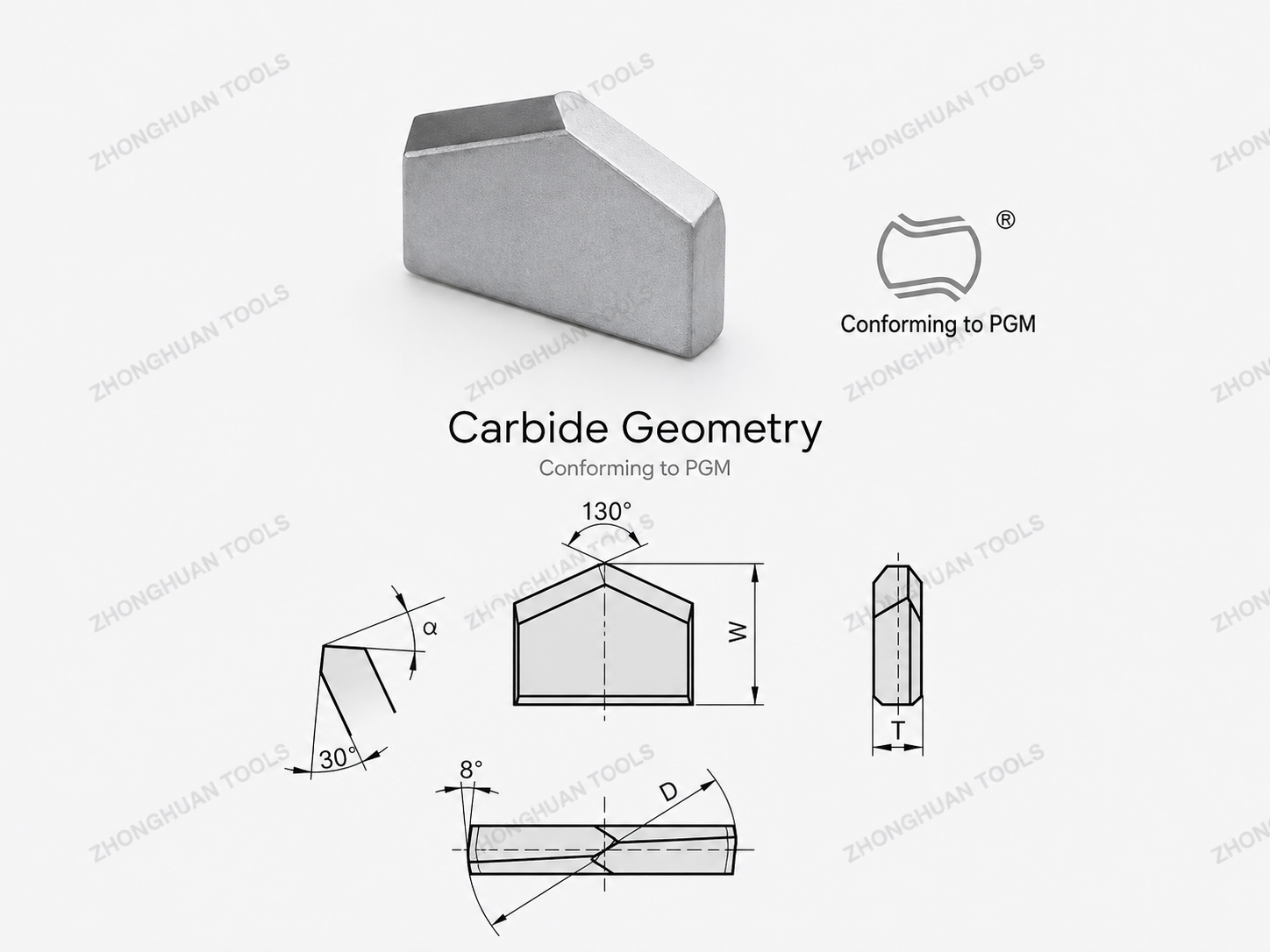
A high-quality grade cannot rescue an unsupported edge, excessive runout or a weak braze. Conversely, a sound geometry made in an application-matched YG8C can outperform a harder premium material used in the wrong head design.
OEM Specification Checklist
- Product: masonry drill bit, stone drill bit, SDS Plus drill bit or SDS Max drill bit.
- Substrate: brick, block, sandstone, hard stone, plain concrete or reinforced concrete.
- Carbide system: Chinese YG grade with mill properties, or named CERATIZIT grade code plus ISO code.
- Properties: cobalt %, WC grain classification, hardness test scale, TRS method, density and porosity where required.
- Geometry: cutter count, centre point, included angle, rake, relief, protecting chamfer and gauge width.
- Joining: brazing or welding route, joint acceptance criteria and sample destructive check.
- Finished-bit checks: shank fit, runout, cutting diameter, hole-diameter result and target-material witness drilling.
Specify the carbide system, not just the word “carbide.”
Send the drill-bit type, substrate, diameter range, head geometry, target grade and quantity. Zhonghuan will return a sample and quotation path with the material variables made explicit.
Request Engineering Review

