

Who actually makes bush hammers: the global landscape
Bush hammers and bushing bits — the same accessory listed as a 'bushing tool' in the Bosch, DeWalt, Milwaukee, and Makita catalogs, and sometimes written 'bushing hammer bit' — are supplied through two channels: premium power-tool and diamond-tool brands — Hilti, Bosch, Makita, DeWalt, Milwaukee, Tyrolit — whose SDS-Max and breaker-shank lines set the reference for pin metallurgy, body forging, and striking-face heat treatment, and factory-direct OEM manufacturers that build the same tool across all four shank families for private-label programs.
This guide covers the premium benchmarks, the factory-direct OEM route — including where Zhonghuan fits — and the pin-count, carbide, and brazing criteria that decide how a bushing bit performs on concrete.
Bush Hammer Supply Landscape
Bush hammers (also called bushing bits, pineapple cutters, or pin head bits) are percussion accessories used for concrete surface roughening, anti-slip texturing, stone finishing, and pre-overlay surface preparation. Despite the variety of names, the tool itself is straightforward: a steel body with a matrix of tungsten carbide pins on the striking face, driven by an SDS Max rotary hammer, hex / square / round-shank breaker, or pneumatic hammer.
Procurement complexity sits behind that simple description. Pin count drives texture grade (16 / 20 / 25 / 30 / 45 typical), shank type matches the breaker platform (SDS Max, hex, square, round), and carbide pin attachment method drives service life. China is the dominant OEM supply base for bush hammers, with both specialist factories (focused only on bushing tools) and full-line SDS factories serving the global market. This guide is a practical shortlist — not a fixed ranking — for distributors, contractors, and OEM buyers building bush hammer programs.
What Quality Actually Looks Like in Bush Hammer Bits
Four production decisions separate quality bush hammers from budget-tier product. None of them are visible at first glance:
| Variable | Good Practice | Common Shortcut | Field Symptom |
|---|---|---|---|
| Carbide pin attachment | Induction-brazed | Mechanical press-fit | Pins loosen and drop out within 200 strikes |
| Body steel | 40Cr or 42CrMo forged + induction-hardened striking face | Generic carbon steel, no hardening | Striking face deforms; pin alignment shifts |
| Shank tolerance | SDS-Max fit checked against the approved shank drawing and gauge | Forged but not ground, ±0.2 mm | Chuck rattle, energy loss, premature hammer bearing wear |
| Pin count coverage | 16 / 20 / 25 / 30 / 45 all available in each shank type | Only 16-pin SDS Max stocked | Distributor cannot serve stone-finishing or anti-slip channels |
The most common failure mode on budget bush hammers is carbide pin loss. Cheap factories press-fit the carbide pins into the steel body without induction brazing. Under repeated impact, the press-fit joint loosens, the pin walks out, and the tool fails. A factory with proper induction brazing produces bush hammers that retain all pins through normal service life.
Ask any supplier: "How are the carbide pins attached to the body? Can you show me a destructive test report where the carbide fractures before the braze joint fails?" Brazed-construction factories answer immediately. Press-fit factories give vague answers about "impact resistance."
Premium global brands: the specification benchmarks
These are the programs buyers benchmark pin metallurgy, body forging, and packaging against:
- Hilti TE-Y BT / TE-Y BH (Liechtenstein): Premium construction-brand bush hammer line — SDS Max shank, pre-assembled bushing bit and rod driver. Inductive hardening for impact resistance. Reference standard for premium retail tier; specified by top-tier professional contractors on infrastructure and architectural projects.
- Bosch HS1909 / HSM Series (Germany): Global retail volume leader in SDS Max bush hammers. One-piece construction, heat treated for service life. The anchor reference for European pro-retail bush hammer programs.
- Makita (Japan): Global power-tool ecosystem with bush hammer accessories for SDS Max rotary hammers and hex-shank handheld breakers. Reference for Japanese-spec finish and contractor-channel ergonomics. The 1-3/4" × 14-3/4" one-piece bushing tool is a commonly stocked SKU.
- DeWalt (Stanley Black & Decker, US): US construction channel bush hammer accessories — high-impact dual-steel SDS Max design for chipping and light demolition. Reference for North American retail blister-packaging programs.
- Milwaukee (TTI, US): US professional demolition channel — SDS Max bush hammers from forged steel. The 10-1/2" 16-tip is a typical contractor stock SKU.
- Tyrolit (Austria): European leader in premium abrasive and diamond bush hammer solutions for floor texturing and anti-slip profiles. Reference for the architectural and decorative concrete tier.
- Diablo Tools (Freud Group, US): High-impact, heat-treated SDS Max bushing bits designed to withstand stress from high-powered hammer drills. North American retail tier.
The direct-from-factory OEM route: where Zhonghuan fits
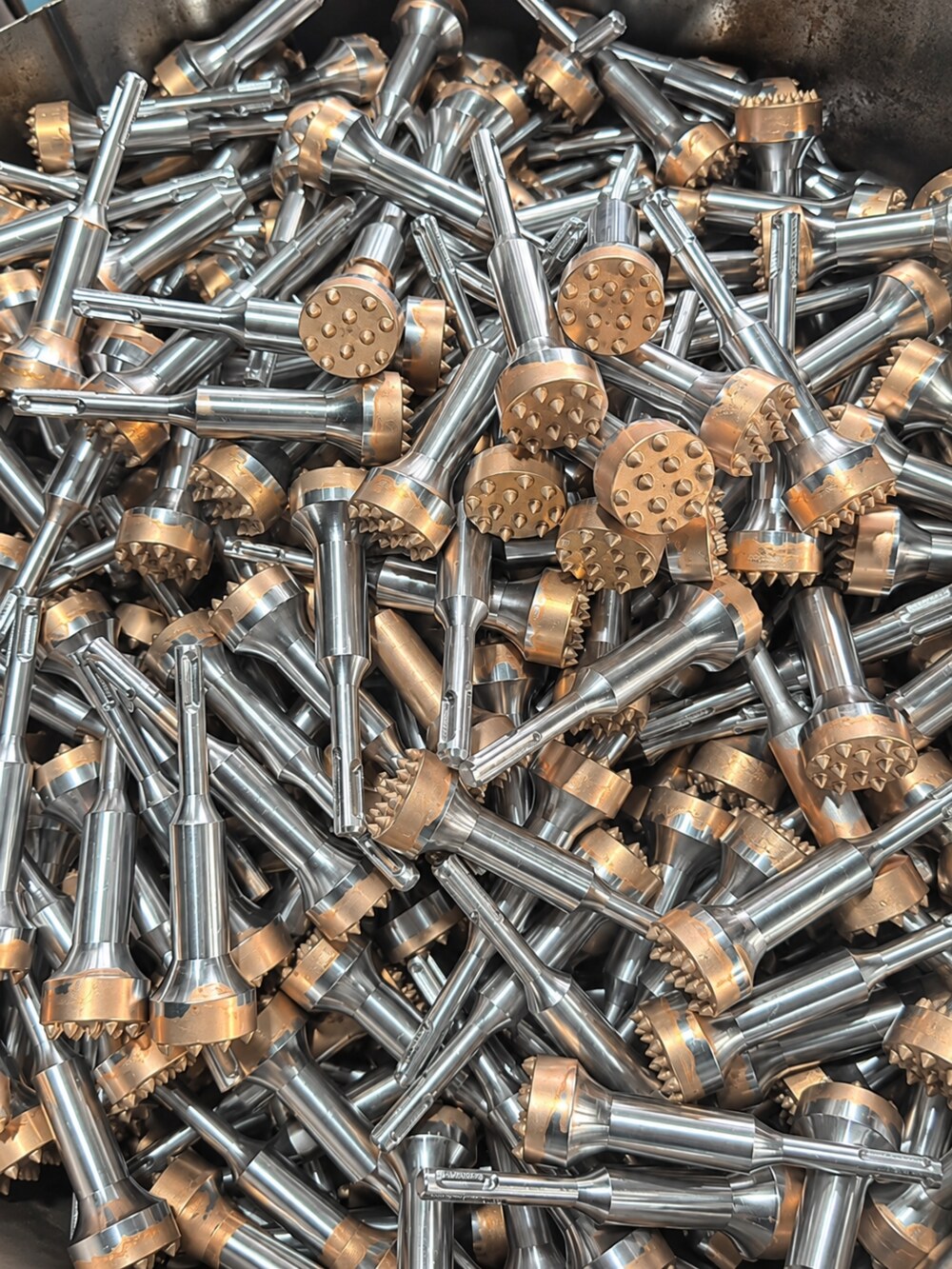
Zhonghuan Tools (Yueqing, Zhejiang — est. 2008, ISO 9001) is a factory-direct OEM manufacturer of bush hammers across all four shank families — SDS-Max, hex, square, and round — in 16 / 20 / 25 / 30 / 45 pin counts, with induction-brazed solid and hollow carbide pin options on 40Cr / 42CrMo forged bodies with induction-hardened striking faces. As a full-line SDS accessory factory (bush hammers alongside chisels, SDS drill bits, and masonry bits), it supports single-supplier programs covering the whole concrete-tool category. Private-label from 2,000 pcs per SKU with English / German / French / Russian / Spanish artwork.
The difference is the channel, not the metallurgy: no brand markup, OEM engineering support direct from the production line. The bush hammer OEM program covers shank types, pin configurations, MOQ, and sampling in detail.
Quick Comparison Table
| Brand | Origin | Position | Where Zhonghuan Fits |
|---|---|---|---|
| Hilti TE-Y BT | Liechtenstein | Premium specified, infrastructure | OEM route for contractor distributors |
| Bosch HS1909 | Germany | Global retail volume leader | Factory-direct alternative to retail |
| Makita | Japan | Global pro ecosystem | Japanese-spec private-label alternative |
| Zhonghuan Tools | China (Zhejiang) | Factory-direct OEM, full 4-shank coverage | — |
| DeWalt | US (Stanley B&D) | US construction retail | Retail blister OEM base |
| Milwaukee | US (TTI) | US demolition channel | Heavy-duty OEM |
| Tyrolit | Austria | Architectural / decorative | Stone-finishing OEM segment |
| Diablo Tools | US (Freud Group) | High-impact retail | US-channel OEM alternative |
Pin Counts and Texture Outcome
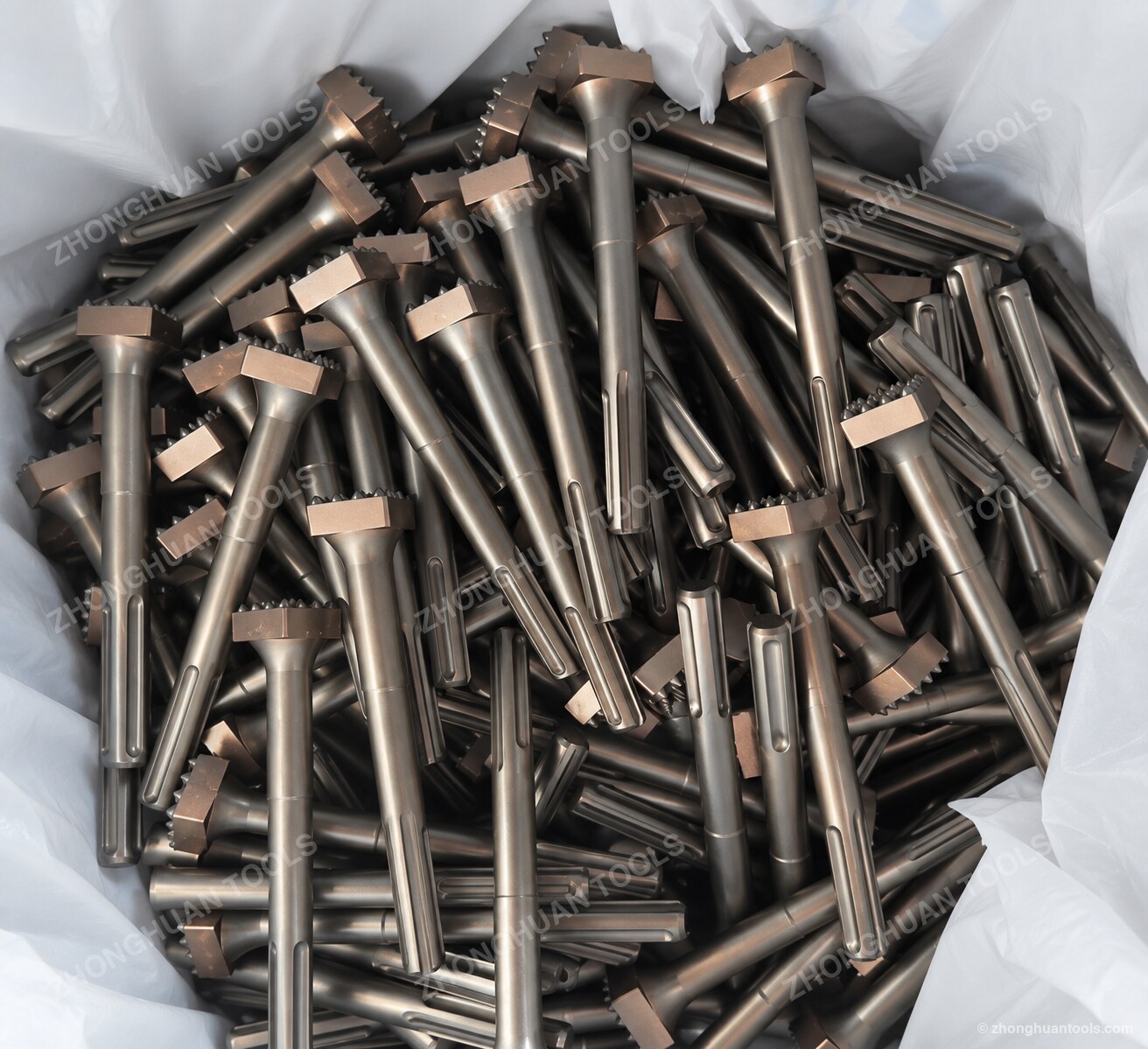
Pin count is the single most important specification beyond shank type. It controls both material removal rate and texture finesse. Distributors stocking bush hammers across multiple channels need the full tooth-count range:
| Pin Count | Texture Grade | Primary Use | Channel Velocity |
|---|---|---|---|
| 16-pin | Coarse | Concrete roughening, shotcrete bonding prep | High in construction trade |
| 20-pin | Coarse-medium | Deep structural keying, heavy bonding prep | Moderate, construction and industrial |
| 25-pin | Medium | General surface preparation, light decorative, anti-slip on industrial floors | Highest overall (workhorse SKU) |
| 30-pin | Medium-fine | Anti-slip stairs, tiling prep, moderate decorative | Moderate, contractor and architectural |
| 45-pin | Fine | Architectural stone, decorative concrete, ramps, walkways | High in stone-finishing channel |
Stock allocation for distributors: For mixed construction / contractor channels, the typical inventory split is 25-pin 40%, 16-pin 25%, 20-pin 15%, 30-pin 12%, 45-pin 8%. For dedicated stone-finishing or architectural channels, shift the mix toward 30-pin and 45-pin.
Buyer Validation Checklist
- Check pin attachment method: Insist on induction-brazed carbide pins. If the supplier cannot show a destructive test report (carbide fractures before braze joint fails), assume press-fit construction.
- Verify shank tolerance: Compare the ground SDS-Max gauge surfaces and grooves with the approved drawing and fit gauge. Forged-only shanks rattle in the chuck and waste hammer energy.
- Confirm pin-count availability: Ask for samples across the 16 / 20 / 25 / 30 / 45 pin-count range in the shank type you need. Specialists usually carry the full range; volume factories may only carry 16-pin and 25-pin.
- Drop test sample: Drop a sample bush hammer from 1 m onto concrete. Verify no pin loss, no braze failure, no body deformation. Repeat 5–10 times to confirm consistency.
- Field test under impact: Run 100–200 strikes on representative concrete substrate. Measure pin wear (typically < 0.5 mm per 100 strikes on solid carbide). Verify pins do not loosen or migrate.
- Audit shank diameter wear: After field test, re-measure the SDS Max shank groove dimensions. A properly hardened shank shows minimal wear.
- Lock in MOQ, lead time, and packaging: Standard private-label MOQ is 2,000 pieces per SKU across most quality factories. Lead time 30–45 days for stock ranges, 45–60 days for first-time artwork.
Why Carbide Brazing Method Matters
The single biggest quality differentiator on bush hammers is how the carbide pins are attached to the steel body. Three methods, very different outcomes:
- Induction brazing (best): The carbide pin is brazed into a precision-machined pocket in the steel body using an induction heater and brazing alloy. The braze joint is metallurgical — the pin and body become a single piece. Failure mode: the carbide tip wears down through service life; the braze joint does not fail. Service life: thousands of impacts on standard concrete.
- Furnace brazing (acceptable): Whole tools heated in a furnace with brazing flux applied to pin pockets. Less consistent joint quality than induction (heat distribution varies across the tool body). Some factories use this for cost reduction; performance is acceptable on light-duty work but degrades faster on hard aggregate concrete.
- Mechanical press-fit (worst): Carbide pin pressed into a slightly undersized hole in the steel body. No metallurgical bond — held only by friction. Under repeated impact, the press-fit relaxes, the pin walks, and eventually drops out. Common on budget-tier bush hammers from unaudited Chinese factories selling on Amazon and Alibaba below $5 per piece.
When sourcing from China, the question is not "do you make bush hammers" — almost every SDS factory does. The question is how the pins are attached. Verify this in writing before placing a bulk order.
For OEM buyers building a bush hammer line, the safest approach is to specify induction brazing explicitly in the PO and request a destructive test report from the production batch. Quality factories provide this routinely; budget factories cannot.
Related Procurement Programs
If you are sourcing bush hammers for a distributor, importer, or private-label channel, these OEM and wholesale programs cover the procurement questions buyers usually ask next.
- Bush Hammer & Bushing Bit Manufacturer & OEM Supply — Four shank families (hex, square, SDS Max, round) × five pin counts (16 / 20 / 25 / 30 / 45) with induction-brazed carbide pin construction and 40Cr / 42CrMo forged bodies.
- SDS Chisels & Demolition Accessories OEM Manufacturer — Companion demolition accessory program covering SDS Plus, SDS Max, hex, square, round, and 65A hydraulic breaker chisels.
- SDS Drill Bits OEM & Wholesale Hub — Main SDS accessory program: drill bits, chisels, bush hammers under a single artwork and packaging system.


